
Mandatory Timelines for Decisions on Applications to Purchase NYC Co-op Shares: A Primer for Board Members
Navigating the new mandatory timelines and compliance requirements for application processing.
New York City has officially created a timeline for Coops to make decisions on applications for the purchase of shares/units with the enactment of Int. No. 1120-B (Title 26, Ch. 37 of the administrative code of the city of New York). This legislation establishes rigid procedural requirements for Co-op boards, making it essential for members to understand their new obligations regarding receipt, review, and decision-making timelines.
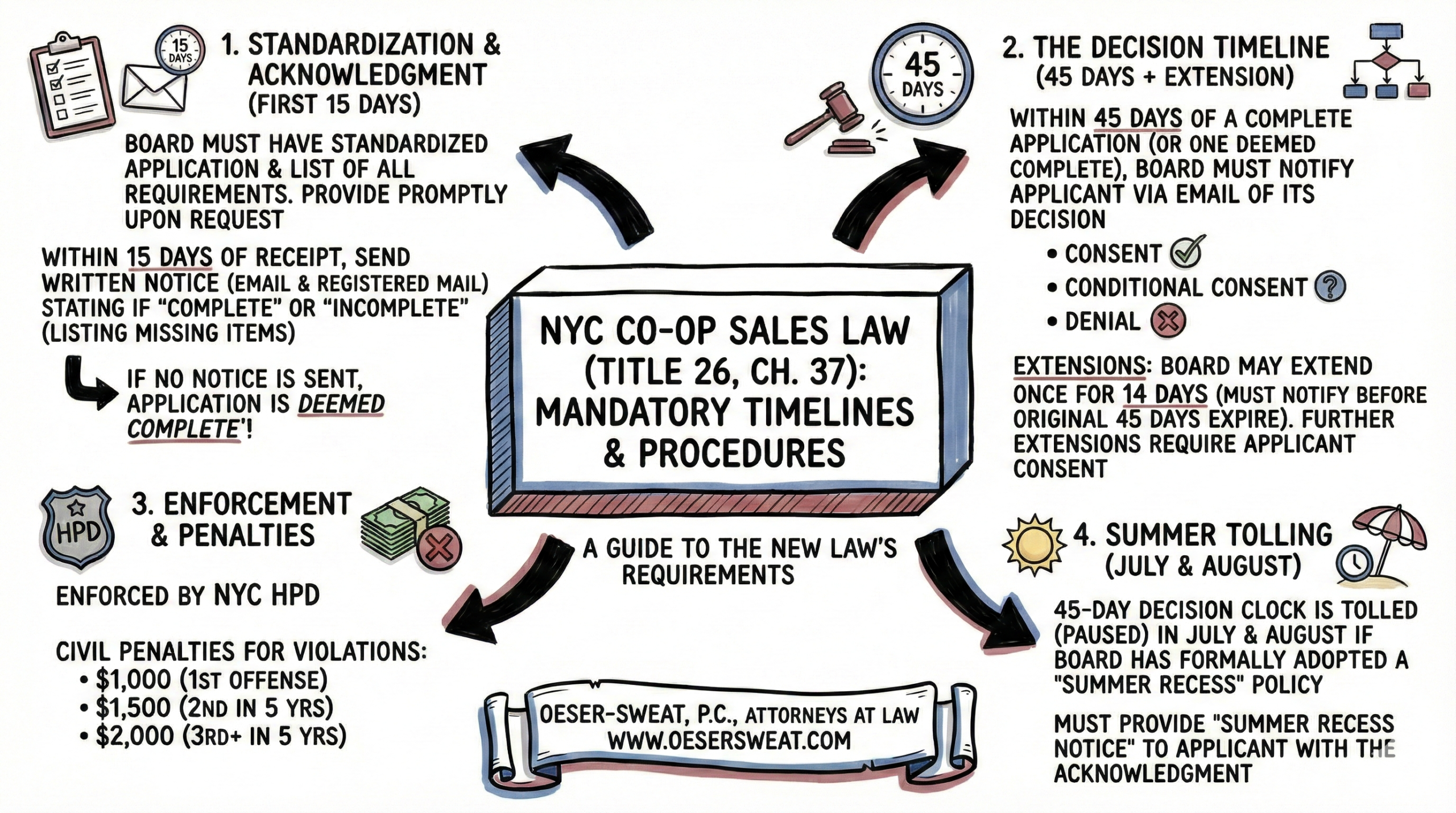
1. The Mandatory Acknowledgment (15 Days)
Upon receiving a sale application, a board or its managing agent has exactly 15 days to provide a written acknowledgment of receipt. This is not just a courtesy; it is a statutory trigger.
The notice must explicitly state:
- Whether the application is considered complete.
- If incomplete, a specific list of missing items, including citations to the application’s original requirements.
Note: Failure to provide this acknowledgment within the 15-day window results in the application being automatically deemed complete as of the date the notice was due.
2. The Decision Window (45 Days)
Once an application is acknowledged as complete—or deemed complete—the board enters a 45-day decision window. Within this timeframe, the board must notify the purchaser via email that their consent to the sale is:
- Granted Unconditionally
- Granted Subject to Stated Conditions
- Denied
3. Extending the Timeline
Boards have specific mechanisms to extend these deadlines if more time is required for due diligence or interviews:
- Unilateral Extension: A board may extend the decision deadline once by no more than 14 days without purchaser consent, provided they notify the purchaser via email before the initial 45-day period expires.
- Purchaser Consent: The purchaser may agree in writing to a longer extension.
- Summer Recess: If the building maintains a formal “Summer Recess Notice” in its records (stating the board does not meet during specific periods in July and August), the timelines are tolled during those dates.
4. Penalties for Non-Compliance
The Department of Housing Preservation and Development (HPD) is tasked with enforcing these rules. Violations result in civil penalties that increase with subsequent offenses:
- $1,000 for the first violation.
- $1,500 for the second violation.
- $2,000 for the third and any subsequent violations.
5. Key Exemptions
While the law applies broadly, it does not cover every building. Exceptions include:
- Buildings with fewer than 10 dwelling units.
- HDFC Co-ops (organized under Article XI).
- Units where the sale requires approval from a governmental housing agency.