Category: Resources

  • Mandatory Timelines for Decisions on Applications to Purchase NYC Co-op Shares: A Primer for Board Members

    Mandatory Timelines for Decisions on Applications to Purchase NYC Co-op Shares: A Primer for Board Members

    Navigating the new mandatory timelines and compliance requirements for application processing.

    New York City has officially created a timeline for Coops to make decisions on applications for the purchase of shares/units with the enactment of Int. No. 1120-B (Title 26, Ch. 37 of the administrative code of the city of New York). This legislation establishes rigid procedural requirements for Co-op boards, making it essential for members to understand their new obligations regarding receipt, review, and decision-making timelines.
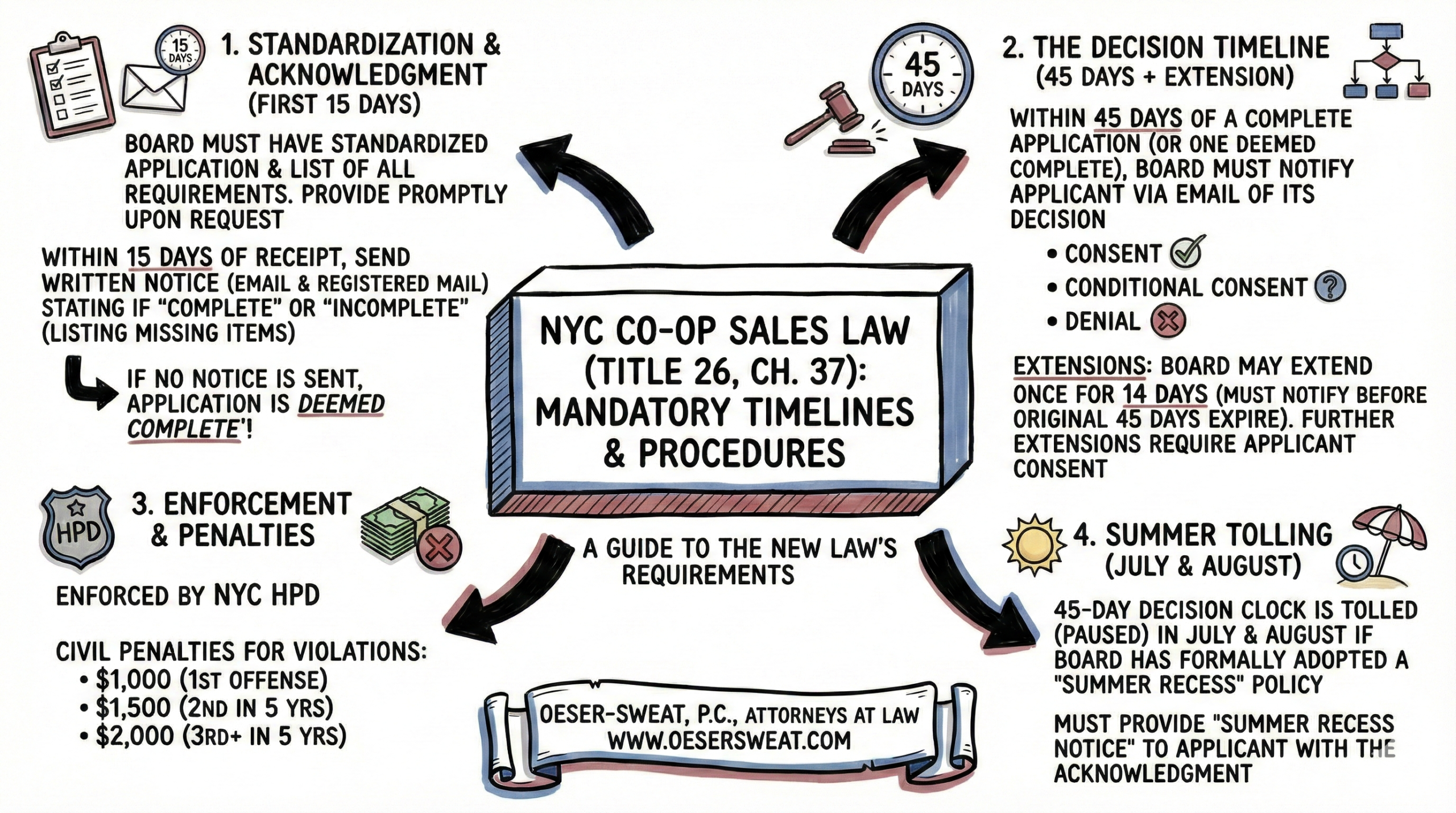
    Timeline of the NYC Co-op Sales Law requirements for boards.
    Figure 1: Statutory Deadlines for NYC Co-op Application Processing

    1. The Mandatory Acknowledgment (15 Days)

    Upon receiving a sale application, a board or its managing agent has exactly 15 days to provide a written acknowledgment of receipt. This is not just a courtesy; it is a statutory trigger.

    Formal Requirements: This acknowledgment MUST be delivered to the purchaser or their agent via both registered mail and email.

    The notice must explicitly state:

    • Whether the application is considered complete.
    • If incomplete, a specific list of missing items, including citations to the application’s original requirements.

    Note: Failure to provide this acknowledgment within the 15-day window results in the application being automatically deemed complete as of the date the notice was due.

    2. The Decision Window (45 Days)

    Once an application is acknowledged as complete—or deemed complete—the board enters a 45-day decision window. Within this timeframe, the board must notify the purchaser via email that their consent to the sale is:

    1. Granted Unconditionally
    2. Granted Subject to Stated Conditions
    3. Denied

    3. Extending the Timeline

    Boards have specific mechanisms to extend these deadlines if more time is required for due diligence or interviews:

    • Unilateral Extension: A board may extend the decision deadline once by no more than 14 days without purchaser consent, provided they notify the purchaser via email before the initial 45-day period expires.
    • Purchaser Consent: The purchaser may agree in writing to a longer extension.
    • Summer Recess: If the building maintains a formal “Summer Recess Notice” in its records (stating the board does not meet during specific periods in July and August), the timelines are tolled during those dates.

    4. Penalties for Non-Compliance

    The Department of Housing Preservation and Development (HPD) is tasked with enforcing these rules. Violations result in civil penalties that increase with subsequent offenses:

    Statutory Fines:
    • $1,000 for the first violation.
    • $1,500 for the second violation.
    • $2,000 for the third and any subsequent violations.

    5. Key Exemptions

    While the law applies broadly, it does not cover every building. Exceptions include:

    • Buildings with fewer than 10 dwelling units.
    • HDFC Co-ops (organized under Article XI).
    • Units where the sale requires approval from a governmental housing agency.
  • Dividing Intellectual Property & Software in NY Divorces

    Dividing “Ideas” in Divorce: The Ruling in D.P. v S.P.

    How New York courts value and split complex intellectual property, patents, and software code.

    Valuing a bank account in a divorce is easy. Valuing an invention, a patent, or a line of code is much harder. In the recent decision of D.P. v S.P. (2026 NY Slip Op 50129(U)), the New York courts provided a critical roadmap for how complex Intellectual Property (IP) is treated during the “Equitable Distribution” phase of a marriage.

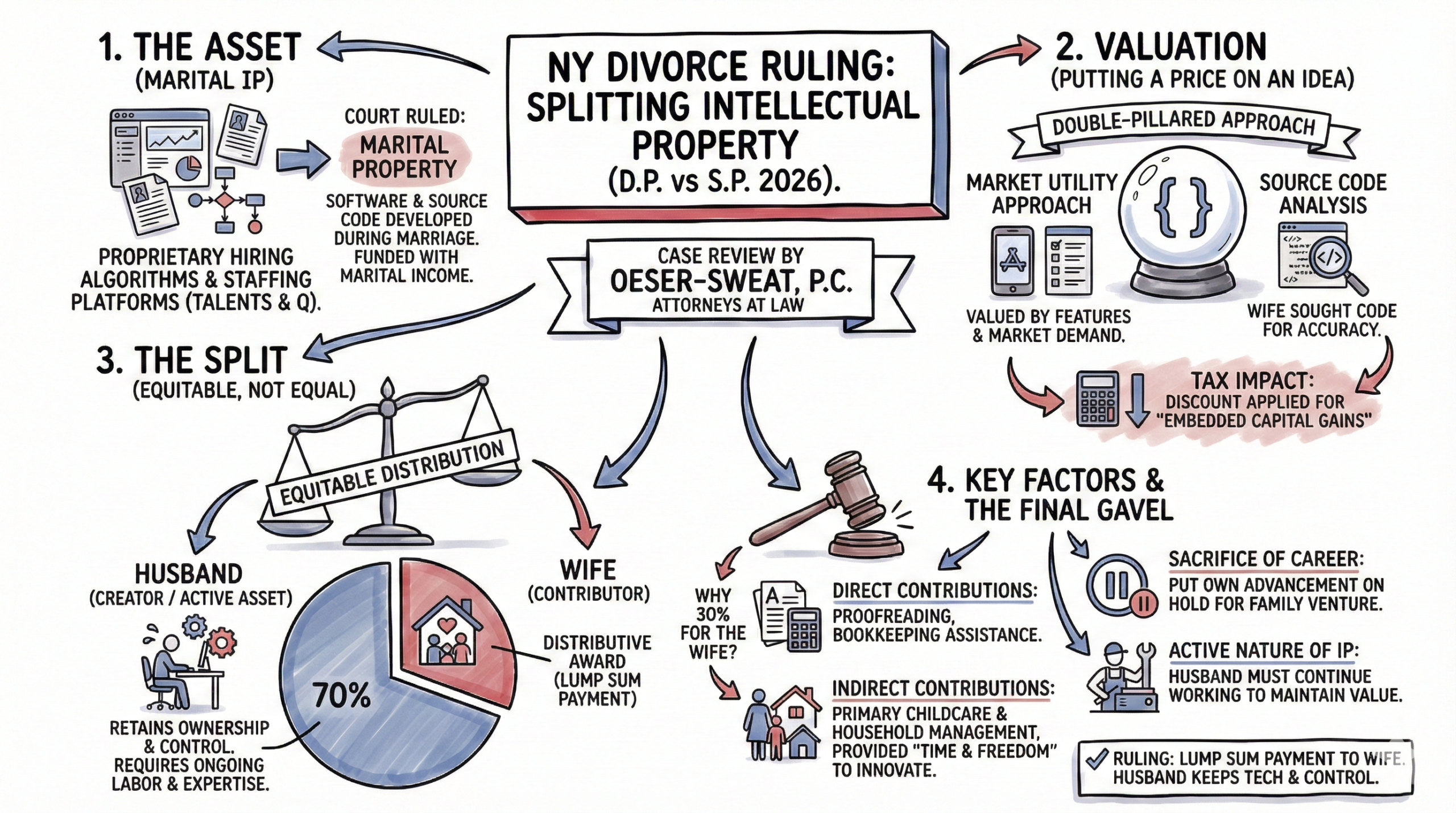
    Infographic: Visual sketchnote of the D.P. vs S.P. case. Shows icons for computer code, valuation methods, and a 70/30 split pie chart.
    Figure 1: Visual Digest of D.P. v S.P. – From Valuation to Distribution
    View Text Description of Case Summary

    The Asset: Software that helped in the hiring process. Ruled as Marital Property because it was developed during the marriage using marital funds.

    Valuation Method: The court used a “Double-Pillared” approach:
    1. Income Approach: Projected royalties over 10 years.
    2. Market Approach: Sales prices of similar forensic technology startups.
    Note: A discount was applied for future taxes (Embedded Capital Gains).

    The Split (70/30): The court awarded 70% to the Husband (creator) and 30% to the Wife. Why? The IP is an “Active Asset” requiring the husband’s continued labor to maintain value.

    The Resolution: A “Distributive Award.” The Husband pays the Wife a cash lump sum for her share, rather than making them co-owners of the patent.

    1. The Asset: What was the Intellectual Property?

    The core of the dispute involved proprietary software and related patents developed by the husband (the titled spouse) during the marriage. Specifically, this IP consisted of software that helped in the hiring process (the SCAnDi Connection).

    The Classification: The Court ruled the IP was Marital Property. Even though the husband was the listed “inventor” and wrote the code, the work was performed during the marriage, and marital income was used to fund the initial patent filings.

    2. Valuation: How to Price an “Idea”

    Valuing IP is notoriously difficult because its value often lies in future potential rather than current cash. The court utilized a “Double-Pillared” approach:

    • The Income Approach: A neutral forensic accountant projected the potential royalty streams and licensing fees the software would generate over the next 10 years.
    • The Market Approach: The court looked at what similar forensic technology startups had been sold for recently.
    Tax Impact: The court applied a discount for “Embedded Capital Gains,” acknowledging that whoever keeps the asset will eventually have to pay taxes on that value.

    3. The Split: Equitable, Not Equal

    New York is an Equitable Distribution state, which means “fair,” but not necessarily “equal” (50/50). In this case, the court did not split the IP down the middle.

    The Result: The court awarded 70% to the Husband (the creator) and 30% to the Wife.

    The Reasoning: The court categorized the IP as an “Active Asset.” Unlike a passive stock portfolio that grows on its own, this software’s continued value depended heavily on the husband’s unique expertise, ongoing labor, and future “manual” refinements. Since he had to keep working to make it valuable, he was entitled to a greater share.

    4. Why the Non-Titled Spouse Got 30%

    The court identified four main factors to justify the 30% award to the Wife, highlighting that contributions to a marriage are not just financial:

    1. Direct Contributions: She assisted in the early days by proofreading patent applications and managing the business’s initial bookkeeping.
    2. Indirect Contributions: By handling the primary care of the couple’s three children and managing the household, she provided the Husband with the “time and freedom” necessary to innovate.
    3. Sacrifice of Career: She put her own professional advancement on hold to support the “family venture” of developing this technology.
    4. The “Active” Nature of IP: As noted above, the necessity of the creator’s future work prevented a higher (50%) award.

    5. The “Final Gavel” (The Holding)

    To avoid forcing divorced spouses to remain business partners, the Court ordered a “Distributive Award.” Instead of making the couple co-owners of the patents (which would lead to endless future conflict), the Husband was ordered to pay the Wife a lump sum representing her 30% share of the appraised value. This allowed him to retain full ownership and control of the technology while she received her fair equity in cash.

  • SCAnDi: Single-cell and single molecule analysis for DNA identification

    SCAnDi: Single-cell and single molecule analysis for DNA identification.

    The end of the “DNA Smoothie?”

    Why prosecutors and defense attorneys need to watch this novel single-cell DNA technology.

    DNA evidence has long been considered the “gold standard” of forensic science. But it has a major weakness: mixtures. When multiple people touch the same object, their DNA gets blended together, often leading to inconclusive results. A new technology currently in development, SCAnDi (Single-cell and Single Molecule Analysis for DNA Identification), promises to solve this problem by analyzing individual cells before they are mixed.

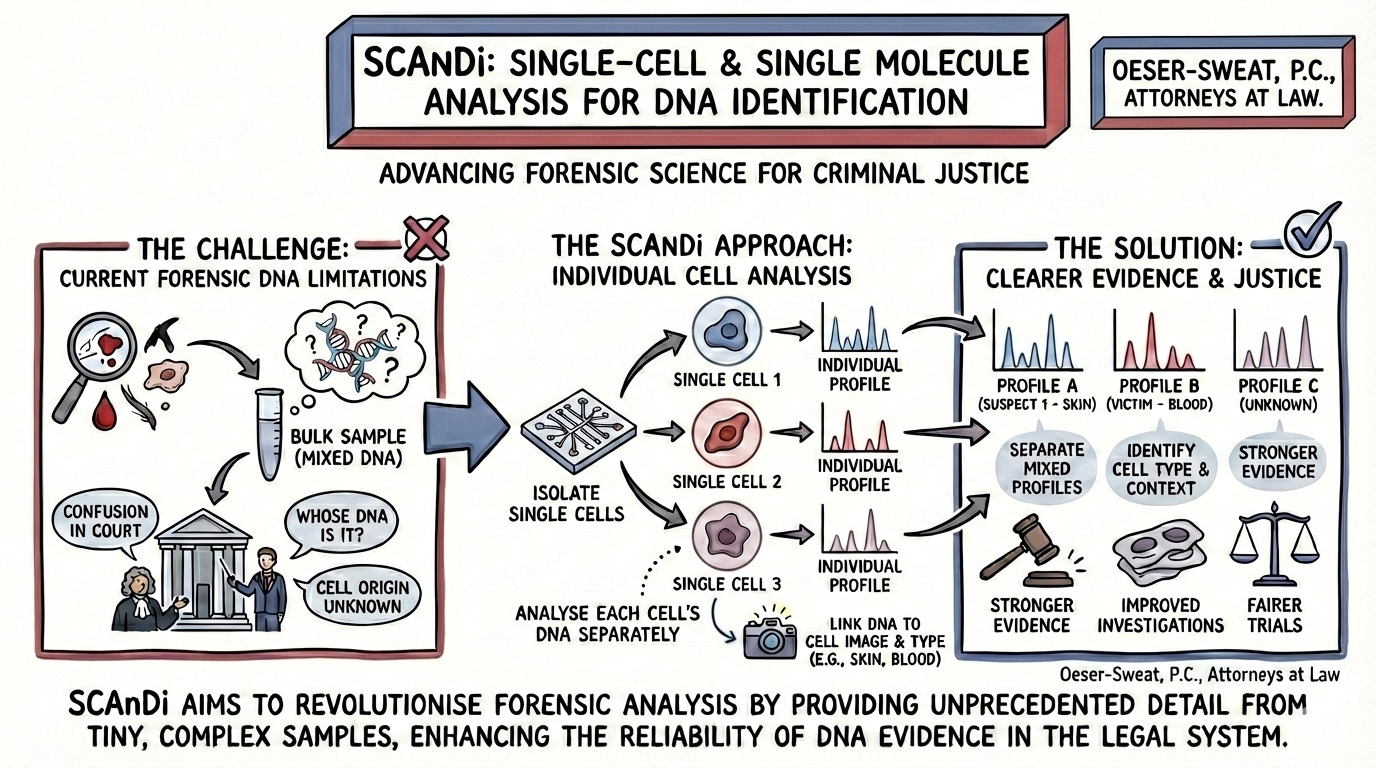
    Infographic: How SCAnDi technology separates individual cells from a mixed DNA sample to create clear profiles.
    Figure 1: The Goal-Moving from “Bulk Mixtures” to Single-Cell Precision
    View Text Description of Infographic

    The Old Way (“DNA Smoothie”): Current methods take a bulk sample (e.g., a swab from a doorknob) and mash all the DNA together. If three people touched it, you get a mixed profile that is hard to interpret.

    The SCAnDi Way: This new tech uses a flow cytometer or similar device to physically separate individual cells before DNA extraction. Each cell is analyzed separately.

    The Result: Instead of a mixture, you get distinct profiles: Profile A (Suspect), Profile B (Victim), and Profile C (Unknown), with no ambiguity.

    1. The Problem: The “DNA Smoothie”

    Current forensic methods rely on “bulk samples.” Imagine a crime scene doorknob touched by the victim, the suspect, and a police officer. When the lab processes the swab, they extract DNA from all three people simultaneously. To a scientist, this looks like a “DNA Smoothie”—a jumbled mix of genetic code.

    Analysts then have to use statistical software (like STRmix) to try to “unmix” the smoothie and guess the probability that a specific person contributed. This often leads to results that are inconclusive or open to fierce debate in court.

    2. The Proposed Solution: SCAnDi

    SCAnDi stands for Single-cell and Single Molecule Analysis for DNA Identification. Instead of blending the sample, SCAnDi uses advanced technology to pick out individual cells one by one.

    • Isolation: The machine isolates a single cell from Person A and a single cell from Person B.
    • Analysis: It extracts a clean, “pristine” DNA profile from each specific cell.
    • Context: Beyond just identity, SCAnDi can potentially tell us what kind of cell it is. It could prove, for example, that the DNA on a jacket came specifically from saliva (implying spitting or biting) rather than skin cells (implying casual contact).

    3. Prosecution vs. Defense: The Upcoming Battle

    Prosecution Perspective: “The End of Ambiguity”
    For prosecutors, SCAnDi is the “Holy Grail.” It moves forensics away from “likelihood ratios” and probabilities toward definitive identifications. It could solve cold cases where samples were previously too mixed to be useful.
    Defense Perspective: “New Science, New Risks”
    Defense attorneys must view this with skepticism. If a machine is sensitive enough to find a single cell, how do we prove that cell wasn’t transferred by a gust of air or “innocent transfer” (secondary touch)? Finding a single skin cell doesn’t prove presence at a crime scene if we shed millions of cells a day.

    4. Current Legal Status: Not Court-Ready

    It is critical to note that SCAnDi is currently a research project. It looks like a very promising scientific endeavor. However, there are some current caveats. It has not yet been accepted as evidence in United States courts yet. Before a jury ever sees SCAnDi results, the technology must pass the Frye or Daubert legal standards. This requires:

    • Peer Review: Publication in scientific journals.
    • Testing: Proof of reliability and known error rates.
    • General Acceptance: Consensus in the scientific community.

    Researchers at institutions like Edge Hill University and the Earlham Institute are currently refining the process and working to advance the science. This work may be groundbreaking. Lawyers on both sides should be watching this space closely.

  • Understanding the Contested Matrimonial Case Process

    Eviction Process Guide: Sale of Property & Holdover

    A strategic roadmap for New York landlords preparing to sell property with existing tenancies.

    Selling a residential property in New York is complicated when a tenant is in possession. Whether you are dealing with an expired lease or a month-to-month arrangement, terminating the tenancy correctly is the most critical step to ensuring a successful closing.

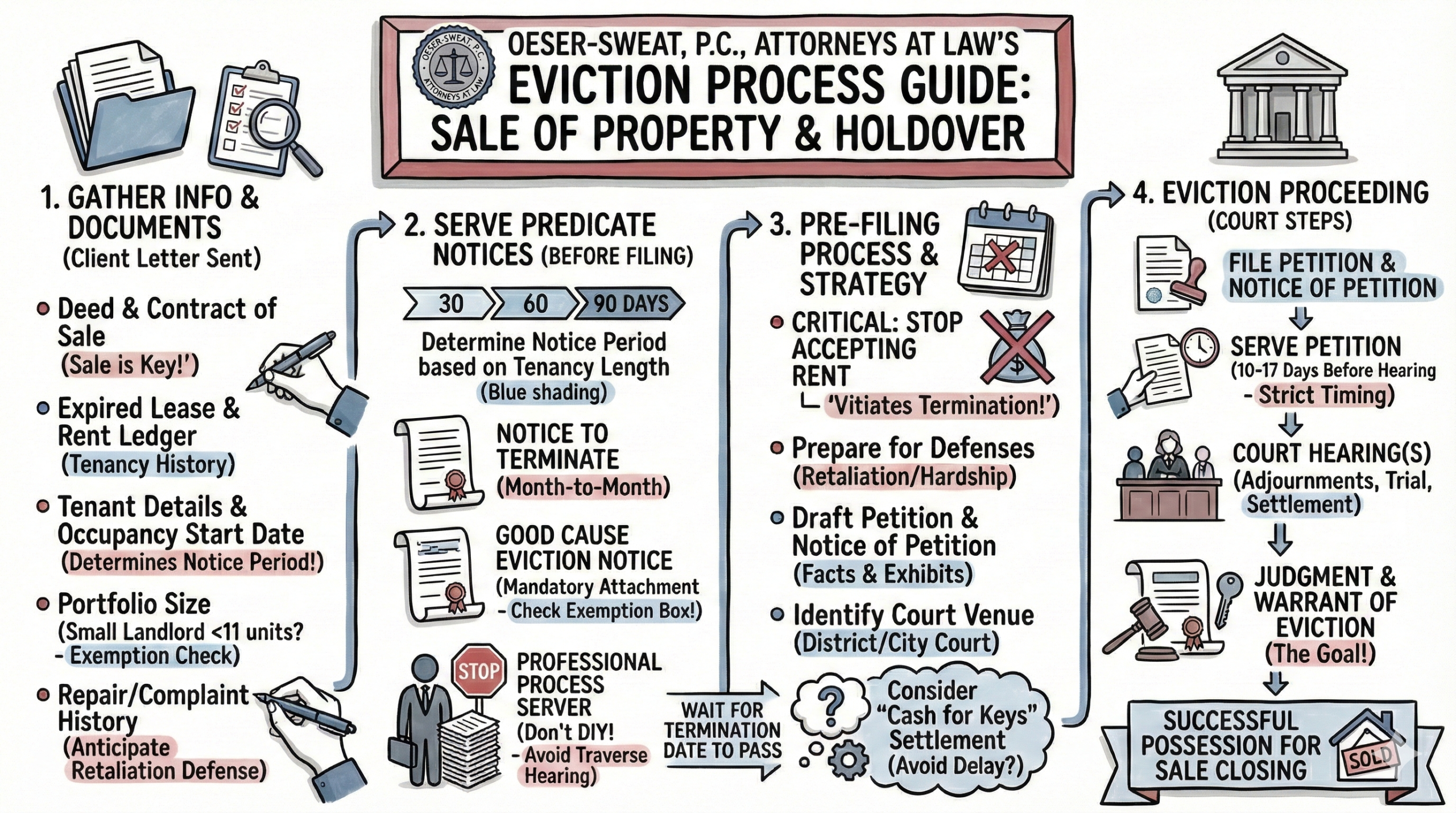
    Infographic: Oeser-Sweat P.C. Eviction Process Guide for Sale of Property & Holdover. Detailed text description below.
    Figure 1: The Step-by-Step Holdover Eviction Process for Landlords
    View Text Description of Eviction Roadmap

    Step 1: Gather Info & Documents. Collect the Deed, Contract of Sale, expired leases, rent ledgers, and tenant occupancy start dates. Verify your portfolio size for Good Cause Eviction exemptions.

    Step 2: Serve Predicate Notices. Determine the notice period (30, 60, or 90 days) based on the length of tenancy. Serve a Notice to Terminate and a Good Cause Eviction Notice via a professional process server.

    Step 3: Pre-Filing Strategy. CRITICAL: Stop accepting rent after the termination date as it “vitiates termination.” Prepare for defenses (Retaliation/Hardship) and identify the correct Court Venue.

    Step 4: Eviction Proceeding. File the Petition and Notice of Petition. Serve the tenant with strict timing (10-17 days before hearing). Attend court hearings. Secure a Judgment and Warrant of Eviction.

    1. Preparation: The “Sale is Key” Strategy

    Before any legal action is taken, you must audit your documentation. In New York, the length of a tenant’s occupancy determines the notice period required to terminate a month-to-month tenancy. If you are selling the property, your Contract of Sale is a vital document that underscores the necessity of delivering the property vacant.

    You must also determine if your property falls under the Good Cause Eviction Law. Small landlords (those owning 10 units or fewer) may be exempt, but this must be specifically asserted in your notices.

    2. Serving the Predicate Notices

    You cannot simply tell a tenant to move out. You must serve formal legal notices. Depending on how long the tenant has lived there, you must provide:

    • 30 Days Notice: Occupancy of less than 1 year.
    • 60 Days Notice: Occupancy between 1 and 2 years.
    • 90 Days Notice: Occupancy of more than 2 years.

    Pro-Tip: Never attempt “DIY” service. Using a professional process server is essential to avoid a “Traverse Hearing,” where a tenant challenges the validity of the service, potentially resetting your entire timeline.

    3. The “No Rent” Rule

    A common mistake landlords make is accepting rent after the termination date specified in the notice. In New York, accepting rent after the termination date but before starting the court case can “vitiate” (cancel) your notice, forcing you to start the 30/60/90 day process all over again.

    4. The Eviction Proceeding (Court Steps)

    If the tenant remains after the notice period expires, we file a Holdover Proceeding in the local District or City Court. This involves:

    • Filing the Petition: Stating the facts of the tenancy and the reason for eviction.
    • The Hearing: Most cases involve at least one adjournment. We aim for a settlement (like “Cash for Keys”) or a trial.
    • The Judgment: Once granted, the Judge signs a Warrant of Eviction, which is then processed by a Sheriff or Marshal.

    Seeking a Settlement

    In many cases, a “Cash for Keys” settlement is the most efficient path. While it may feel counterintuitive to pay a tenant to leave, it often saves months of litigation costs and ensures you meet your closing deadlines for the sale of the property.

  • Traveling with Children: Consent & Custody Rules

    Traveling with Children: Consent & Custody Rules

    Why you need more than just a passport when traveling internationally or relocating with a child.

    For divorced or separated parents, booking a flight is the easy part. The hard part is ensuring you have the legal right to take your child on that plane. Whether you are planning a vacation abroad or a move to a neighboring state, failing to get the proper consent can turn a family trip into an accusation of custodial interference or abduction.

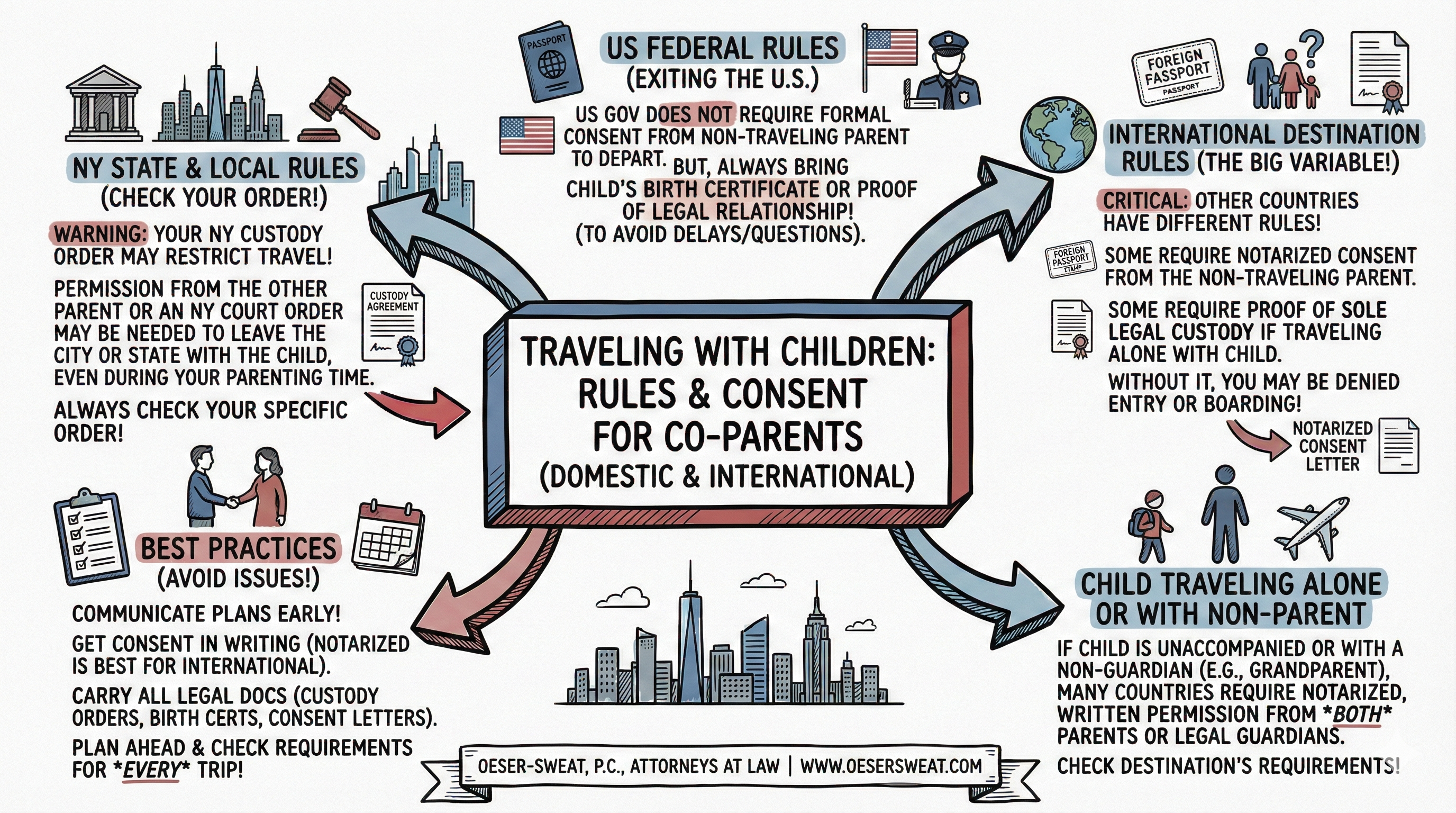
    Infographic: Rules for Traveling with Children - Consent Requirements and Documentation Checklist.
    Figure 1: Essential Documentation for Traveling Minors
    View Text Description of Graphic

    Travel Requirements: The graphic highlights that while the U.S. government doesn’t always demand exit consent, destination countries often require proof of permission.

    Documents Needed: Valid Passport, Copy of Birth Certificate (to prove relationship), and a Notarized Consent Letter from the non-traveling parent.

    Special Circumstances: If you have sole custody, bring the court order. If the other parent is deceased, bring the death certificate.

    Warning: Traveling without these documents can lead to being denied entry or detained at the border.

    1. The “Permission Slip” Rule: Notarized Consent

    The United States does not generally require you to show a permission letter to leave the country. However, many foreign countries (like Canada, Mexico, and nations in the EU) require strict proof that the traveling parent has permission from the non-traveling parent to cross their borders with a minor.

    The Solution: If you share custody, or even if there is no formal order but the other parent is on the birth certificate, you should carry a Notarized Travel Consent Letter. This document should state:

    • Who the child is traveling with;
    • The specific dates of travel;
    • The contact information for the non-traveling parent; and
    • That the non-traveling parent explicitly consents to the trip.

    Without this, border agents have the discretion to stop you, fearing international child abduction.

    2. Getting a Passport: The Two-Parent Rule

    Before you can even travel, you need a passport. Under federal law, for children under 16, both parents must authorize the issuance of the passport. This usually means both parents must appear in person at the passport agency.

    If the other parent cannot or will not appear, you must provide a notarized Form DS-3053 (Statement of Consent) along with a copy of their ID. If you have sole legal custody and the other parent has no rights, you must provide the court order proving this status.

    3. Relocation: The “Close Move” Trap

    WARNING: Moving to New Jersey, Connecticut, or Westchester is NOT just a “move.” Legally, it may be considered Relocation.

    Many parents in NYC assume they can move to a nearby suburb in New Jersey or Westchester without permission because “it’s only 45 minutes away.” This is incorrect. Taking a child across state lines to live, or moving them a distance that disrupts the other parent’s visitation schedule, often requires either:

    1. Written permission from the other parent; or
    2. A Court Order granting permission to relocate.

    If you move without these, the court can order the child returned immediately to New York City, and you could face sanctions for custodial interference.

    4. How We Can Help

    At Oeser-Sweat, P.C., we assist parents on both sides of this issue. We can:

    • Draft Travel Agreements: Creating robust consent letters and stipulations that satisfy border authorities.
    • Seek Court Permission: If your ex-spouse unreasonably refuses to sign a passport application or consent to a vacation, we can file a motion asking the judge to grant permission.
    • Litigate Relocation: If you need to move for a job or family support, we can petition the court to show why the move is in the child’s best interest.
  • Understanding NY Speedy Trial Law

    The Clock is Ticking: Understanding NY Speedy Trial Law (CPL 30.30)

    How the prosecutor’s failure to be ready on time can lead to your case being dismissed.

    In New York, the District Attorney cannot keep a criminal case hanging over your head forever. Under Criminal Procedure Law (CPL) § 30.30, the prosecutor has a strict time limit to get ready for trial. This is often called the “Speedy Trial Clock.” If the clock runs out before they are ready, your case must be dismissed.

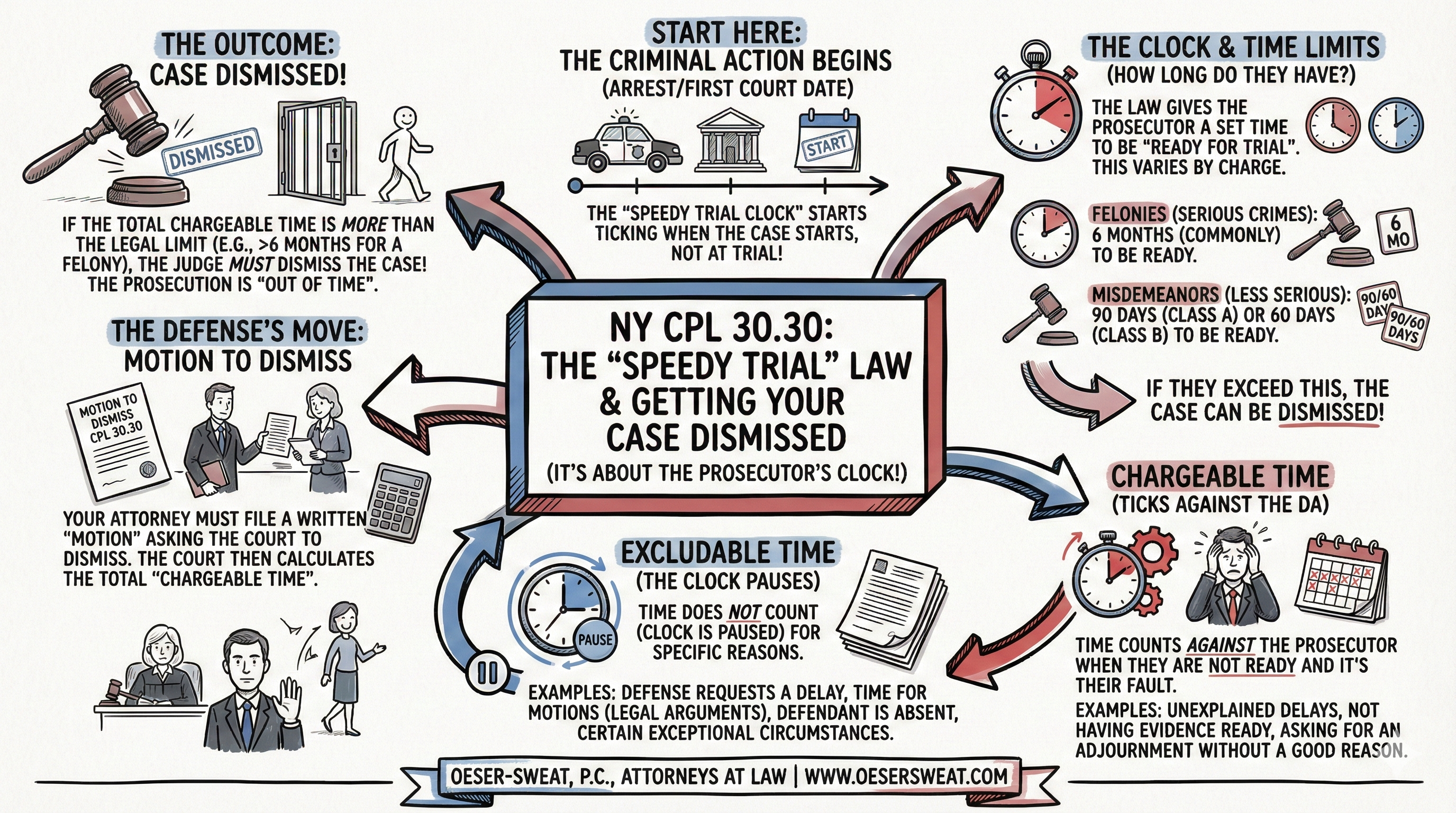
    Infographic: Visual explanation of CPL 30.30 time limits and exclusions.
    Figure 1: The CPL 30.30 Countdown
    View Text Description of Infographic

    The Core Concept: The graphic shows a “Time Limit” based on the seriousness of the charge. The clock starts ticking when the first paper (accusatory instrument) is filed.

    Time Limits:
    Felonies: 6 Months.
    “A” Misdemeanors: 90 Days.
    “B” Misdemeanors: 60 Days.
    Violations: 30 Days.

    Stopping the Clock (Exclusions): The graphic illustrates that time stops for specific reasons, such as defense adjournments, motion practice, or when the defendant is without counsel.

    1. How Much Time Do They Have?

    The amount of time the prosecutor has depends entirely on the most serious charge against you. This is a hard deadline set by law:

    • Felonies: The prosecutor has 6 calendar months to be ready for trial.
    • “A” Misdemeanors: They have 90 days.
    • “B” Misdemeanors: They have 60 days.
    • Violations: They have 30 days.

    Note: Traffic infractions are also “offenses” and technically fall under these rules if charged alongside crimes, but CPL 30.30 is primarily used to dismiss criminal charges.

    2. What Does “Ready for Trial” Mean?

    The prosecutor stops the clock by declaring they are “Ready for Trial.” To do this validly, they must:

    1. State Readiness: Say “The People are ready” in open court or file a written notice.
    2. File a Valid Accusatory Instrument: They cannot be ready if the complaint is defective (e.g., based only on hearsay without supporting depositions).
    3. Certify Discovery Compliance: Under recent laws (CPL 245.50), they must file a “Certificate of Compliance” stating they have turned over all required evidence (police reports, body cam footage, etc.) to your lawyer. If they haven’t turned over the evidence, their statement of “ready” is fake (illusory) and the clock keeps ticking.

    3. Stopping the Clock: Excludable Time

    This is where it gets tricky. The clock does not just run continuously. It pauses (“tolls”) for certain events. These pauses are called exclusions.

    Common Reasons the Clock Stops (Time Not Charged to Prosecutor):
    • Defense Requests: If your lawyer asks for an adjournment (e.g., to review papers or negotiate a plea), that time is excluded.
    • Motions: Time spent filing and deciding legal motions (like a motion to suppress evidence) is excluded.
    • No Counsel: Time when you are without a lawyer through no fault of the court is excluded.
    • Bench Warrants: If you skip court and a warrant is issued, the time you are missing is usually excluded.

    4. The Motion to Dismiss

    If the prosecutor exceeds their time limit (e.g., more than 90 days of “chargeable” time on an “A” misdemeanor), the case does not disappear automatically. Your lawyer must file a CPL 30.30 Motion to Dismiss.

    In this motion, your lawyer will list every adjournment period and argue why it should count against the prosecutor. The prosecutor will argue that the time should be excluded. If the judge agrees that the non-excludable time adds up to more than the statutory limit, the case is dismissed, and the record is sealed.

    WARNING: You can waive your 30.30 rights. Often, when taking a plea deal, the prosecutor will require you to waive your right to a speedy trial. Make sure you understand what you are giving up.
  • How to Get an Uncontested Divorce in NY

    How to Get an Uncontested Divorce in NY

    Navigating the paperwork, venue rules, and settlement process without a trial.

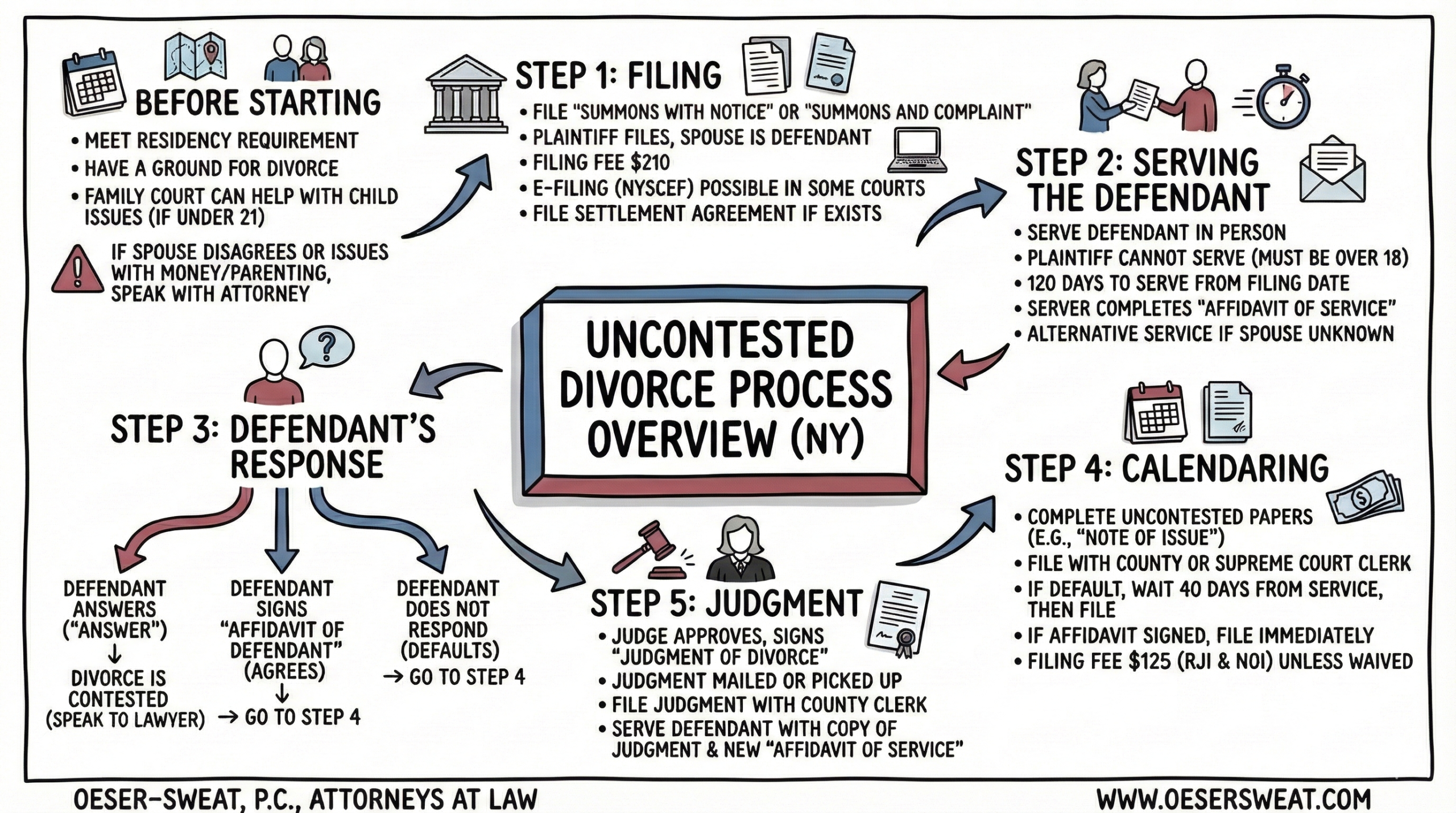
    Many people believe that an “Uncontested Divorce” means a divorce where you and your spouse agree on everything from day one. In legal reality, almost every divorce starts as “semi-contested.” It only becomes truly uncontested when you sign the final settlement papers and submit them to the clerk.

    Infographic: The step-by-step roadmap of the Uncontested Divorce Process.
    Figure 1: The Roadmap to Judgment
    View Text Description of Figure 1

    1. Purchase Index Number: File Summons with Notice or Summons and Complaint.

    2. Service of Process: Personally serve the defendant within 120 days.

    3. Defendant Defaults or Consents: The Defendant signs an “Affidavit of Defendant” agreeing to the divorce, or fails to respond.

    4. Note of Issue: File papers to place the case on the calendar (if necessary).

    5. Submission of Packet: Submit Findings of Fact, Conclusions of Law, and Judgment.

    6. Judgment Signed: The Judge or Referee signs the final decree.

    1. Filing the Case: The Venue Rule (CPLR 515)

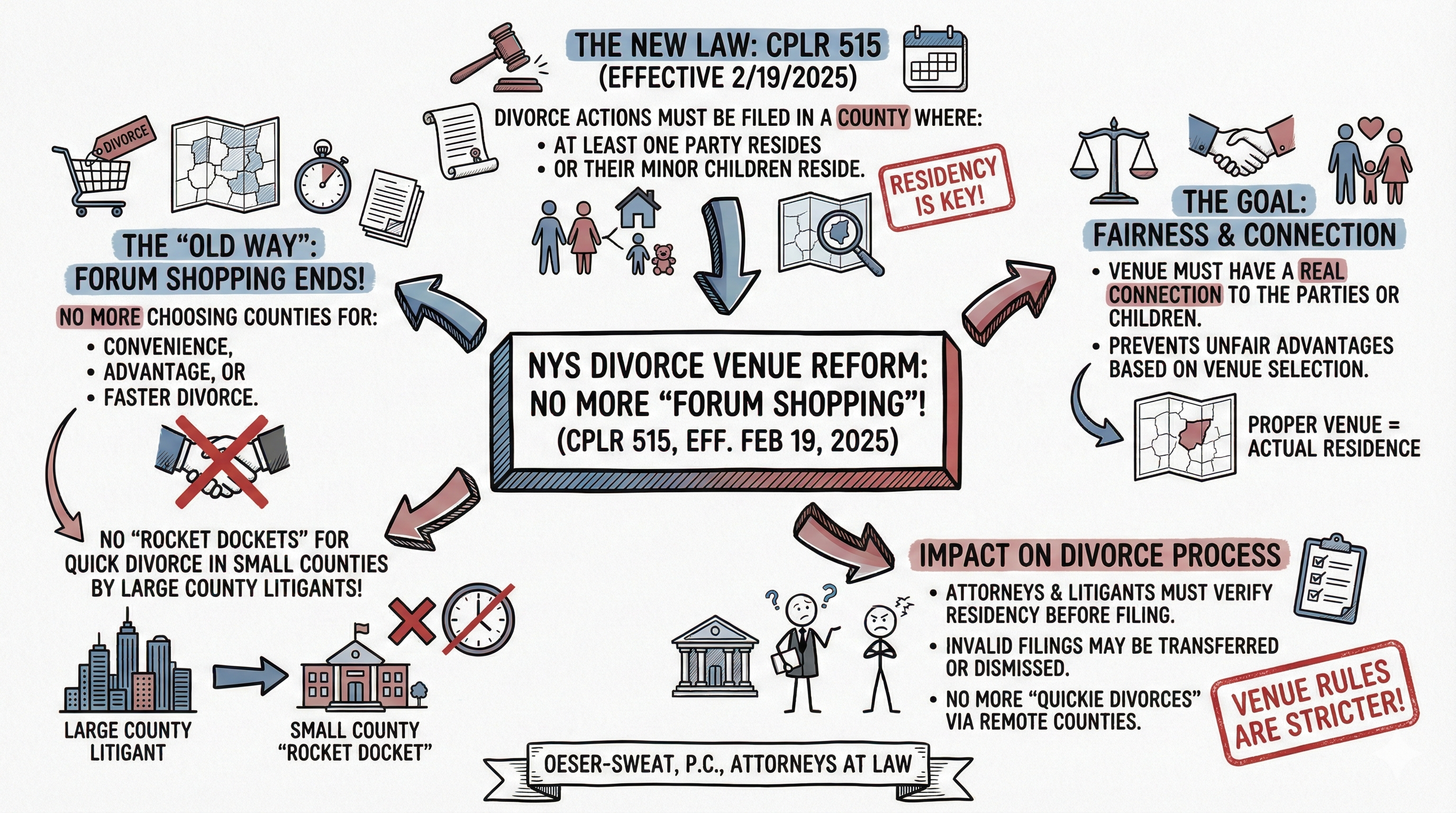
    Before you even fill out a form, you must know where to file. As of early 2025, the new CPLR § 515 mandates that you file for divorce in a county where at least one of the parties or their minor children resides. You can no longer pick a distant “rocket docket” county just because it processes papers faster. If you live in Queens, you file in Queens.

    2. Is It Really Uncontested? The “Notice of No Necessity”

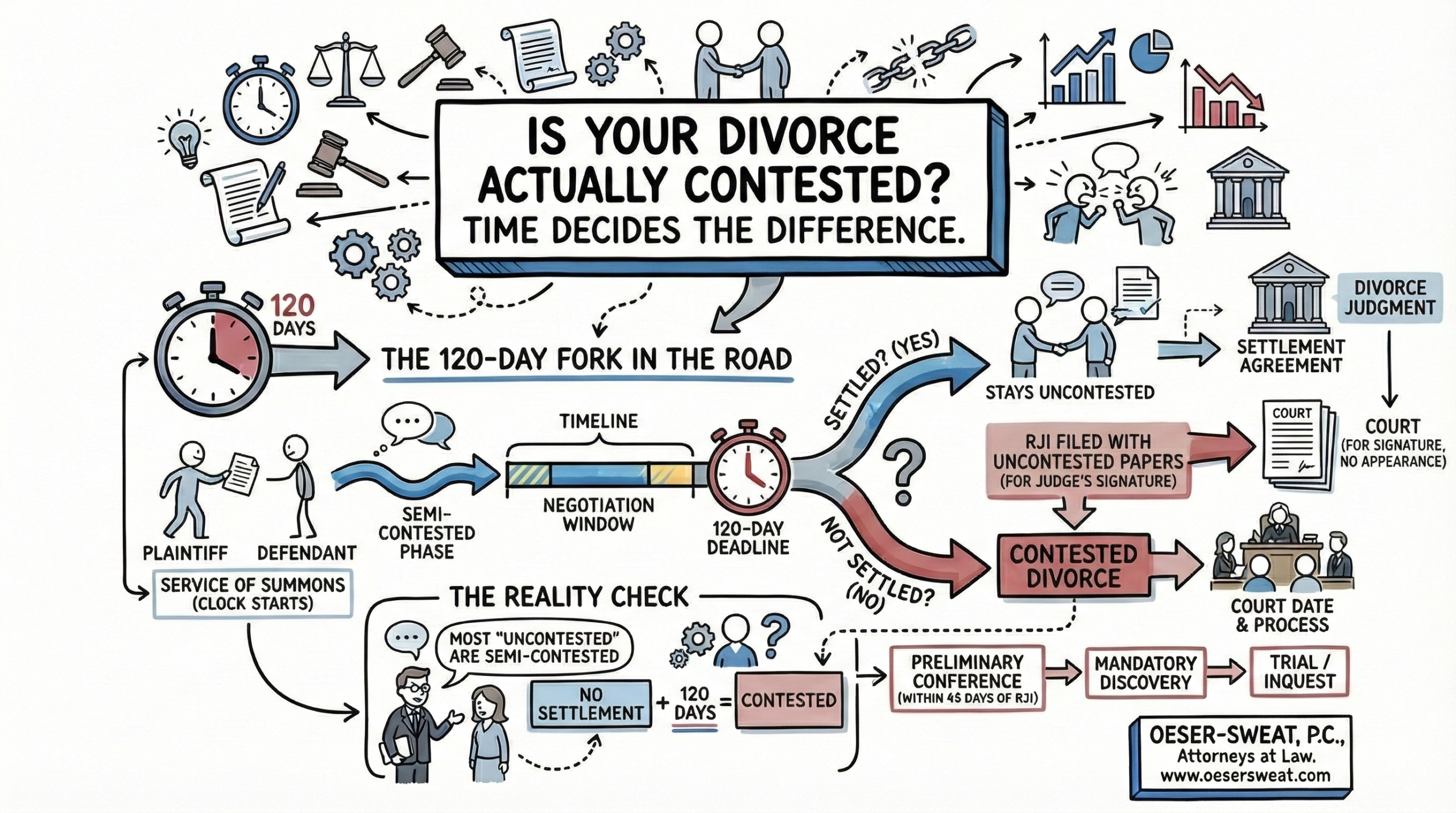
    Technically, every divorce is “contested” until it is settled. However, the court gives you a window of opportunity to work things out.

    After the Summons is served, if you and your spouse believe you can settle without judicial intervention, you can file a document called a “Notice of No Necessity.” This extends the deadline to file a Request for Judicial Intervention (RJI) from 45 days to 120 days.

    The 120-Day Clock: If you settle within this period, you proceed as an uncontested divorce. If you do not settle within 120 days, the case becomes technically contested, and you must request a Preliminary Conference. At that point, it follows the standard litigation track.
    Graphic: Flowchart determining if a divorce is truly uncontested based on agreement on custody, support, and assets.
    Figure 2: The “Semi-Contested” Reality Check
    View Text Description of Figure 2

    The Agreement Test: Do both parties agree on Custody? Support? Asset Division? If YES to all, it is Uncontested.

    The Time Factor: Even if you agree, if you miss the deadlines or fail to sign the papers, the court treats it as contested to force movement.

    The “No Necessity” Path: Using the 120-day window to finalize terms without seeing a judge.

    3. The “Uncontested Packet”

    If you reach a settlement, you don’t just tell the judge “we agree.” You must draft a massive stack of specific legal documents known as the “Uncontested Divorce Packet.” This replaces a trial. Instead of testifying on a witness stand, you provide “written testimony” through sworn affidavits.

    Key Documents in the Packet:

    • Affidavit of Plaintiff: Your sworn story stating the grounds for divorce and that you meet the residency requirements.
    • Affidavit of Defendant: Your spouse’s sworn statement admitting service and consenting to the divorce (or waiving their right to answer).
    • Findings of Fact & Conclusions of Law: A document you draft for the Judge to sign, summarizing the legal “facts” of the marriage and the “conclusions” (that you are entitled to a divorce).
    • Judgment of Divorce: The final decree that legally ends the marriage.

    If there are children under 21, you must also submit child support worksheets and specific language regarding custody and health insurance to ensure compliance with the Child Support Standards Act (CSSA).

    4. Submission and Judgment

    Once the packet is assembled, it is submitted to the Matrimonial Clerk’s office. A court attorney (referee) reviews every line to ensure it complies with the law. If there is a mistake—even a missing social security number or a math error in child support—the packet will be “defected” (rejected), and you will have to fix it. If approved, the Judge signs the Judgment, and you are officially divorced.

  • How to Get a Police Accident Report in NYC

    How to Get a Police Accident Report in NYC

    A simple guide to retrieving your collision report (MV-104AN) online or by mail.

    Getting into a car accident is scary and confusing. Once the dust settles, you need proof of what happened for your insurance company or for a lawsuit. In New York City, this proof is called the Police Collision Report (form MV-104AN). Getting this report used to be easy, but the rules have changed.

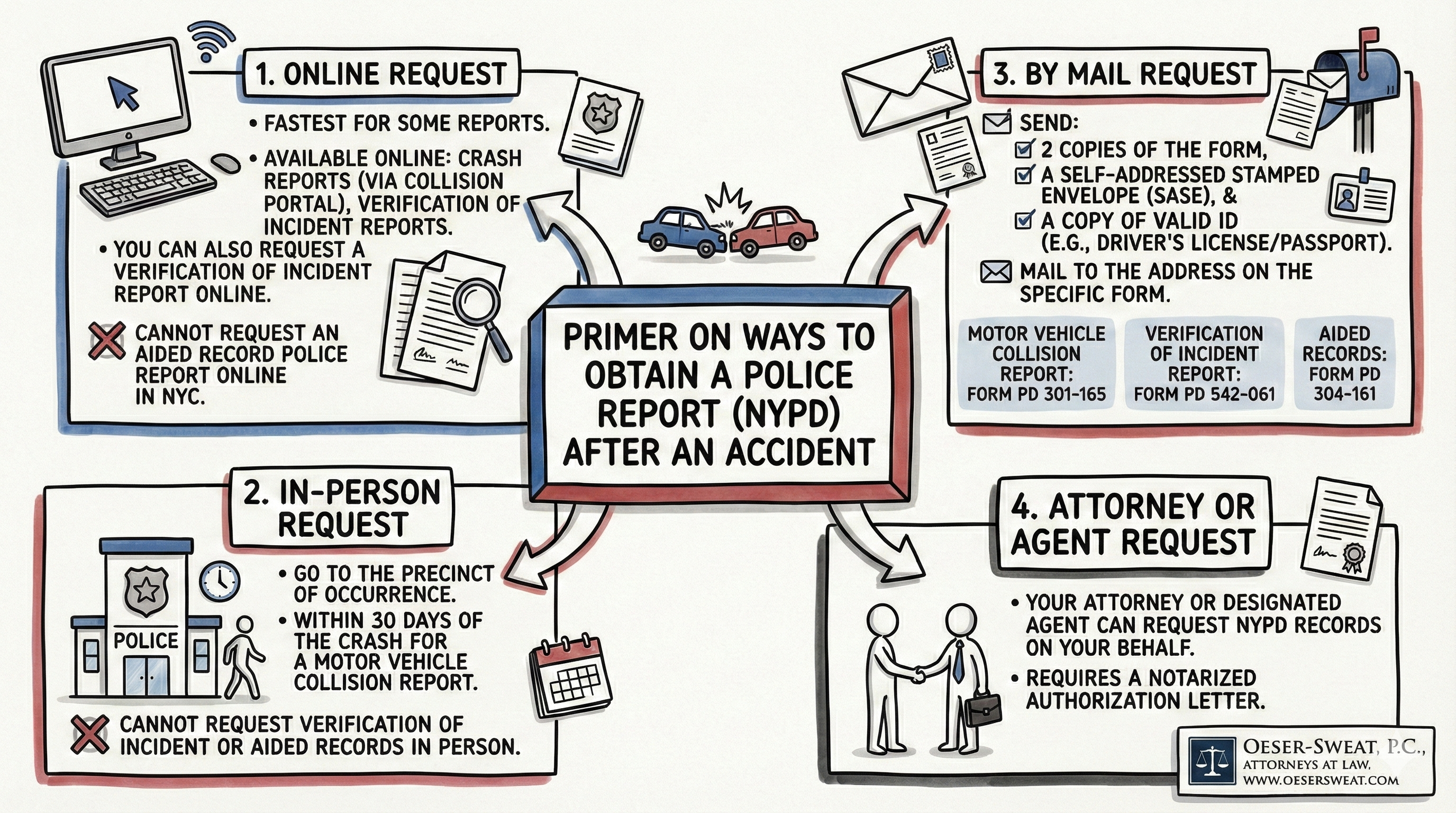
    Flowchart showing the steps to get a police report: At the Scene, The Waiting Period, and How to Request Online or by Mail.
    Figure 1: The Steps to Retrieve Your Collision Report
    View Text Description of Graphic

    1. At the Scene: The police officer writes down the details. You should ask for the “Accident Report Number” or “Complaint Number.”

    2. The Wait: It usually takes a few days for the report to be typed up and put into the computer system.

    3. Requesting the Report: You can go to the NYPD Collision Report Portal online. You enter the date and your license plate number to find it.

    4. Alternative: If you can’t find it online, you have to mail a “Verification of Incident” form to the NYPD Criminal Records Section.

    1. What is the MV-104AN?

    The MV-104AN is the official form the police fill out when they come to an accident scene. It lists the drivers involved, the insurance information, and a diagram of how the crash happened. This piece of paper is critical. Without it, your insurance company might delay fixing your car or paying your medical bills.

    2. Don’t Just Go to the Station (Most of the Time)

    WARNING: You might think you should just walk into the police precinct to get your report. Stop! Many precincts in New York City no longer give out these reports at the front desk.

    To save time and avoid frustration, you should try to get the report online first. If you just show up at the station, they might just hand you a piece of paper telling you to go home and use the computer. You can go to the local precinct where the accident occurred within 30 days and get the report.

    3. The Best Way: Go Online

    The fastest way to get your report is through the NYPD Collision Report Portal. It is free and available 24/7. Here is how it works:

    1. It can take up to 7 days after the accident for the report to be available. It takes time for officers to enter the data.
    2. Go to the Collision Report Website.
    3. You will need to search using the Incident Date and the License Plate Number of one of the cars involved.
    4. If found, you can download the PDF right away.

    4. The Slower Way: By Mail

    If you cannot find the report online, or if the police did not file a full collision report but only made a record of the incident, you have to use the mail. You must fill out a specific form depending on what you need:

    • Collision Report Request: Use the form found in the links to request the standard accident report.
    • Verification of Incident: Use form PD 542-061 if you just need proof that something happened (like a tree falling on your car) but it wasn’t a two-car crash.
    • Aided Record: Use form PD 304-161 if someone was hurt and taken to the hospital by ambulance.

    You must include a stamped, self-addressed envelope with your request so they can mail the report back to you.

    5. Is There a Fee?

    Getting the report from the NYPD website is usually free. However, if you order it through the New York State DMV, there might be a fee. Also, if you are paying for other police records, you might use the CityPay portal. Always check if a fee applies before you send a check.

  • Co-op vs. Condo: What Are You Actually Buying?

    Co-op vs. Condo: What Are You Actually Buying?

    A guide to shares, proprietary leases, and Board interviews for the New York buyer.

    New York City real estate is unique. Not all of the properties you buy here come with a deed. Unlike the rest of the country where you will likely buy a “House” and get a deed, in New York, when looking to buy an apartment, you are often asked to consider buying into a corporation that owns one or more buildings in which you would live as a “tenant” or “shareholder” in one of the building’s apartments. Understanding the legal difference between a Cooperative (Co-op) and a Condominium (Condo) is critical before you sign a contract or hire a lawyer.

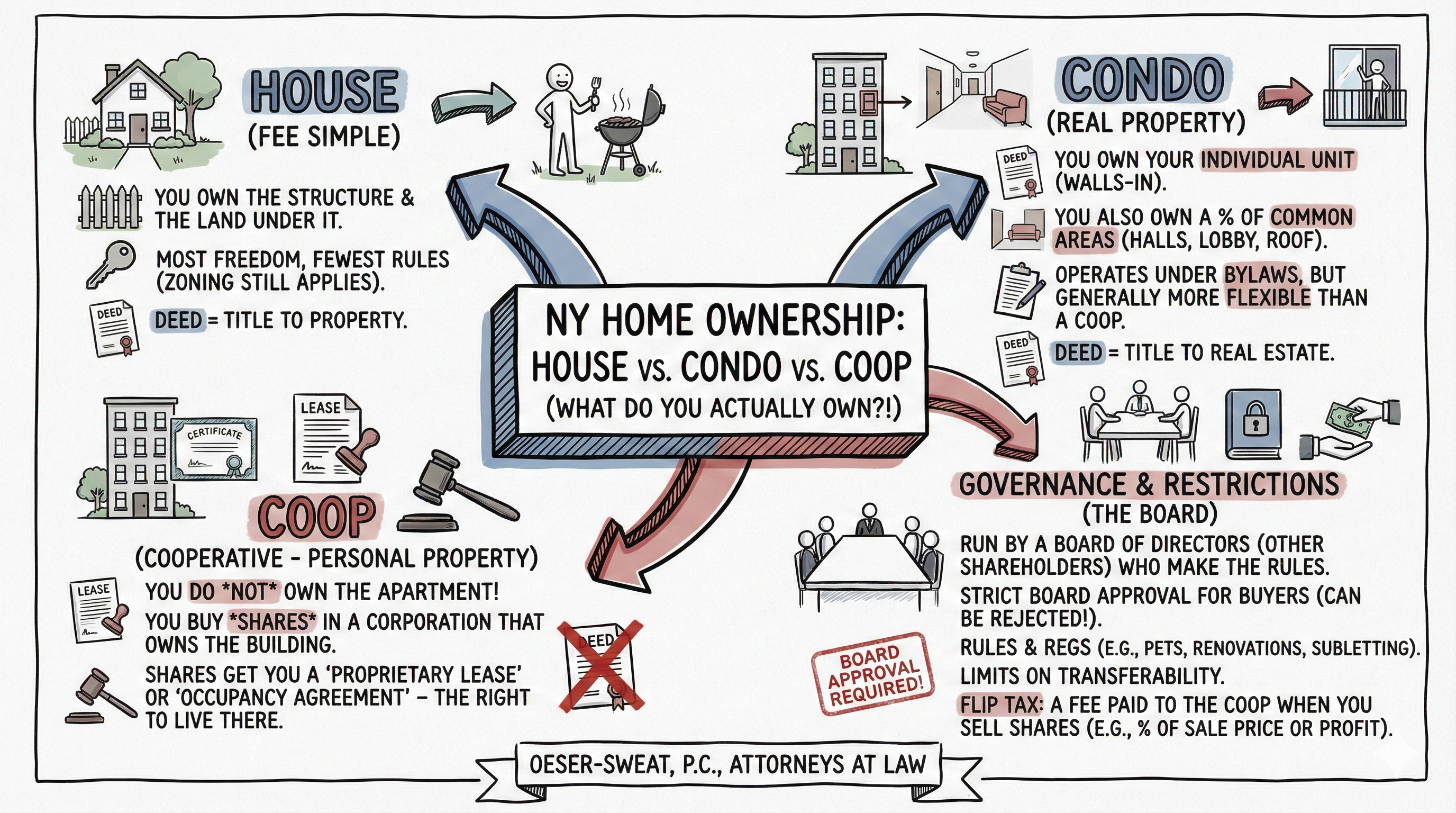
    Graphic comparing Real Property (House/Condo) vs Personal Property (Co-op Shares).
    Figure 1: The Legal Distinction: Real Estate vs. Shares
    View Text Description of Figure 1

    House/Condo: You receive a Deed. You own “Real Property” (the physical walls and land). You pay your own tax bill to the city.

    Co-op: You receive a Stock Certificate and a Proprietary Lease. You own “Personal Property” (shares in a company). You pay “Maintenance” which includes your share of the building’s taxes.

    1. Ownership Structure: You Don’t Own the Apartment

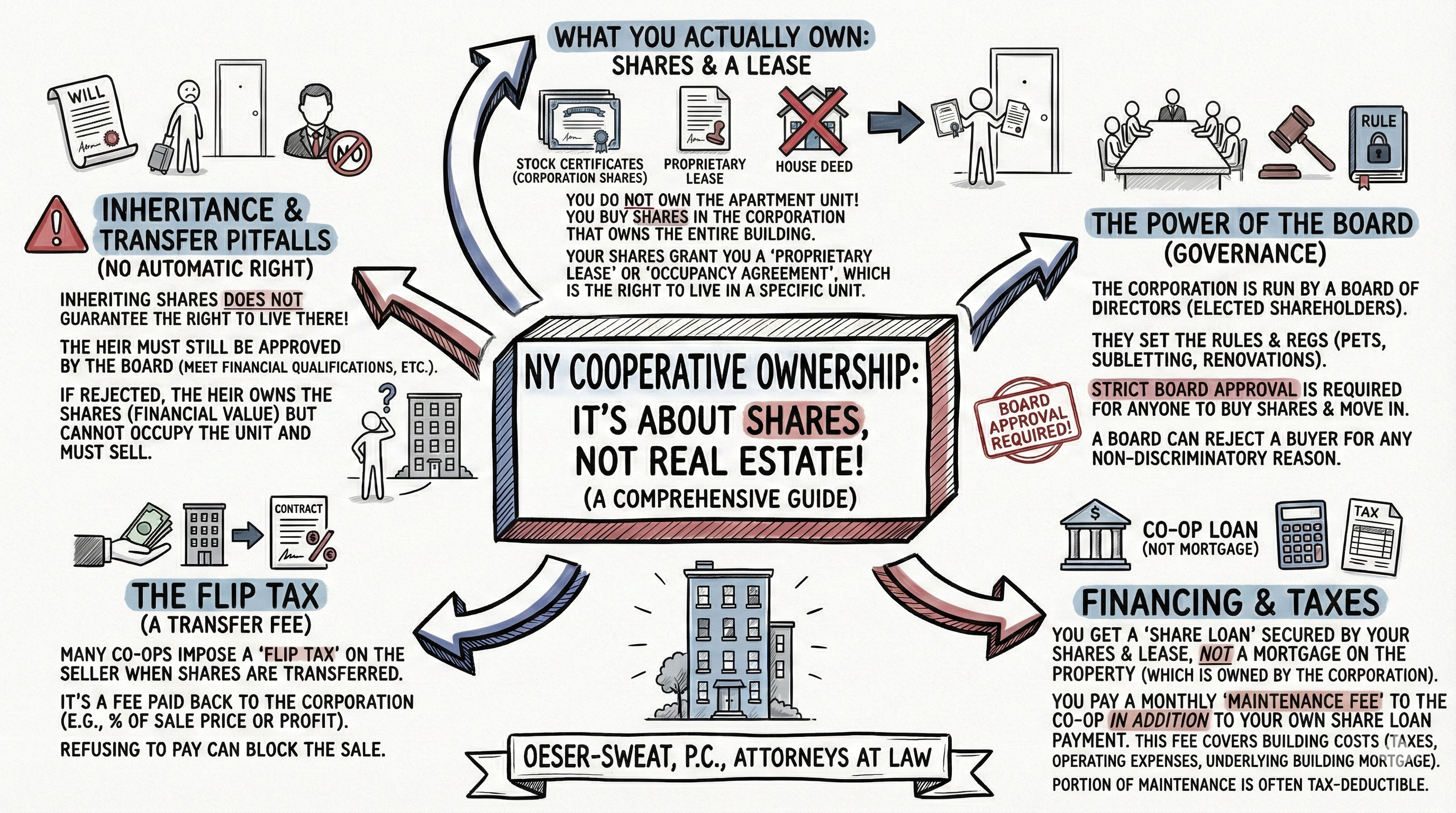
    When you “buy” a Co-op, you are not buying real estate in a traditional sense. You are buying shares of stock in a corporation that owns the building. Because you own shares, the corporation (usually) grants you a Proprietary Lease which allows you to live in a specific unit.

    This is why Co-ops have “Maintenance Fees” instead of Common Charges. Your maintenance pays for the building’s mortgage, the doorman (or super and staff), the heat, AND the property taxes for the whole building. At some Coops, the maintenance even includes electricity, which is a welcome controlled expense for everyone, but especially financially vunerable populations on a fixed income such as the elderly and retirees. Including electricity and heat in the maintenance makes these populations less likely to feel immediate pressure from price increases, as they are more evenly split between a population of shareholders.

    2. The Co-op Board: The Gatekeepers

    Because you are becoming a business partner with your neighbors, Co-op Boards have immense power. They review your financials, credit, and character references. They require a face-to-face interview. Crucially, a Co-op Board can reject a buyer for any reason (or no reason) as long as it is not discriminatory (based on race, religion, etc.).

    Cooperatives have been described by Courts in NY as “a little democratic sub society of necessity”, as a “quasi-government” and even as “a fiefdom”. Board members have a duty to the collective and not individual shareholders. This means if a rule is not good for a single shareholder but benefits the collective, they will likely implement such a rule. If you are the individual shareholder that gets the short end of the stick, notions of duty to the collective will not make the situation any less bitter.

    A Board’s decisions will always be compared against something called the Business Judgment Rule. The Board has significant power over the affairs of the Cooperative. These powers come from the State Laws, from the Bylaws, and from the Rules that the Board makes through its authority.

    “A governing board may significantly restrict the bundle of rights a property owner normally enjoys. Moreover, as with any authority to govern, the broad powers of a cooperative board hold potential for abuse through arbitrary and malicious decision-making, favoritism, discrimination and the like.” Levandusky v. One Fifth Ave., 75 NY 2d 530 – NY: Court of Appeals 1990

    Graphic detailing the Co-op Structure: Corporation owns building -> You buy shares -> You get a Lease.” 
                            class=”w-full h-auto rounded block”
                        />
                        <figcaption class= Figure 2: The Flow of Co-op Ownership
    View Text Description of Figure 2

    The Corporation: A single entity owns the entire building and the land under it.

    The Shareholder (You): You purchase a specific number of shares allocated to an apartment (e.g., 500 shares for Unit 4B).

    The Lease: The “Proprietary Lease” links your shares to your right to occupy that specific apartment.

    3. Financial Due Diligence: Looking Under the Hood

    WARNING: Never buy a co-op without reviewing the building’s Financial Statements.

    Since you are buying shares in a business, if the business (the building) goes bankrupt, your shares become worthless. Before signing a contract, your lawyer must check:

    • Underlying Mortgage: Does the building have a massive loan coming due?
    • Reserve Fund: Does the building have cash saved for emergencies?
    • Assessments: Are there major repairs (roof, elevator, Local Law 11 facade work) planned that will cause your monthly bill to jump up?

    4. Restrictions and Flip Taxes

    Co-op living is restrictive. Before buying, you must know the rules:

    • Subletting: Many Co-ops forbid subletting entirely, or limit it to 2 years out of every 5. You generally cannot buy a Co-op as a pure investment property.
    • Renovations: You need Board approval to renovate. They can dictate work hours, insurance requirements, and materials.
    • Financing Caps: Some buildings only allow you to finance 80% or even 50% of the purchase price.
    • Flip Tax: When you sell, the Co-op may charge a fee (transfer or “waiver of option” fee) that goes back to the building’s reserve fund. This can be a flat fee, a percentage of the profit or a percentage of the sale price (sometimes up to 65% in HDFCs, though 2-3% is common. Some coops have flip taxes of 75% within the first two years and 25% of profit thereafter).
    • Carpets: Many Co-ops require carpets. As many of these buildings are over a quarter century old, the floors creak and in addition to the normal noises of living, noise can be a serious concern. Many co-ops require carpeting for noise mitigation and heat insulation purposes and as a result, this can be an additional expense to those moving in and can affect your lifestyle.

    5. Special Category: HDFC Co-ops

    Housing Development Fund Corporation (HDFC) Co-ops are income-restricted affordable housing units. They are significantly cheaper to buy, but come with strict rules:

    HDFC Constraints:
    • Income Caps: You cannot earn more than a certain amount (based on Area Median Income).
    • High Flip Taxes: The building often takes a huge chunk of your profit when you sell to keep the unit affordable.
    • Cash Heavy: Financing can be difficult; some require all-cash purchases.

    Housing Development Fund Corporation (HDFC) Co-ops are often buildings that were abandoned by landlords or had financial distress in the 1970’s and 1980s and were renovated by HPD to give tenants of the units in the building the opportunity to own their apartments by becoming shareholders with limited equity in a cooperative (HDFC). There are over 1,100 HDFC coops in just New York City. These buildings often get reduced real estate taxes, which significantly reduces costs.

    6. Pros and Cons Summary

    Advantages: Lower purchase price and closing costs than Condos. Often financially stable with vetted neighbors and a strong sense of community. Often lower carrying costs, which arguably in many cases means that lower sale prices when compared to condos can be offset by the amount of carrying costs over time. If there is a huge problem with the halls or walls, the costs are often borne by the coop as a collective rather than the individual. It costs way less to repair a roof when the bill is split between 50-100 people vs you being the only person paying.

    Disadvantages: Invasive Board interviews. Risk of rejection without cause. Strict rules on how you live. Harder to sell or rent out. Boards can change and like the Supreme Court, and major shift in the number of people or changes in philosophy of members can have a significant impact on your day to day life without notice and often without recourse.

  • New Divorce Venue Rules

    The End of the “Rocket Docket”: New Divorce Venue Rules

    Why you can no longer “shop” for a court, and why filing in your home county is now the law.

    For years, getting a “quickie divorce” in New York often meant filing your paperwork in a tiny county hundreds of miles away—a place where neither you nor your spouse had ever lived. This practice, of using a “Rocket Docket,” allowed litigants from crowded counties like New York or Kings to skip the line. As of February 19, 2025, that door has been slammed shut.

    Graphic: No More Forum Shopping. Visual illustrating that you must file where you live.
    Figure 1: The New Rule – No More Shopping for Better Courts
    View Text Description of Graphic

    The Old Way: People living in busy areas (like NYC) would file in distant, quiet counties to get a judgment faster.

    The New Way (CPLR 515): You must file in a county where the Plaintiff, the Defendant, or their minor children actually reside.

    The Goal: Fairness. To ensure local courts handle local families and prevent wealthy litigants from “buying” a faster divorce.

    1. What Exactly Changed? (CPLR 515)

    Under the new law, CPLR § 515, you are no longer allowed to pick a court based on convenience or speed. The law now mandates that a divorce action must be filed in a county where:

    • The Plaintiff (the person filing) resides; OR
    • The Defendant (the other spouse) resides; OR
    • Their minor children reside.

    Before this change, law firms often advised clients to file in counties hours upstate. Why? Because those court clerks had fewer cases and could sign a Judgment of Divorce in weeks, whereas a Downstate court might take months. This created a system where people were “shopping” for the best court.

    2. The “Rocket Docket” Trap

    While the old way seemed faster, it carried a hidden danger that this new law eliminates. Under the old system, if you filed in a county 4 hours away because it was “fast,” you were taking a gamble. If your “uncontested” divorce suddenly became “contested” (meaning your spouse disagreed with something), that distant court would still be the one handling your case.

    The Danger: If the court upstate refused to allow remote (video) appearances, you and your lawyer would have to drive 4 hours each way for every 15-minute conference. This turned a “cheap, fast” divorce into an expensive logistical nightmare.

    3. Exceptions to the Rule

    The legislature understood that sometimes, you need to hide your location. CPLR 515(b) provides strict exceptions where you can still file in a different county (as allowed by CPLR 509):

    • Confidentiality Orders: If your address is confidential due to a court order (like in Domestic Violence cases under DRL §254 or Family Court Act §154-b).
    • Address Not Public: If the addresses of the parties and children are not matters of public record.
    • Good Cause: A judge can still allow a case to proceed in a different county if you can prove there is a very good reason (“good cause”) to do so, though “convenience” is no longer enough.

    4. What This Means for You

    If you are looking to get divorced, you must plan to file locally. While it might feel frustrating to wait in line with everyone else in your home county, this rule ensures that if issues regarding custody or support arise, the court handling them is in the same community where your children actually sleep at night.