
Understanding the Contested Matrimonial Case Process
A visual guide and explanation of the divorce timeline in New York State.
Navigating a contested divorce can be one of the most complex legal challenges a person faces. The process involves multiple stages, strict deadlines, and specific legal filings. We have created the infographic below to simplify this timeline and help you understand where you stand in the process.
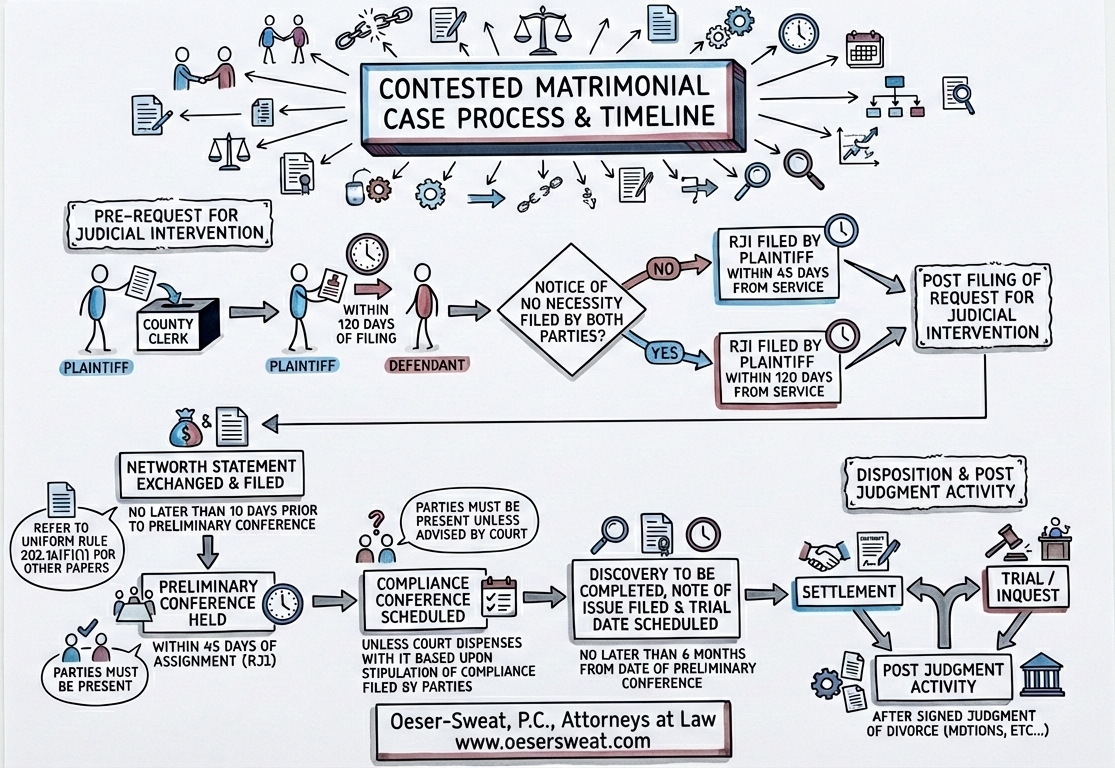
View Text Description of Infographic
Step 1: Commencement. The Plaintiff files a Summons with Notice or Summons and Verified Complaint with the County Clerk.
Step 2: Service. The Defendant must be personally served within 120 days of filing.
Step 3: Response. The Defendant serves a Notice of Appearance or Verified Answer.
Step 4: RJI. Request for Judicial Intervention is filed to assign a judge.
Step 5: Discovery & Compliance. Both parties exchange financial documents (Net Worth Statements). Preliminary Conference is held.
Step 6: Trial or Settlement. Note of Issue is filed signaling readiness for trial. If no settlement is reached, the case proceeds to trial.
Step 7: Judgment. The Judge signs the Judgment of Divorce.
1. Commencement of the Action
Every matrimonial case begins with the filing of a “Summons with Notice” or a “Summons and Complaint.” This serves as the formal notification to the court that a legal action has begun. In New York, the person filing is the “Plaintiff” and the other spouse is the “Defendant.”
2. The Preliminary Conference (PC)
The PC is the first major court appearance. The judge will set a timeline for the rest of the case, including deadlines for discovery and dates for future appearances. It is vital to have experienced counsel at this stage to ensure the schedule is realistic for your situation.
3. The Discovery Phase
Once the case is active, both parties engage in “Discovery.” This is crucial for ensuring equitable distribution of marital property. You will be required to produce:
- Statements of Net Worth
- Tax Returns (3-5 years)
- Real Estate Appraisals
- Pension and Retirement Account Statements
Failure to disclose assets during this phase can lead to severe penalties from the court.
4. Compliance Conference(s)
The Compliance Conference is a conference in which the parties come together to show the court how far they have gotten in the case and whether they have complied with the requirements of the previously issued court orders (PC Order, etc.) Often a new Order outlining next steps is signed by a judge in order to ensure the case moves along.
4. Completion of Discovery & Filing of Note of Issue
Once Discovery is completed, a Note of Issue must be filed. A trial date is usually scheduled at this point.
What happens if the case doesn’t settle?
All cases are moving towards a trial date. If a case settles before the court schedules a trial and holds one, a packet of documents is filed with the court by the parties and if it is acceptable to the court, Findings of Fact, Conclusions of Law and a Judgment of Divorce are issued. Otherwise there is a trial, which can lead to the same outcome, with the court deciding these items in its sole discretion rather than the parties agreeing in advance to the items contained therein.