
The Clock is Ticking: Understanding NY Speedy Trial Law (CPL 30.30)
How the prosecutor’s failure to be ready on time can lead to your case being dismissed.
In New York, the District Attorney cannot keep a criminal case hanging over your head forever. Under Criminal Procedure Law (CPL) § 30.30, the prosecutor has a strict time limit to get ready for trial. This is often called the “Speedy Trial Clock.” If the clock runs out before they are ready, your case must be dismissed.
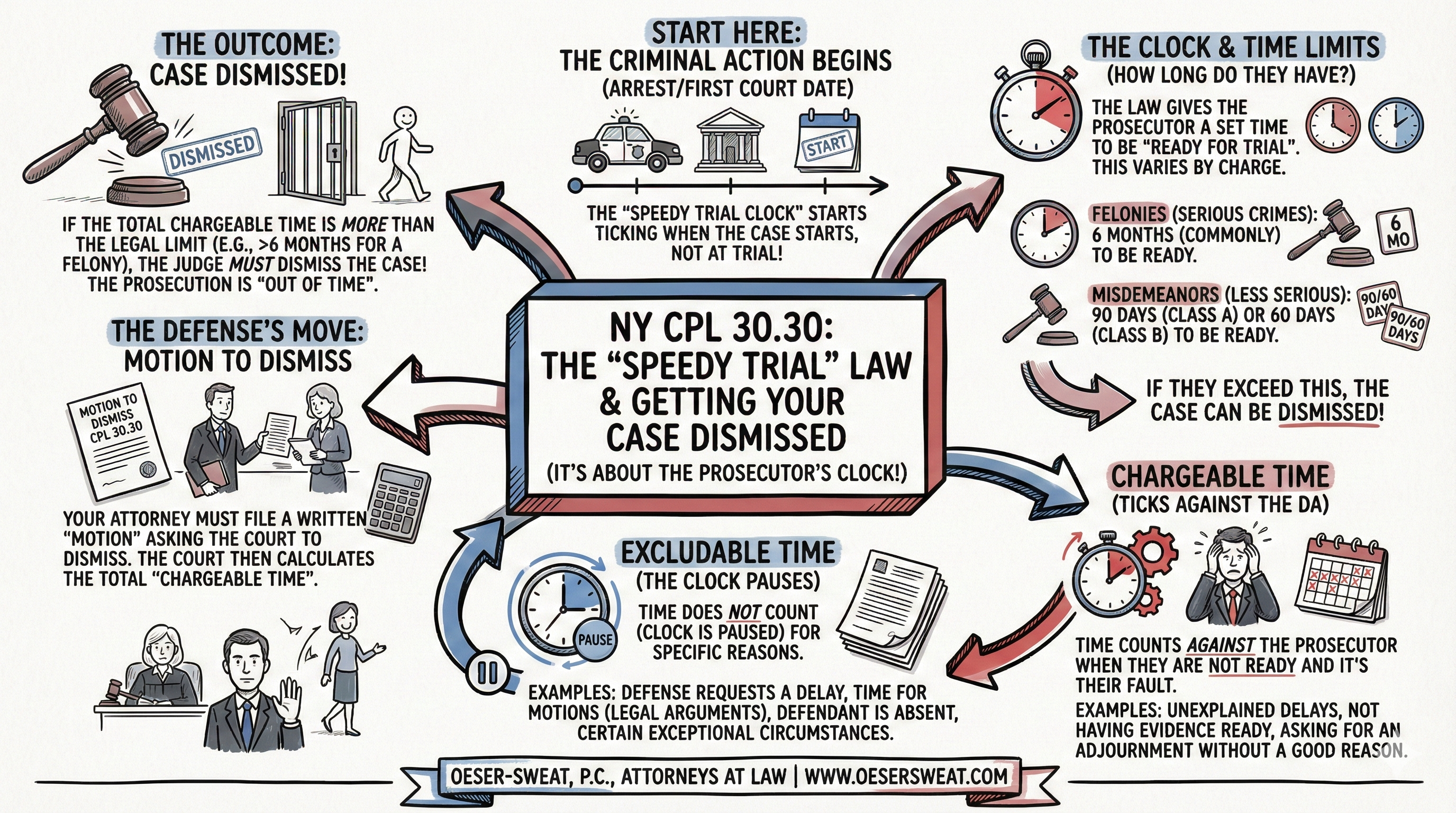
View Text Description of Infographic
The Core Concept: The graphic shows a “Time Limit” based on the seriousness of the charge. The clock starts ticking when the first paper (accusatory instrument) is filed.
Time Limits:
– Felonies: 6 Months.
– “A” Misdemeanors: 90 Days.
– “B” Misdemeanors: 60 Days.
– Violations: 30 Days.
Stopping the Clock (Exclusions): The graphic illustrates that time stops for specific reasons, such as defense adjournments, motion practice, or when the defendant is without counsel.
1. How Much Time Do They Have?
The amount of time the prosecutor has depends entirely on the most serious charge against you. This is a hard deadline set by law:
- Felonies: The prosecutor has 6 calendar months to be ready for trial.
- “A” Misdemeanors: They have 90 days.
- “B” Misdemeanors: They have 60 days.
- Violations: They have 30 days.
Note: Traffic infractions are also “offenses” and technically fall under these rules if charged alongside crimes, but CPL 30.30 is primarily used to dismiss criminal charges.
2. What Does “Ready for Trial” Mean?
The prosecutor stops the clock by declaring they are “Ready for Trial.” To do this validly, they must:
- State Readiness: Say “The People are ready” in open court or file a written notice.
- File a Valid Accusatory Instrument: They cannot be ready if the complaint is defective (e.g., based only on hearsay without supporting depositions).
- Certify Discovery Compliance: Under recent laws (CPL 245.50), they must file a “Certificate of Compliance” stating they have turned over all required evidence (police reports, body cam footage, etc.) to your lawyer. If they haven’t turned over the evidence, their statement of “ready” is fake (illusory) and the clock keeps ticking.
3. Stopping the Clock: Excludable Time
This is where it gets tricky. The clock does not just run continuously. It pauses (“tolls”) for certain events. These pauses are called exclusions.
- Defense Requests: If your lawyer asks for an adjournment (e.g., to review papers or negotiate a plea), that time is excluded.
- Motions: Time spent filing and deciding legal motions (like a motion to suppress evidence) is excluded.
- No Counsel: Time when you are without a lawyer through no fault of the court is excluded.
- Bench Warrants: If you skip court and a warrant is issued, the time you are missing is usually excluded.
4. The Motion to Dismiss
If the prosecutor exceeds their time limit (e.g., more than 90 days of “chargeable” time on an “A” misdemeanor), the case does not disappear automatically. Your lawyer must file a CPL 30.30 Motion to Dismiss.
In this motion, your lawyer will list every adjournment period and argue why it should count against the prosecutor. The prosecutor will argue that the time should be excluded. If the judge agrees that the non-excludable time adds up to more than the statutory limit, the case is dismissed, and the record is sealed.