
Prenuptial Agreements: A Roadmap for Your Marriage
Why having “the conversation” now can protect your future and strengthen your partnership.
For many, the mention of a Prenuptial Agreement feels like an accusation. If you are being pressured by family or a fiancé to sign one, it is natural to feel defensive. However, viewed correctly, a prenup is not about planning for divorce—it is about defining the rules of your marriage on your own terms, rather than letting the state decide for you.
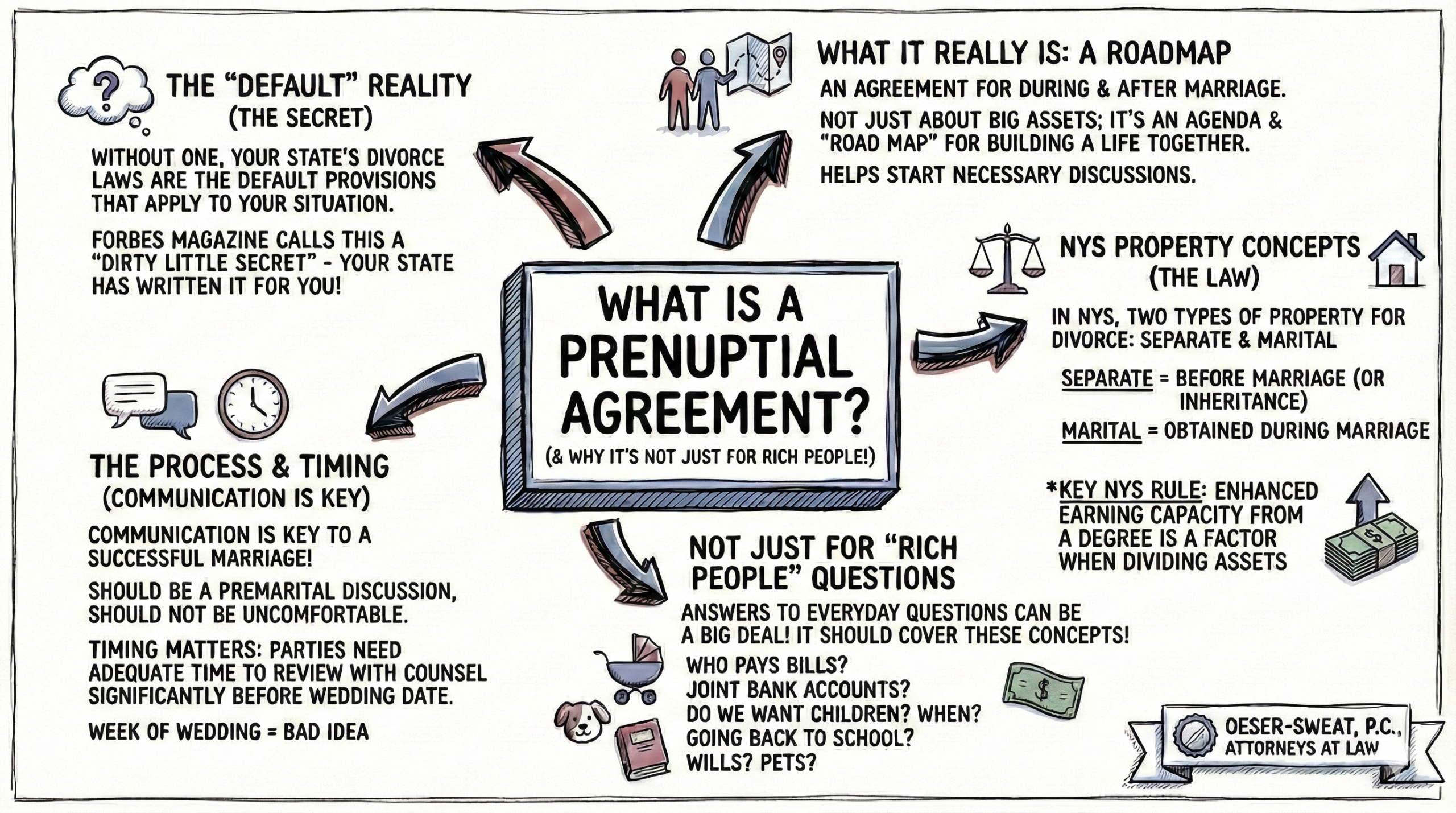
View Text Summary of Graphic
The Default Prenup: The infographic reminds readers that everyone already has a prenup—it’s called “State Law.” If you don’t write your own, the state’s default rules apply to your assets.
The Conversation: Encourages couples to use crayons, chalk, or fun methods to discuss serious topics to lower the tension.
Timing Warning: “Week of Wedding = Bad Idea.” Agreements signed under time pressure are vulnerable to being overturned by a court.
Scope: A prenup is an agenda for discussion: Children, career goals, parents living in the home, and property division.
1. The Legal Requirement: DRL §236(B)(3)
In New York, a prenuptial agreement is a powerful document, but only if it strictly follows the law. Under Domestic Relations Law §236(B)(3), an agreement must be:
- In writing;
- Subscribed (signed) by the parties; AND
- Acknowledged or proven in the manner required to entitle a deed to be recorded.
This “acknowledgment” requirement is critical. A simple notary stamp is often not enough; specific language is required. If these technical formalities are missed, the entire agreement can be tossed out years later.
2. Designing Your “Lifestyle Agenda”
If you are feeling pressured, try shifting the focus from “assets” to “lifestyle.” A well-crafted agreement plans for the everyday realities of your life together:
- Finances: Will you have a joint bank account for bills? Who contributes what percentage?
- Career & Education: If one spouse goes back to school, is that degree marital property? Who pays for the tuition?
- Family Dynamics: What happens if an aging parent needs to move in?
Use the agreement to have these difficult conversations now, when you love each other, rather than fighting about them later.
3. What You CANNOT Include
While you have broad freedom to contract, there are lines you cannot cross. Courts generally will not enforce provisions regarding:
- Child Custody: You cannot pre-determine who gets the kids. The court always decides based on the “best interests of the child” at the time of divorce.
- Child Support: You cannot waive your child’s right to support.
- “Lifestyle Clauses”: Penalties for gaining weight or not visiting in-laws are often viewed as unenforceable or frivolous by New York courts.
4. The Danger Zone: Timing & Counsel
The closer you are to the wedding date, the more scrutiny a court will apply to the agreement. If a prenup is presented on the eve of the wedding (“Sign this or the wedding is off”), it may be challenged later on the grounds of duress.
You Need Independent Counsel: It is practically mandatory that both sides have their own lawyer. One lawyer cannot ethically represent both parties in a prenup. If you are being asked to sign an agreement written by your fiancé’s wealthy family lawyers, you must have your own advocate to review it and explain what you are giving up.