Category: Matrimonial Law

  • Traveling with Children: Consent & Custody Rules

    Traveling with Children: Consent & Custody Rules

    Why you need more than just a passport when traveling internationally or relocating with a child.

    For divorced or separated parents, booking a flight is the easy part. The hard part is ensuring you have the legal right to take your child on that plane. Whether you are planning a vacation abroad or a move to a neighboring state, failing to get the proper consent can turn a family trip into an accusation of custodial interference or abduction.

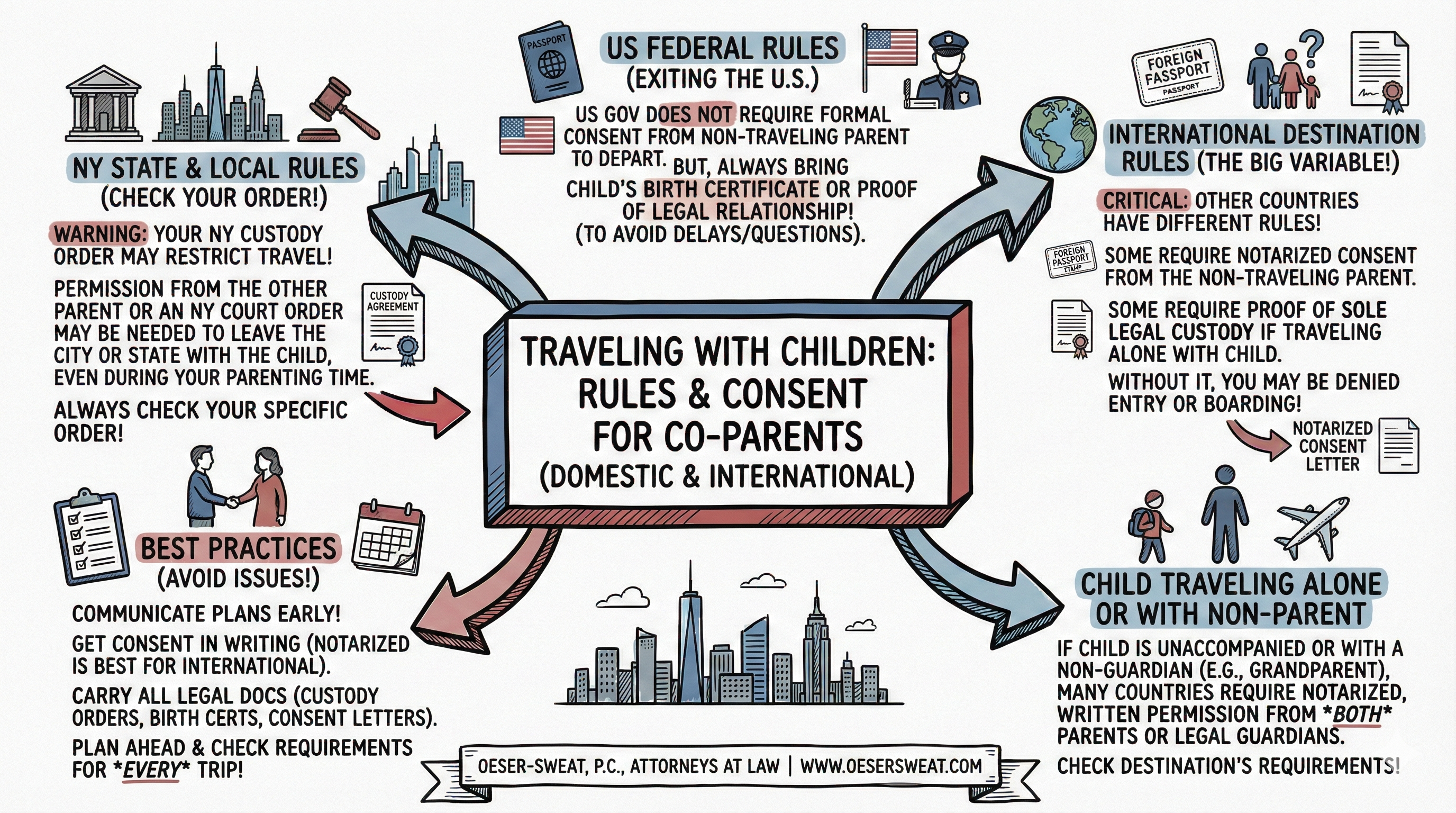
    Infographic: Rules for Traveling with Children - Consent Requirements and Documentation Checklist.
    Figure 1: Essential Documentation for Traveling Minors
    View Text Description of Graphic

    Travel Requirements: The graphic highlights that while the U.S. government doesn’t always demand exit consent, destination countries often require proof of permission.

    Documents Needed: Valid Passport, Copy of Birth Certificate (to prove relationship), and a Notarized Consent Letter from the non-traveling parent.

    Special Circumstances: If you have sole custody, bring the court order. If the other parent is deceased, bring the death certificate.

    Warning: Traveling without these documents can lead to being denied entry or detained at the border.

    1. The “Permission Slip” Rule: Notarized Consent

    The United States does not generally require you to show a permission letter to leave the country. However, many foreign countries (like Canada, Mexico, and nations in the EU) require strict proof that the traveling parent has permission from the non-traveling parent to cross their borders with a minor.

    The Solution: If you share custody, or even if there is no formal order but the other parent is on the birth certificate, you should carry a Notarized Travel Consent Letter. This document should state:

    • Who the child is traveling with;
    • The specific dates of travel;
    • The contact information for the non-traveling parent; and
    • That the non-traveling parent explicitly consents to the trip.

    Without this, border agents have the discretion to stop you, fearing international child abduction.

    2. Getting a Passport: The Two-Parent Rule

    Before you can even travel, you need a passport. Under federal law, for children under 16, both parents must authorize the issuance of the passport. This usually means both parents must appear in person at the passport agency.

    If the other parent cannot or will not appear, you must provide a notarized Form DS-3053 (Statement of Consent) along with a copy of their ID. If you have sole legal custody and the other parent has no rights, you must provide the court order proving this status.

    3. Relocation: The “Close Move” Trap

    WARNING: Moving to New Jersey, Connecticut, or Westchester is NOT just a “move.” Legally, it may be considered Relocation.

    Many parents in NYC assume they can move to a nearby suburb in New Jersey or Westchester without permission because “it’s only 45 minutes away.” This is incorrect. Taking a child across state lines to live, or moving them a distance that disrupts the other parent’s visitation schedule, often requires either:

    1. Written permission from the other parent; or
    2. A Court Order granting permission to relocate.

    If you move without these, the court can order the child returned immediately to New York City, and you could face sanctions for custodial interference.

    4. How We Can Help

    At Oeser-Sweat, P.C., we assist parents on both sides of this issue. We can:

    • Draft Travel Agreements: Creating robust consent letters and stipulations that satisfy border authorities.
    • Seek Court Permission: If your ex-spouse unreasonably refuses to sign a passport application or consent to a vacation, we can file a motion asking the judge to grant permission.
    • Litigate Relocation: If you need to move for a job or family support, we can petition the court to show why the move is in the child’s best interest.
  • How to Get an Uncontested Divorce in NY

    How to Get an Uncontested Divorce in NY

    Navigating the paperwork, venue rules, and settlement process without a trial.

    Many people believe that an “Uncontested Divorce” means a divorce where you and your spouse agree on everything from day one. In legal reality, almost every divorce starts as “semi-contested.” It only becomes truly uncontested when you sign the final settlement papers and submit them to the clerk.

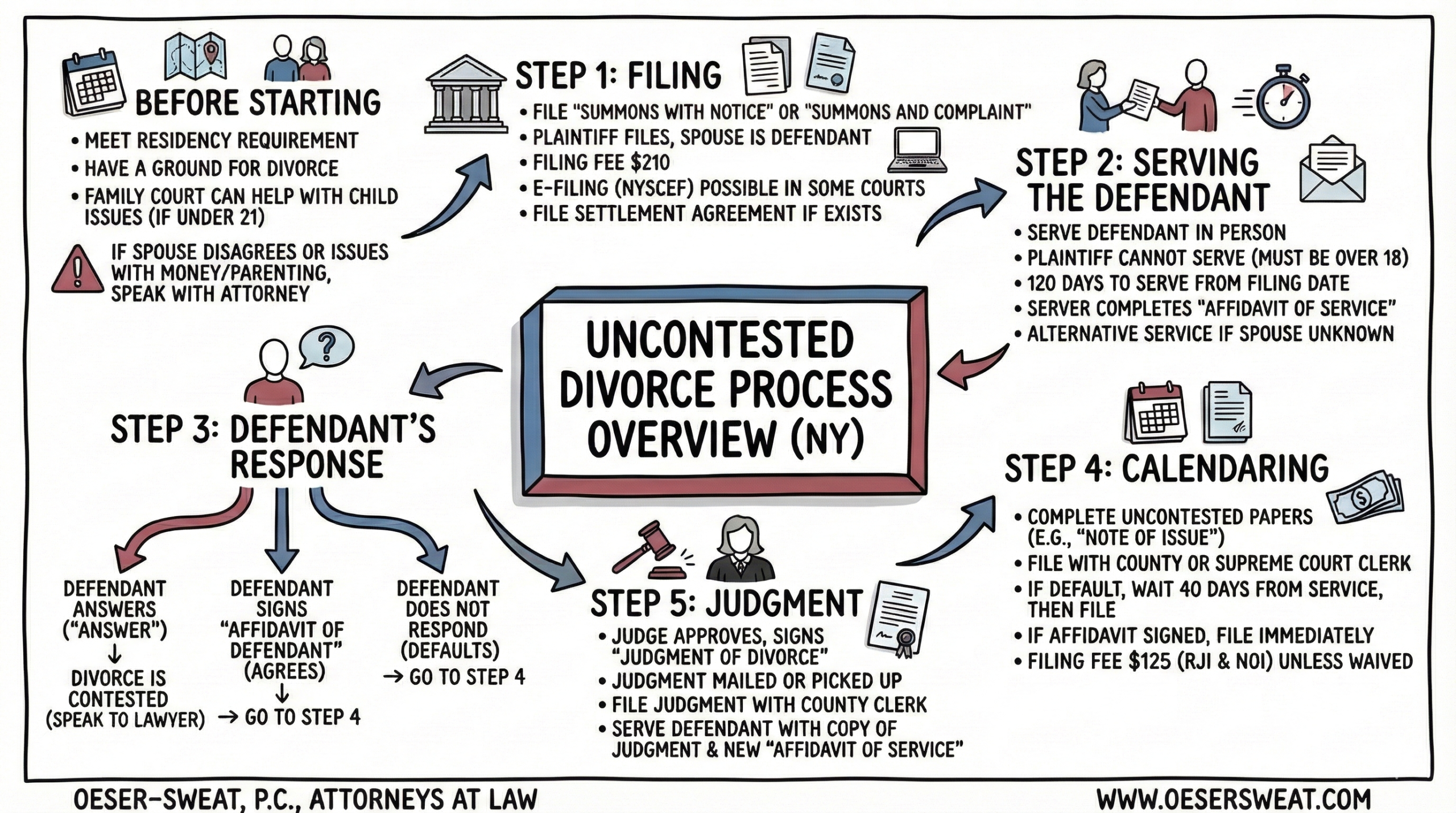
    Infographic: The step-by-step roadmap of the Uncontested Divorce Process.
    Figure 1: The Roadmap to Judgment
    View Text Description of Figure 1

    1. Purchase Index Number: File Summons with Notice or Summons and Complaint.

    2. Service of Process: Personally serve the defendant within 120 days.

    3. Defendant Defaults or Consents: The Defendant signs an “Affidavit of Defendant” agreeing to the divorce, or fails to respond.

    4. Note of Issue: File papers to place the case on the calendar (if necessary).

    5. Submission of Packet: Submit Findings of Fact, Conclusions of Law, and Judgment.

    6. Judgment Signed: The Judge or Referee signs the final decree.

    1. Filing the Case: The Venue Rule (CPLR 515)

    Before you even fill out a form, you must know where to file. As of early 2025, the new CPLR § 515 mandates that you file for divorce in a county where at least one of the parties or their minor children resides. You can no longer pick a distant “rocket docket” county just because it processes papers faster. If you live in Queens, you file in Queens.

    2. Is It Really Uncontested? The “Notice of No Necessity”

    Technically, every divorce is “contested” until it is settled. However, the court gives you a window of opportunity to work things out.

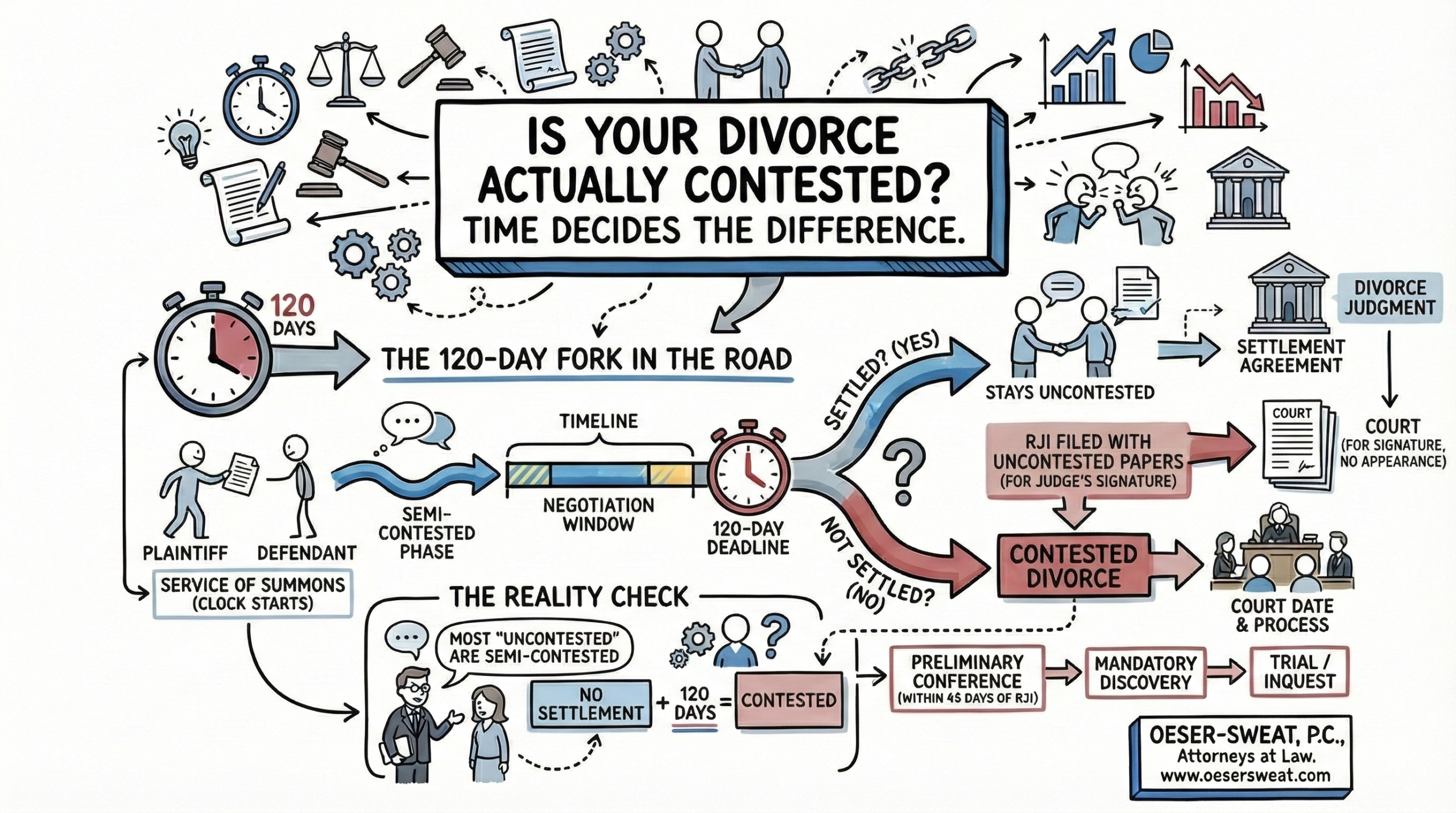
    After the Summons is served, if you and your spouse believe you can settle without judicial intervention, you can file a document called a “Notice of No Necessity.” This extends the deadline to file a Request for Judicial Intervention (RJI) from 45 days to 120 days.

    The 120-Day Clock: If you settle within this period, you proceed as an uncontested divorce. If you do not settle within 120 days, the case becomes technically contested, and you must request a Preliminary Conference. At that point, it follows the standard litigation track.
    Graphic: Flowchart determining if a divorce is truly uncontested based on agreement on custody, support, and assets.
    Figure 2: The “Semi-Contested” Reality Check
    View Text Description of Figure 2

    The Agreement Test: Do both parties agree on Custody? Support? Asset Division? If YES to all, it is Uncontested.

    The Time Factor: Even if you agree, if you miss the deadlines or fail to sign the papers, the court treats it as contested to force movement.

    The “No Necessity” Path: Using the 120-day window to finalize terms without seeing a judge.

    3. The “Uncontested Packet”

    If you reach a settlement, you don’t just tell the judge “we agree.” You must draft a massive stack of specific legal documents known as the “Uncontested Divorce Packet.” This replaces a trial. Instead of testifying on a witness stand, you provide “written testimony” through sworn affidavits.

    Key Documents in the Packet:

    • Affidavit of Plaintiff: Your sworn story stating the grounds for divorce and that you meet the residency requirements.
    • Affidavit of Defendant: Your spouse’s sworn statement admitting service and consenting to the divorce (or waiving their right to answer).
    • Findings of Fact & Conclusions of Law: A document you draft for the Judge to sign, summarizing the legal “facts” of the marriage and the “conclusions” (that you are entitled to a divorce).
    • Judgment of Divorce: The final decree that legally ends the marriage.

    If there are children under 21, you must also submit child support worksheets and specific language regarding custody and health insurance to ensure compliance with the Child Support Standards Act (CSSA).

    4. Submission and Judgment

    Once the packet is assembled, it is submitted to the Matrimonial Clerk’s office. A court attorney (referee) reviews every line to ensure it complies with the law. If there is a mistake—even a missing social security number or a math error in child support—the packet will be “defected” (rejected), and you will have to fix it. If approved, the Judge signs the Judgment, and you are officially divorced.

  • New Divorce Venue Rules

    The End of the “Rocket Docket”: New Divorce Venue Rules

    Why you can no longer “shop” for a court, and why filing in your home county is now the law.

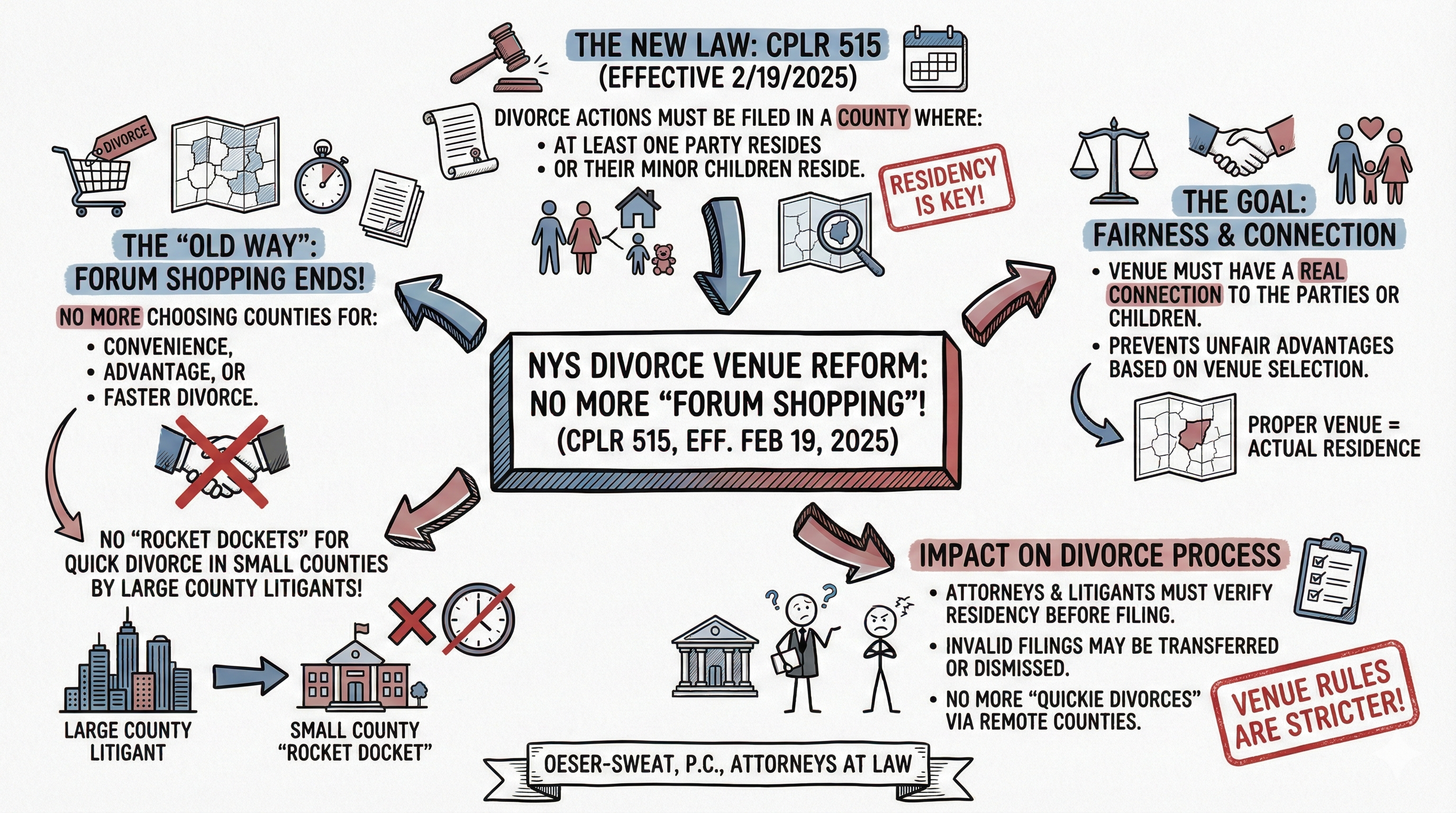
    For years, getting a “quickie divorce” in New York often meant filing your paperwork in a tiny county hundreds of miles away—a place where neither you nor your spouse had ever lived. This practice, of using a “Rocket Docket,” allowed litigants from crowded counties like New York or Kings to skip the line. As of February 19, 2025, that door has been slammed shut.

    Graphic: No More Forum Shopping. Visual illustrating that you must file where you live.
    Figure 1: The New Rule – No More Shopping for Better Courts
    View Text Description of Graphic

    The Old Way: People living in busy areas (like NYC) would file in distant, quiet counties to get a judgment faster.

    The New Way (CPLR 515): You must file in a county where the Plaintiff, the Defendant, or their minor children actually reside.

    The Goal: Fairness. To ensure local courts handle local families and prevent wealthy litigants from “buying” a faster divorce.

    1. What Exactly Changed? (CPLR 515)

    Under the new law, CPLR § 515, you are no longer allowed to pick a court based on convenience or speed. The law now mandates that a divorce action must be filed in a county where:

    • The Plaintiff (the person filing) resides; OR
    • The Defendant (the other spouse) resides; OR
    • Their minor children reside.

    Before this change, law firms often advised clients to file in counties hours upstate. Why? Because those court clerks had fewer cases and could sign a Judgment of Divorce in weeks, whereas a Downstate court might take months. This created a system where people were “shopping” for the best court.

    2. The “Rocket Docket” Trap

    While the old way seemed faster, it carried a hidden danger that this new law eliminates. Under the old system, if you filed in a county 4 hours away because it was “fast,” you were taking a gamble. If your “uncontested” divorce suddenly became “contested” (meaning your spouse disagreed with something), that distant court would still be the one handling your case.

    The Danger: If the court upstate refused to allow remote (video) appearances, you and your lawyer would have to drive 4 hours each way for every 15-minute conference. This turned a “cheap, fast” divorce into an expensive logistical nightmare.

    3. Exceptions to the Rule

    The legislature understood that sometimes, you need to hide your location. CPLR 515(b) provides strict exceptions where you can still file in a different county (as allowed by CPLR 509):

    • Confidentiality Orders: If your address is confidential due to a court order (like in Domestic Violence cases under DRL §254 or Family Court Act §154-b).
    • Address Not Public: If the addresses of the parties and children are not matters of public record.
    • Good Cause: A judge can still allow a case to proceed in a different county if you can prove there is a very good reason (“good cause”) to do so, though “convenience” is no longer enough.

    4. What This Means for You

    If you are looking to get divorced, you must plan to file locally. While it might feel frustrating to wait in line with everyone else in your home county, this rule ensures that if issues regarding custody or support arise, the court handling them is in the same community where your children actually sleep at night.

  • Legal Separation & Conversion Divorce

    Legal Separation & Conversion Divorce

    Using a Separation Agreement to negotiate terms now and divorce later.

    Not every marriage ends with an immediate divorce filing. For couples who agree that the marriage is over but are not ready to divorce—whether for health insurance reasons, religious beliefs, or simply a need to “cool off”—New York offers a powerful alternative: the Separation Agreement. If executed correctly, this agreement can not only resolve all your issues today but serve as the guaranteed basis for a divorce one year later.

    Infographic: The timeline and process of a Conversion Divorce based on a Separation Agreement.
    Figure 1: From Agreement to Conversion Divorce
    View Text Description of Graphic

    1. Negotiation: The parties negotiate all terms of the split (Custody, Support, Property) while still married.

    2. Execution: The Separation Agreement is drafted, signed, and formally acknowledged (notarized like a deed).

    3. Filing: The Agreement is filed with the County Clerk (Fee: $210) to obtain an Index Number.

    4. The Cooling Off Period: The parties must live separate and apart for at least one year.

    5. Conversion: After one year, either party may file for divorce using the Agreement as the specific ground (DRL 170.6).

    1. New York’s 7 Grounds for Divorce

    To get divorced in New York, you must state a legal reason, or “ground.” While most people today use the “No-Fault” ground (Irretrievable Breakdown), the law actually provides seven distinct options:

    1. Cruel and Inhuman Treatment
    2. Abandonment
    3. Imprisonment (3+ consecutive years)
    4. Adultery
    5. Living apart pursuant to a Decree or Judgment of Separation (DRL § 170(5))
    6. Living apart pursuant to a written Agreement of Separation (DRL § 170(6))
    7. Irretrievable Breakdown (“No-Fault”)

    This guide focuses on Ground #6. Unlike Ground #5, which requires a lawsuit and a Judge’s order (a “Separation Judgment”), Ground #6 allows you to control the process privately through a contract.

    2. The “Conversion” Divorce Process

    A “Conversion Divorce” is essentially turning a Separation Agreement into a Divorce Judgment after a waiting period. This is the path for couples who can agree on terms upfront.

    Step A: The Separation Agreement

    This is a contract where you and your spouse agree to live apart. It must resolve the issues of the marriage, including:

    • Child Support & Custody: You cannot ignore the kids. The court will not grant a divorce later if support guidelines aren’t followed.
    • Equitable Distribution: Who keeps the house? The car? The pension?
    • Spousal Maintenance: Will one party pay alimony?

    Step B: The Formalities (The Trap!)

    WARNING: A Separation Agreement is not valid if it is just signed on a napkin. Under New York law, it must be “subscribed by the parties, and acknowledged or proved in the form required to entitle a deed to be recorded.”

    If the notary acknowledgment is missing or incorrect, the agreement cannot be used as grounds for divorce later. This is the most common mistake in DIY separations.

    Step C: Filing & Fees

    Once signed, the Agreement (or a Memorandum of the Agreement) should be filed with the County Clerk in the county where either party resides. The current filing fee is $210. This establishes the official start date of your separation.

    Step D: The One-Year Wait

    You must live separate and apart for one year after the agreement is signed. If you move back in together with an intent to reconcile, you may void the agreement and have to start the clock over.

    3. Why Choose Separation Over Divorce?

    Why wait a year? There are several strategic reasons:

    • Health Insurance: Once a divorce is final, a non-employee spouse usually loses coverage under the other spouse’s plan. A Legal Separation allows the parties to live apart while maintaining insurance coverage (though you must check your specific policy).
    • Religion: Some couples have religious objections to divorce but can no longer live together.
    • Financial Stability: It allows parties to lock in financial terms now while emotional tensions cool, without the finality of a divorce judgment.

    4. The End Game: Filing the Divorce

    After the year has passed, either party can file a Summons and Complaint for divorce. The “Ground” for the divorce is simply that you have substantially complied with the terms of the Separation Agreement for one year. The terms of your agreement are then incorporated into the final Divorce Judgment.

  • Pendente Lite Relief: Survival During Divorce

    Pendente Lite Relief: Survival During Divorce

    How to secure temporary support, custody, and exclusive occupancy while your divorce is pending.

    Divorce cases in New York can take months or even years to resolve. But mortgages, tuition, and grocery bills are due today. If your spouse has cut off your access to funds, locked you out of accounts, or is hiding assets, you cannot wait for the final trial. You need Pendente Lite (Latin for “pending the litigation”) relief immediately.

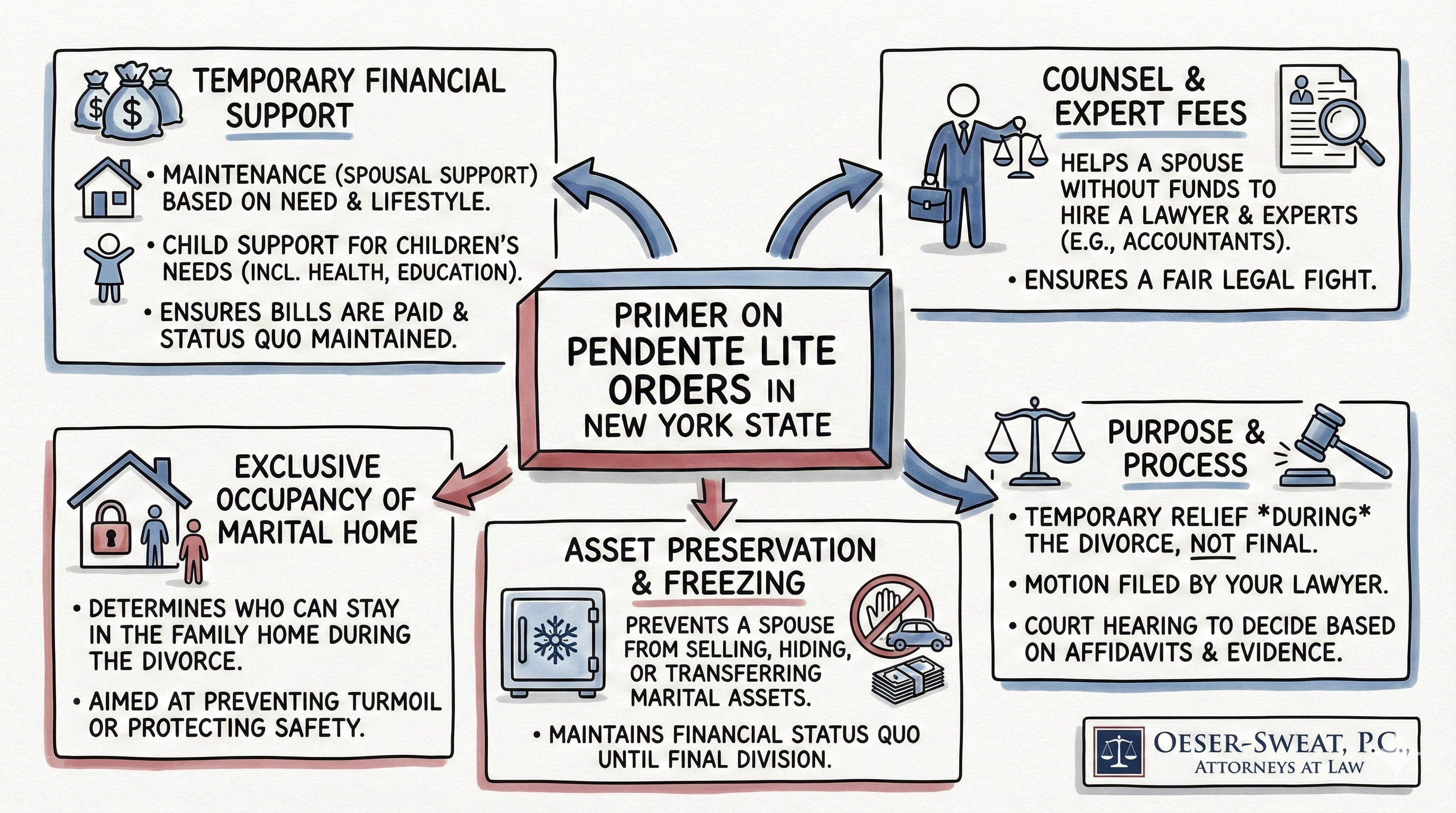
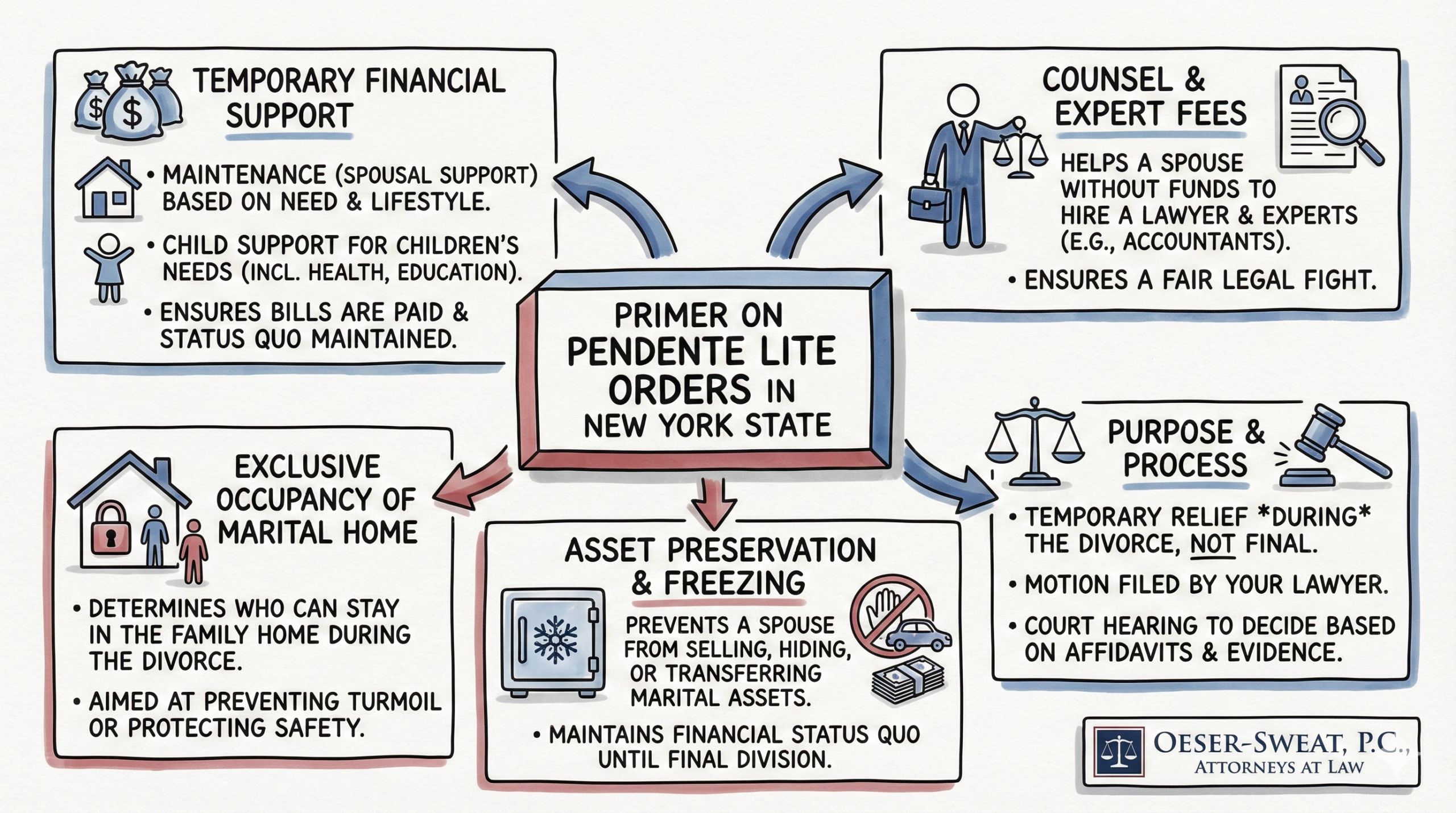
    Graphic: Overview of Pendente Lite Relief - Defining the concept of temporary orders during litigation.
    Figure 1: The Concept of Pendente Lite Relief
    View Text Description of Figure 1

    Definition: Pendente Lite is a temporary order issued by the Supreme Court while a divorce case is ongoing.

    Purpose: To maintain the “status quo,” prevent financial starvation of the less wealthy spouse, and ensure bills are paid.

    Scope: It can cover temporary maintenance (alimony), child support, interim counsel fees, and exclusive occupancy of the marital home.

    Method: It is not automatic; it requires filing a formal motion (Notice of Motion or Order to Show Cause) with a Statement of Net Worth.

    1. What is Pendente Lite Relief?

    A “Pendente Lite Order” is a temporary court order that dictates who pays for what, who lives where, and who the children stay with while the divorce is in progress. The purpose is to maintain the status quo and ensure the lower-income spouse (“non-monied spouse”) is not starved into a bad settlement.

    Key Concept: The Motion
    This relief is not automatic. You must file a formal written application to the court, known as a Motion for Pendente Lite Relief (via Notice of Motion or Order to Show Cause). The court decides based on the papers you submit.

    2. The Financial Lifelines: Support and Fees

    When you ask the court for financial help, the Judge looks at specific legal factors (often cited in sample decisions like the one provided in our sidebar):

    • Temporary Maintenance (Alimony): The court considers the standard of living established during the marriage (Hartog v. Hartog, 85 N.Y.2d 36, 623 N.Y.S.2d 537, 647 N.E.2d 749 (1995)). The goal is to make sure you can support yourself now.
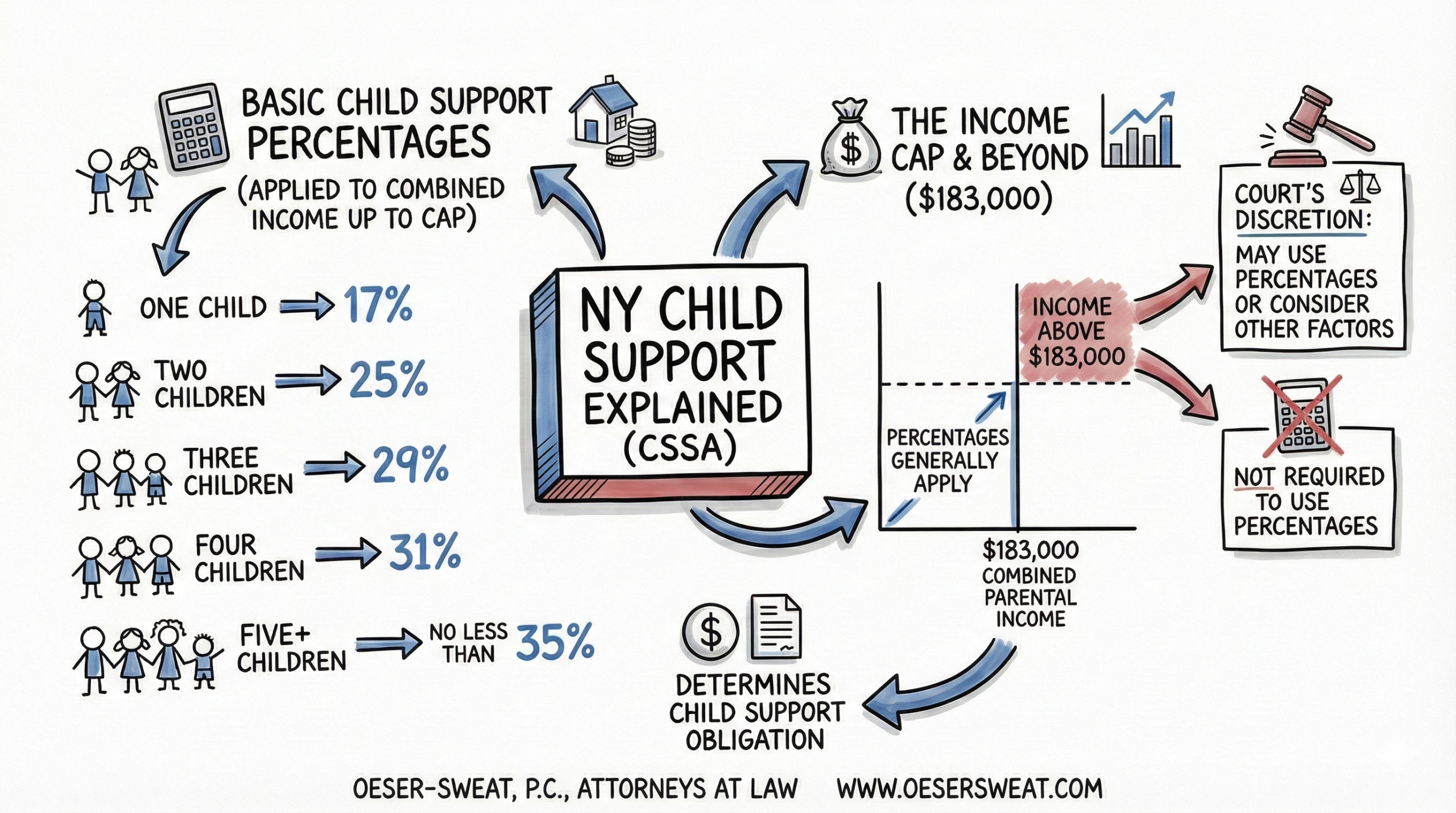
    • Child Support: The court applies the Child Support Standards Act (CSSA). They look at the combined income and apply the standard percentages (17% for one child, 25% for two, etc.), even on a temporary basis.
    • Interim Counsel Fees: Under DRL §237, there is a presumption that the “monied spouse” should pay the legal fees of the “non-monied spouse.” This is to ensure a level playing field so the wealthier spouse cannot out-spend you in litigation. (DeCabrera v. Cabrera-Rosete, 70 N.Y.2d 879, 524 N.Y.S.2d 176 (1987)).
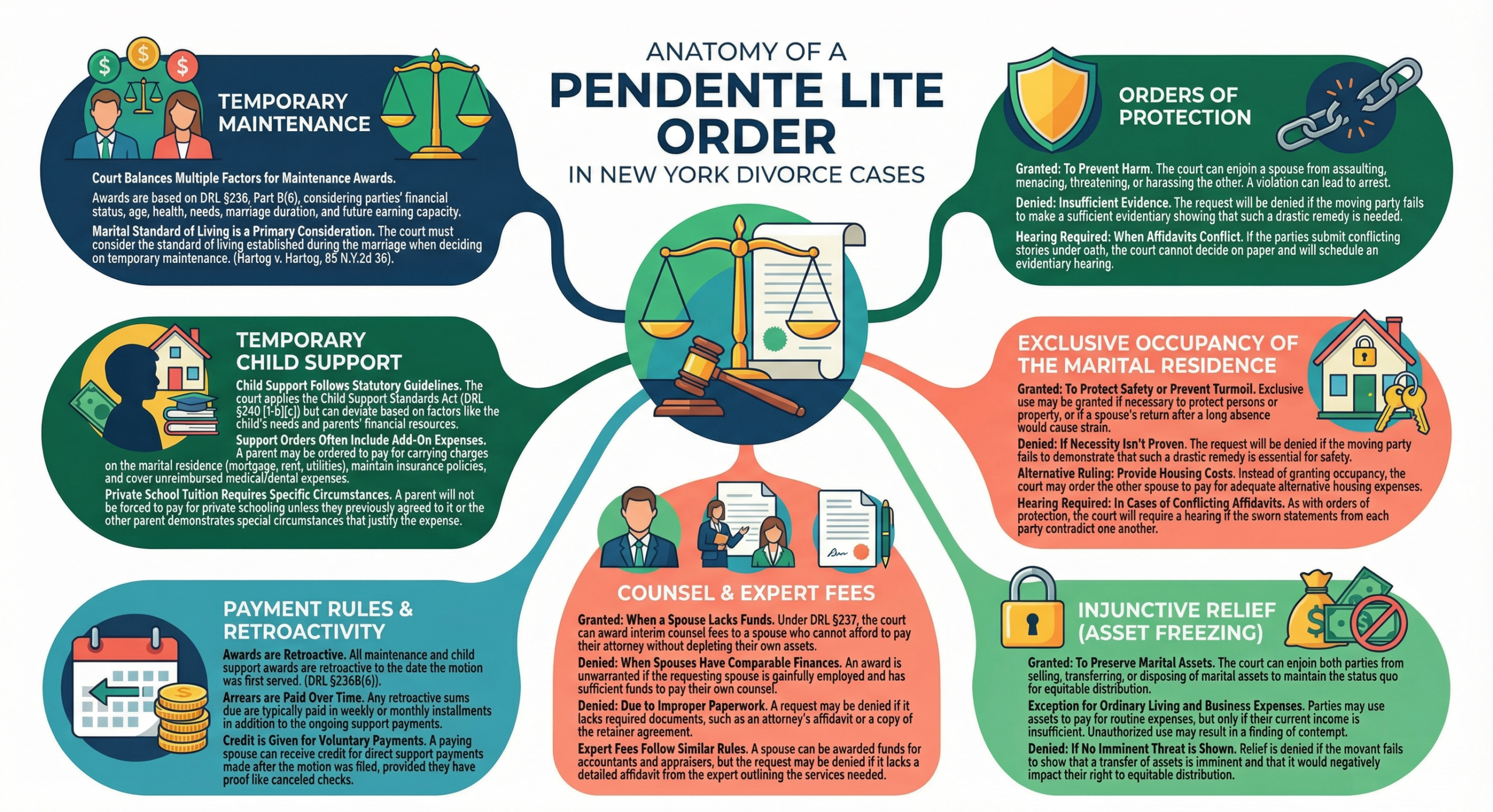
    Graphic: Breakdown of a Pendente Lite Order - Showing sections for Maintenance, Child Support, and Counsel Fees.
    Figure 2: The Anatomy of a Temporary Order
    View Text Description of Figure 2

    Key Components: A typical order breaks down obligations into distinct categories.

    Maintenance Calculation: Shows the court using statutory formulas based on income caps (often capped at approx. $228,000 for maintenance).

    Child Support: Calculated separately after maintenance is deducted, using the standard 17%/25% percentages.

    Carrying Charges: Often directs the monied spouse to directly pay the mortgage, utilities, and insurance (known as “carrying charges”) to prevent foreclosure or shut-offs.

    Retroactivity: The order emphasizes that amounts are owed from the date the motion was served, often creating immediate “arrears” (debt).

    3. Drastic Remedies: Occupancy and Restraints

    Sometimes money isn’t the only issue; safety or dissipation of assets is the concern. You can ask for:

    Exclusive Use and Occupancy

    This asks the court to kick your spouse out of the marital home while the case is pending. This is a drastic remedy. Courts rarely grant it unless you can show:

    • Physical violence or threats to safety; or
    • That the spouse’s presence causes “domestic strife and turmoil” so severe it damages the mental health of you or the children (Judell v. Judell, 128 A.D.2d 416, 512 N.Y.S.2d 693 (1st Dept. 1987)).
    • Note: If a spouse has voluntarily left for a long period (e.g., 30+ days), it can potentially be easier to get an order keeping them out.

    Restraining Orders (Injunctions)

    If you fear your spouse is hiding money or selling assets, you can ask for an injunction preventing the transfer of assets. The court will usually grant this to maintain the financial status quo, with an exception allowed for “ordinary and routine living expenses.”

    4. The Traps: Retroactivity and Credits

    WARNING: Retroactivity
    Pendente Lite awards are often retroactive to the date you served the motion papers. This means if it takes the Judge 3 months to decide, the payor may owe 3 months of back support immediately.

    Conversely, the paying spouse may be entitled to a credit for voluntary payments made during that time. If you are the higher earner, keeping receipts of every bill you pay while the motion is pending is critical (Peltz v. Peltz, 110 A.D.3d 1030, 973 N.Y.S.2d 762 (2013)).

    5. Filing the Application

    To succeed, you generally need three documents:

    1. Affidavit: Your sworn story detailing the finances, the need for support, and any safety issues.
    2. Statement of Net Worth: A mandatory New York form detailing every expense (rent, food, clothing) and asset. If this is incomplete, your motion may be denied.
    3. Attorney Affirmation: The legal arguments supporting your request.
  • Calculating Child Support in New York

    Calculating Child Support in New York

    A definitive guide to the Child Support Standards Act (CSSA), Pendente Lite support, and navigating the courts.

    Child support is not a punishment for one parent or a reward for the other; under New York law, it is the fundamental right of the child to be supported by their parents. Whether you are in Supreme Court for a divorce or in Family Court for a support petition, the math used to determine the obligation is strict, statutory, and largely unavoidable.

    Infographic: The New York Child Support Standards Act (CSSA) Calculation Process.
    Figure 1: The Step-by-Step Formula for Determining Support Obligations
    View Text Description of Graphic

    1. Calculate Income: Determine gross income for both parents as reported on the most recent tax return.

    2. Deductions: Subtract mandatory deductions like FICA (Social Security/Medicare) and NYC/Yonkers local taxes. This results in Adjusted Gross Income.

    3. Combined Income: Add both parents’ Adjusted Gross Incomes together.

    4. Apply Percentage: Multiply the combined income by the statutory percentage: 17% (1 child), 25% (2), 29% (3), 31% (4), 35%+ (5 or more).

    5. Pro Rata Share: Divide the total obligation between parents based on their specific contribution to the total combined income.

    1. The Formula: Child Support Standards Act (CSSA)

    New York does not guess at child support numbers. It uses a rigid formula known as the CSSA. The court looks at the “Combined Parental Income” and applies a percentage based on how many children you have:

    • 1 Child: 17% of combined parental income
    • 2 Children: 25% of combined parental income
    • 3 Children: 29% of combined parental income
    • 4 Children: 31% of combined parental income
    • 5 or More: No less than 35%

    This percentage applies to the combined income up to a statutory cap (which adjusts annually, currently approx. $183,000 as of 2024). For income over that cap, the court has the discretion to apply the same percentage or use a different calculation based on the “Paragraph F” factors (standard of living, special needs, etc.).

    2. The “Add-Ons”: It’s Not Just the Base Check

    The monthly check calculated by the percentage above is the “Basic Child Support Obligation.” However, parents can also be responsible for mandatory “add-ons” which are split pro-rata (based on who earns more). These include:

    • Health Insurance: The cost of premiums to cover the child.
    • Unreimbursed Medical: Co-pays, dental, and optical costs not covered by insurance.
    • Child Care: Costs incurred so a parent can work or attend school.
    • Education: In some cases, private school or tutoring costs.

    3. Supreme Court vs. Family Court

    Where you file depends on your marital status and the stage of your case.

    Supreme Court (The Divorce Forum)

    If you are getting divorced, child support is handled as part of the matrimonial action in Supreme Court. You do not need to go to a separate building. In fact, if a divorce is pending, Family Court generally cannot touch support issues unless the Supreme Court refers it there.

    Critical Concept: Pendente Lite Support
    Divorces can take years. Likely, you cannot wait until the trial is over to feed your children or pay tuition. In Supreme Court, a parent can file a Motion for Pendente Lite Relief (temporary support).

    To succeed on this motion, you must submit a detailed Statement of Net Worth, current pay stubs, and tax returns. The court uses the CSSA guidelines to calculate temporary support immediately. This “temporary” order often sets the tone for the final settlement, so it must be taken seriously.

    Family Court

    If you are not married, or if your divorce is already finished and you need to modify the order, you go to Family Court. Here, a “Support Magistrate” (not a Judge) usually hears the case. The process begins by filing a Petition. If you fail to appear for a hearing, a default judgment can be entered against you.

    4. What Needs to Be Shown?

    To get a court to set support, you do not need to prove the other parent is “bad.” Many times you only need to prove:

    1. The legal parent-child relationship exists.
    2. The child is under 21 (New York’s age of emancipation for support).
    3. The financial income of both parties.

    Warning on “Hidden” Income: If a parent claims they have no income but lives a lavish lifestyle, the court can “impute” income to them—basically pretending they earn what they should be earning based on their education and past employment history.

  • Prenuptial Agreements: A Roadmap for Your Marriage

    Prenuptial Agreements: A Roadmap for Your Marriage

    Why having “the conversation” now can protect your future and strengthen your partnership.

    For many, the mention of a Prenuptial Agreement feels like an accusation. If you are being pressured by family or a fiancé to sign one, it is natural to feel defensive. However, viewed correctly, a prenup is not about planning for divorce—it is about defining the rules of your marriage on your own terms, rather than letting the state decide for you.

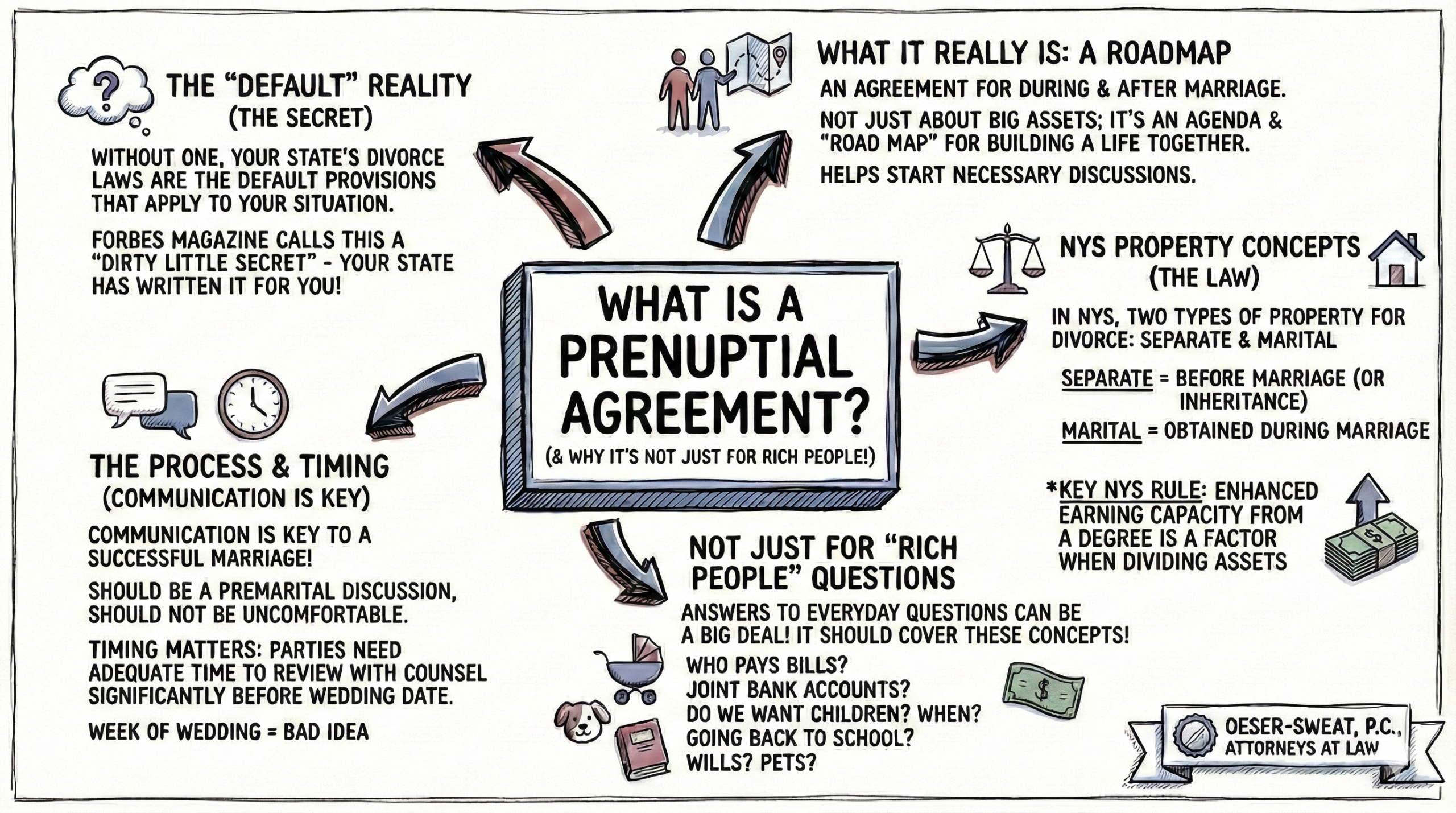
    Infographic: Understanding Prenuptial Agreements. A guide to planning your financial future together.
    Figure 1: Turning Uncomfortable Conversations into a Life Plan
    View Text Summary of Graphic

    The Default Prenup: The infographic reminds readers that everyone already has a prenup—it’s called “State Law.” If you don’t write your own, the state’s default rules apply to your assets.

    The Conversation: Encourages couples to use crayons, chalk, or fun methods to discuss serious topics to lower the tension.

    Timing Warning: “Week of Wedding = Bad Idea.” Agreements signed under time pressure are vulnerable to being overturned by a court.

    Scope: A prenup is an agenda for discussion: Children, career goals, parents living in the home, and property division.

    1. The Legal Requirement: DRL §236(B)(3)

    In New York, a prenuptial agreement is a powerful document, but only if it strictly follows the law. Under Domestic Relations Law §236(B)(3), an agreement must be:

    • In writing;
    • Subscribed (signed) by the parties; AND
    • Acknowledged or proven in the manner required to entitle a deed to be recorded.

    This “acknowledgment” requirement is critical. A simple notary stamp is often not enough; specific language is required. If these technical formalities are missed, the entire agreement can be tossed out years later.

    2. Designing Your “Lifestyle Agenda”

    If you are feeling pressured, try shifting the focus from “assets” to “lifestyle.” A well-crafted agreement plans for the everyday realities of your life together:

    • Finances: Will you have a joint bank account for bills? Who contributes what percentage?
    • Career & Education: If one spouse goes back to school, is that degree marital property? Who pays for the tuition?
    • Family Dynamics: What happens if an aging parent needs to move in?

    Use the agreement to have these difficult conversations now, when you love each other, rather than fighting about them later.

    3. What You CANNOT Include

    While you have broad freedom to contract, there are lines you cannot cross. Courts generally will not enforce provisions regarding:

    • Child Custody: You cannot pre-determine who gets the kids. The court always decides based on the “best interests of the child” at the time of divorce.
    • Child Support: You cannot waive your child’s right to support.
    • “Lifestyle Clauses”: Penalties for gaining weight or not visiting in-laws are often viewed as unenforceable or frivolous by New York courts.

    4. The Danger Zone: Timing & Counsel

    The closer you are to the wedding date, the more scrutiny a court will apply to the agreement. If a prenup is presented on the eve of the wedding (“Sign this or the wedding is off”), it may be challenged later on the grounds of duress.

    You Need Independent Counsel: It is practically mandatory that both sides have their own lawyer. One lawyer cannot ethically represent both parties in a prenup. If you are being asked to sign an agreement written by your fiancé’s wealthy family lawyers, you must have your own advocate to review it and explain what you are giving up.

  • Contested Divorce Process in New York

    Understanding the Contested Matrimonial Case Process

    A visual guide and explanation of the divorce timeline in New York State.

    Navigating a contested divorce can be one of the most complex legal challenges a person faces. The process involves multiple stages, strict deadlines, and specific legal filings. We have created the infographic below to simplify this timeline and help you understand where you stand in the process.

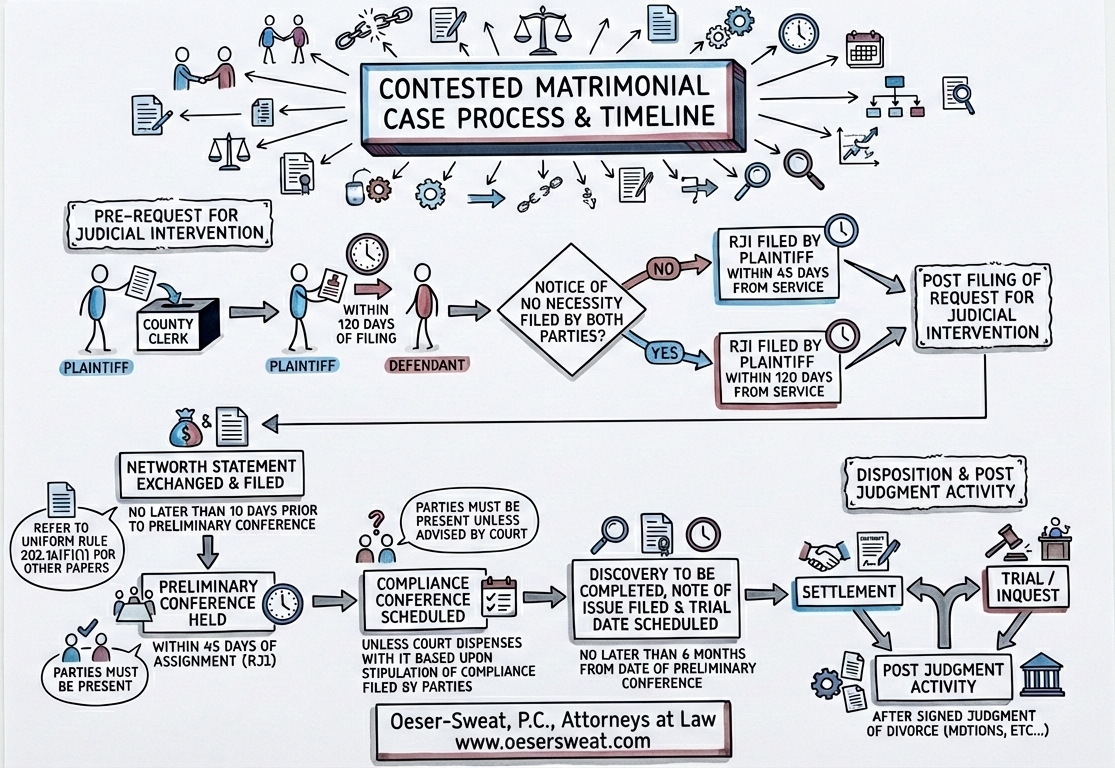
    Flowchart illustrating the 7 stages of a contested matrimonial case in New York. Full text description available below.
    Figure 1: The Standard Timeline for Contested Matrimonial Cases
    View Text Description of Infographic

    Step 1: Commencement. The Plaintiff files a Summons with Notice or Summons and Verified Complaint with the County Clerk.

    Step 2: Service. The Defendant must be personally served within 120 days of filing.

    Step 3: Response. The Defendant serves a Notice of Appearance or Verified Answer.

    Step 4: RJI. Request for Judicial Intervention is filed to assign a judge.

    Step 5: Discovery & Compliance. Both parties exchange financial documents (Net Worth Statements). Preliminary Conference is held.

    Step 6: Trial or Settlement. Note of Issue is filed signaling readiness for trial. If no settlement is reached, the case proceeds to trial.

    Step 7: Judgment. The Judge signs the Judgment of Divorce.

    1. Commencement of the Action

    Every matrimonial case begins with the filing of a “Summons with Notice” or a “Summons and Complaint.” This serves as the formal notification to the court that a legal action has begun. In New York, the person filing is the “Plaintiff” and the other spouse is the “Defendant.”

    2. The Preliminary Conference (PC)

    The PC is the first major court appearance. The judge will set a timeline for the rest of the case, including deadlines for discovery and dates for future appearances. It is vital to have experienced counsel at this stage to ensure the schedule is realistic for your situation.

    3. The Discovery Phase

    Once the case is active, both parties engage in “Discovery.” This is crucial for ensuring equitable distribution of marital property. You will be required to produce:

    • Statements of Net Worth
    • Tax Returns (3-5 years)
    • Real Estate Appraisals
    • Pension and Retirement Account Statements

    Failure to disclose assets during this phase can lead to severe penalties from the court.

    4. Compliance Conference(s)

    The Compliance Conference is a conference in which the parties come together to show the court how far they have gotten in the case and whether they have complied with the requirements of the previously issued court orders (PC Order, etc.) Often a new Order outlining next steps is signed by a judge in order to ensure the case moves along.

    4. Completion of Discovery & Filing of Note of Issue

    Once Discovery is completed, a Note of Issue must be filed. A trial date is usually scheduled at this point.

    What happens if the case doesn’t settle?

    All cases are moving towards a trial date. If a case settles before the court schedules a trial and holds one, a packet of documents is filed with the court by the parties and if it is acceptable to the court, Findings of Fact, Conclusions of Law and a Judgment of Divorce are issued. Otherwise there is a trial, which can lead to the same outcome, with the court deciding these items in its sole discretion rather than the parties agreeing in advance to the items contained therein.

    © 2026 Oeser-Sweat, P.C. All Rights Reserved. Attorney Advertising.
    Prior results do not guarantee a similar outcome.

  • Considering a Divorce in New York

    Considering a Divorce in New York?

    Understanding the grounds, residency requirements, and the difference between contested and uncontested proceedings.

    We know that the process is never as simple as it seems. Our goal is not to provide a one-size-fits-all solution—every divorce is different. This guide familiarizes those contemplating divorce with the essential decisions needed to determine whether to end their marriage.

    1. Residency Requirements (Jurisdiction)

    To file for divorce in New York, you must have specific ties to the state. You cannot simply move here and file immediately. You generally meet the requirements if:

    • Continuous Residency (2 Years): Either spouse has lived in NY continuously for at least two years before filing.
    • Residency (1 Year) + Link: Either spouse lived in NY for one year AND (1) you married in NY, (2) lived in NY as a couple, or (3) the grounds happened in NY.
    • Current Residents + Grounds: Both are residents on the day of filing AND the grounds for divorce happened in NY.

    2. You Need a Reason (Grounds)

    New York requires a legal reason to end the marriage. While “No-Fault” is the most common, others still exist in the law.

    Irretrievable Breakdown

    The relationship has broken down irretrievably for a period of at least 6 months. This is the most common ground (“No-Fault”).

    Cruel & Inhuman Treatment

    Specific acts that endanger the physical or mental well-being of the spouse, making it unsafe to cohabit.

    Abandonment

    Voluntary separation for at least one year without consent.

    Imprisonment / Adultery

    Imprisonment for 3+ years or commission of adultery are also valid grounds.

    3. Contested vs. Uncontested

    The cost and speed of your divorce depend entirely on whether you and your spouse can agree.

    Uncontested

    Your spouse agrees to the divorce AND agrees on ALL terms (custody, support, property). This is faster and less expensive.

    Contested

    Your spouse does not agree to the divorce OR disagrees on specific terms. This requires judicial intervention.

    4. The Process Overview

    1

    File Papers

    Purchase an Index Number and file the Summons with Notice or Summons and Complaint.

    2

    Serve Your Spouse

    Your spouse must be personally served with the papers. They will either answer or default.

    3

    Resolution

    The case is disposed of by Settlement or Trial/Inquest.

    Judgment of Divorce

    The Court signs the Judgment. Congrats, you are single!