
Category: Client Information

  • SCAnDi: Single-cell and single molecule analysis for DNA identification

    SCAnDi: Single-cell and single molecule analysis for DNA identification.

    The end of the “DNA Smoothie?”

    Why prosecutors and defense attorneys need to watch this novel single-cell DNA technology.

    DNA evidence has long been considered the “gold standard” of forensic science. But it has a major weakness: mixtures. When multiple people touch the same object, their DNA gets blended together, often leading to inconclusive results. A new technology currently in development, SCAnDi (Single-cell and Single Molecule Analysis for DNA Identification), promises to solve this problem by analyzing individual cells before they are mixed.
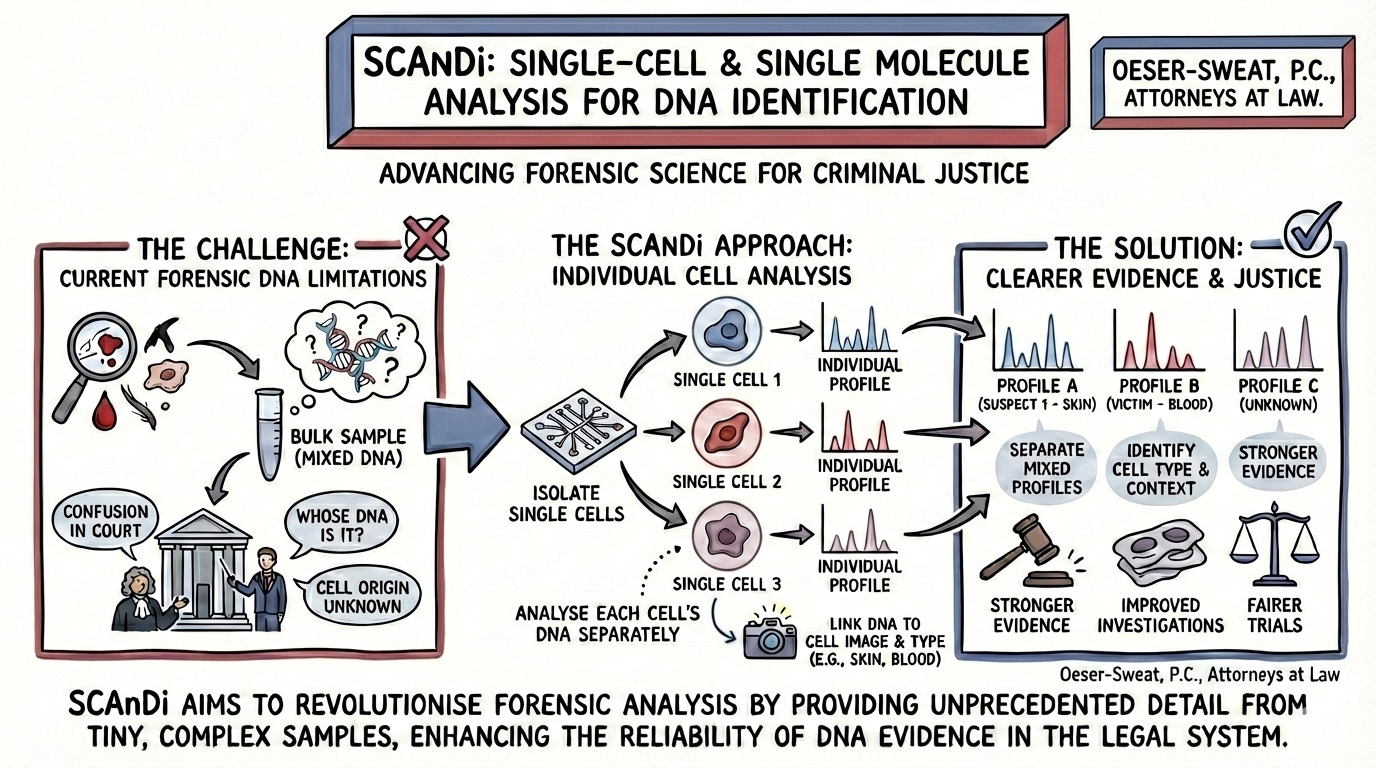
    Infographic: How SCAnDi technology separates individual cells from a mixed DNA sample to create clear profiles.
    Figure 1: The Goal-Moving from “Bulk Mixtures” to Single-Cell Precision
    View Text Description of Infographic

    The Old Way (“DNA Smoothie”): Current methods take a bulk sample (e.g., a swab from a doorknob) and mash all the DNA together. If three people touched it, you get a mixed profile that is hard to interpret.

    The SCAnDi Way: This new tech uses a flow cytometer or similar device to physically separate individual cells before DNA extraction. Each cell is analyzed separately.

    The Result: Instead of a mixture, you get distinct profiles: Profile A (Suspect), Profile B (Victim), and Profile C (Unknown), with no ambiguity.

    1. The Problem: The “DNA Smoothie”

    Current forensic methods rely on “bulk samples.” Imagine a crime scene doorknob touched by the victim, the suspect, and a police officer. When the lab processes the swab, they extract DNA from all three people simultaneously. To a scientist, this looks like a “DNA Smoothie”—a jumbled mix of genetic code.

    Analysts then have to use statistical software (like STRmix) to try to “unmix” the smoothie and guess the probability that a specific person contributed. This often leads to results that are inconclusive or open to fierce debate in court.

    2. The Proposed Solution: SCAnDi

    SCAnDi stands for Single-cell and Single Molecule Analysis for DNA Identification. Instead of blending the sample, SCAnDi uses advanced technology to pick out individual cells one by one.

    • Isolation: The machine isolates a single cell from Person A and a single cell from Person B.
    • Analysis: It extracts a clean, “pristine” DNA profile from each specific cell.
    • Context: Beyond just identity, SCAnDi can potentially tell us what kind of cell it is. It could prove, for example, that the DNA on a jacket came specifically from saliva (implying spitting or biting) rather than skin cells (implying casual contact).

    3. Prosecution vs. Defense: The Upcoming Battle

    Prosecution Perspective: “The End of Ambiguity”
    For prosecutors, SCAnDi is the “Holy Grail.” It moves forensics away from “likelihood ratios” and probabilities toward definitive identifications. It could solve cold cases where samples were previously too mixed to be useful.
    Defense Perspective: “New Science, New Risks”
    Defense attorneys must view this with skepticism. If a machine is sensitive enough to find a single cell, how do we prove that cell wasn’t transferred by a gust of air or “innocent transfer” (secondary touch)? Finding a single skin cell doesn’t prove presence at a crime scene if we shed millions of cells a day.

    4. Current Legal Status: Not Court-Ready

    It is critical to note that SCAnDi is currently a research project. It looks like a very promising scientific endeavor. However, there are some current caveats. It has not yet been accepted as evidence in United States courts yet. Before a jury ever sees SCAnDi results, the technology must pass the Frye or Daubert legal standards. This requires:

    • Peer Review: Publication in scientific journals.
    • Testing: Proof of reliability and known error rates.
    • General Acceptance: Consensus in the scientific community.

    Researchers at institutions like Edge Hill University and the Earlham Institute are currently refining the process and working to advance the science. This work may be groundbreaking. Lawyers on both sides should be watching this space closely.

  • Considering a Divorce in New York

    Considering a Divorce in New York?

    Understanding the grounds, residency requirements, and the difference between contested and uncontested proceedings.

    We know that the process is never as simple as it seems. Our goal is not to provide a one-size-fits-all solution—every divorce is different. This guide familiarizes those contemplating divorce with the essential decisions needed to determine whether to end their marriage.

    1. Residency Requirements (Jurisdiction)

    To file for divorce in New York, you must have specific ties to the state. You cannot simply move here and file immediately. You generally meet the requirements if:

    • Continuous Residency (2 Years): Either spouse has lived in NY continuously for at least two years before filing.
    • Residency (1 Year) + Link: Either spouse lived in NY for one year AND (1) you married in NY, (2) lived in NY as a couple, or (3) the grounds happened in NY.
    • Current Residents + Grounds: Both are residents on the day of filing AND the grounds for divorce happened in NY.

    2. You Need a Reason (Grounds)

    New York requires a legal reason to end the marriage. While “No-Fault” is the most common, others still exist in the law.

    Irretrievable Breakdown

    The relationship has broken down irretrievably for a period of at least 6 months. This is the most common ground (“No-Fault”).

    Cruel & Inhuman Treatment

    Specific acts that endanger the physical or mental well-being of the spouse, making it unsafe to cohabit.

    Abandonment

    Voluntary separation for at least one year without consent.

    Imprisonment / Adultery

    Imprisonment for 3+ years or commission of adultery are also valid grounds.

    3. Contested vs. Uncontested

    The cost and speed of your divorce depend entirely on whether you and your spouse can agree.

    Uncontested

    Your spouse agrees to the divorce AND agrees on ALL terms (custody, support, property). This is faster and less expensive.

    Contested

    Your spouse does not agree to the divorce OR disagrees on specific terms. This requires judicial intervention.

    4. The Process Overview

    1

    File Papers

    Purchase an Index Number and file the Summons with Notice or Summons and Complaint.

    2

    Serve Your Spouse

    Your spouse must be personally served with the papers. They will either answer or default.

    3

    Resolution

    The case is disposed of by Settlement or Trial/Inquest.

    Judgment of Divorce

    The Court signs the Judgment. Congrats, you are single!

  • Was Your Business Interruption Insurance Claim Denied?

    Was Your Business Interruption Insurance Claim Denied?

    DENIAL OF BUSINESS INTERRUPTION INSURANCE CLAIMS

    Was Your Business Interruption Insurance Claim Denied?

    If your business:

    1. had business interruption insurance;

    2. had losses that exceeded or will exceed $100,000 by the middle of June 2020;

    3. submitted a business interruption claim AND it was denied OR has not submitted a claim yet;

    We may be able to help you file a lawsuit!

    FREQUENTLY ASKED QUESTIONS REGARDING BUSINESS INTERRUPTION INSURANCE

    WHAT IS BUSINESS INTERRUPTION INSURANCE? Collapse

    Business Interruption insurance is a product that compensates your business in the event of an occurrence specified in the policy. The occurrences covered typically included things that prevent your entity or venture from doing business such as a fire, a disaster, or some other event outside of your control.  Business interruption insurance often promises to provide compensation for financial losses, often using business records to predict what your business would have earned if the event at issue had not occurred.

    WHAT DO YOU DO IF YOUR BUSINESS INTERRUPTION INSURANCE CLAIM WAS DENIED? Expand

    If your business interruption insurance was denied, you should review your policy documents to see what options you may have.  If the losses tied to your claim exceed one hundred thousand dollars ($100,000.00), we may be able to help you file a lawsuit in order to obtain relief or some remedy.

    Many have already sued their carriers for declarations of coverage and improper refusal to honor their insurance contracts. Claims include bad faith, failure to investigate, failure to promptly pay claims, unfair settlement practices, breach of contract, and violations of various state insurance codes.

    WHY ARE SOME BUSINESS INTERRUPTION INSURANCE CLAIMS BEING DENIED? Expand

    Many business interruption insurance claims have been denied recently based on the argument that there was no direct damage to the business which would trigger coverage under the policy. The rationale behind such a denial is that the recent pandemic for instance might be caused by a virus and there might not be a direct relation between the damage caused by a virus to third parties and the business that is seeking to file a claim under a policy. Such an argument might be harder to make if a storm destroyed a building housing the business. In the case of COVID-19, denials have been reported on the ground that the virus has not directly impacted the business in a manner that would require payment under the business interruption insurance policy. Situations have also been reported in which insurance companies deny coverage for business interruption even if the loss was because the government issued stay in place orders or ordered people not to go to work or school and those circumstances led to a loss of business.


    Several insurance companies have stated that claims based on business losses incurred in connection with COVID-19 may not be covered and that policy documents should be consulted.

    See also:

    https://www.thehartford.com/coronavirus/businesses

    https://www.travelers.com/about-travelers/covid-19-business-interruption

    DOES MY INSURANCE COVER BUSINESS INTERRUPTIONS CAUSED BY DISEASE? Expand

    Your insurance policy documents will best give you an idea of whether your insurance policy covers interruptions caused by diseases, pandemics, or viruses.  Even if a policy includes pandemic coverage, it might not cover your current situation. In other cases, the policy may require a direct connection between the pandemic and the losses suffered by your business. It may not be enough to have insurance and losses.  The policy may require that you are directly affected in such a way as your building was contaminated or your employees were infected.


    The New York State Department of Financial Service has a very useful FAQ on Business Interruption Insurance and coronavirus/COVID-19.

    NEED TO SPEAK TO A LAWYER?

    Do you think you have a potential case? Looking for a lawyer? Contact us.

    SEE FORM BELOW
  • Virtual Attorney-Client Meeting Information

    Virtual Attorney-Client Meeting Information

    Oeser-Sweat, P.C. Virtual Attorney-Client Consultations

    Our firm is taking steps to ensure the safety of our clients and our attorneys!

    We built our firm on 21st Century Infrastructure!

    Virtual Meetings

    Our firm utilizes several virtual conferencing services, including Google Meet and Zoom in order to meet with clients.

    Get Zoom Meeting Rules and Protocals

    Schedule Meeting

    All consultations and meetings are subject to additional approval and may be canceled or rescheduled at the sole discretion of our firm.

    Schedule Meeting

    Get In Touch

    Don’t compete with the Robo-Callers! If you are looking to contact us, please use our intake or contact page.

    Contact Page

    Looking to Hire an Attorney? Check Out our Intake Page!

    Our firm utilizes a virtual intake page for new matters. This allows us to work more efficiently and effectively and make sure your inquiry gets where it should!

    Go to Intake Page
  • Client Discount Program

    Client Discount Program

    Oeser-Sweat, P.C. Client Perks

    Doing the Little Things for Oeser-Sweat, P.C. Clients

    As a courtesy to Oeser-Sweat, P.C. clients, we are offering Oeser-Sweat, P.C. Client Perks, a FREE savings program that provides discounted pricing through the Corporate Perks program.

    Oeser-Sweat, P.C. Client Perks leverages the purchasing power of all members and families to negotiate Corporate Rates on your behalf. Whether you are shopping for Electronics, Automobiles, Movie Tickets or anything else, save with member pricing at hundreds of manufacturers, retailers and brands in all these areas.

    As an added benefit, all members can invite up to five family members or close friends to access members.

    Corporate Rates on Car Rental

    With our Corporate Codes, you’ll save every time you rent a car!

    Monthly Discounts on Cell Phone Service

    Apply a corporate discount to your existing or new cell phone plans from Verizon, AT&T, or Sprint.

    Member Pricing on Computers & Software

    Pay the same as employees of Lenovo, HP, Dell, and Apple pay for their products!

    How to Sign On

    Oeser-Sweat, P.C. Client Perks is accessible on-line by computer as well as on your mobile device.

    1. Visit the program https://oesersweat.corporateperks.com
    2. Log in with your email and password. First time users: Click the “Register Now” button to set up your account.
    3. Start saving!

    FAQs

    If you have any questions regarding Oeser-Sweat, P.C. Client Perks, please download and consult our full list of FAQs here.

    You can also refer to the Oeser-Sweat, P.C. Perks Help Center for assistance with any issues you are having with the program.