Author: admin

  • Legal Separation & Conversion Divorce

    Legal Separation & Conversion Divorce

    Using a Separation Agreement to negotiate terms now and divorce later.

    Not every marriage ends with an immediate divorce filing. For couples who agree that the marriage is over but are not ready to divorce—whether for health insurance reasons, religious beliefs, or simply a need to “cool off”—New York offers a powerful alternative: the Separation Agreement. If executed correctly, this agreement can not only resolve all your issues today but serve as the guaranteed basis for a divorce one year later.
    Infographic: The timeline and process of a Conversion Divorce based on a Separation Agreement.
    Figure 1: From Agreement to Conversion Divorce
    View Text Description of Graphic

    1. Negotiation: The parties negotiate all terms of the split (Custody, Support, Property) while still married.

    2. Execution: The Separation Agreement is drafted, signed, and formally acknowledged (notarized like a deed).

    3. Filing: The Agreement is filed with the County Clerk (Fee: $210) to obtain an Index Number.

    4. The Cooling Off Period: The parties must live separate and apart for at least one year.

    5. Conversion: After one year, either party may file for divorce using the Agreement as the specific ground (DRL 170.6).

    1. New York’s 7 Grounds for Divorce

    To get divorced in New York, you must state a legal reason, or “ground.” While most people today use the “No-Fault” ground (Irretrievable Breakdown), the law actually provides seven distinct options:

    1. Cruel and Inhuman Treatment
    2. Abandonment
    3. Imprisonment (3+ consecutive years)
    4. Adultery
    5. Living apart pursuant to a Decree or Judgment of Separation (DRL § 170(5))
    6. Living apart pursuant to a written Agreement of Separation (DRL § 170(6))
    7. Irretrievable Breakdown (“No-Fault”)

    This guide focuses on Ground #6. Unlike Ground #5, which requires a lawsuit and a Judge’s order (a “Separation Judgment”), Ground #6 allows you to control the process privately through a contract.

    2. The “Conversion” Divorce Process

    A “Conversion Divorce” is essentially turning a Separation Agreement into a Divorce Judgment after a waiting period. This is the path for couples who can agree on terms upfront.

    Step A: The Separation Agreement

    This is a contract where you and your spouse agree to live apart. It must resolve the issues of the marriage, including:

    • Child Support & Custody: You cannot ignore the kids. The court will not grant a divorce later if support guidelines aren’t followed.
    • Equitable Distribution: Who keeps the house? The car? The pension?
    • Spousal Maintenance: Will one party pay alimony?

    Step B: The Formalities (The Trap!)

    WARNING: A Separation Agreement is not valid if it is just signed on a napkin. Under New York law, it must be “subscribed by the parties, and acknowledged or proved in the form required to entitle a deed to be recorded.”

    If the notary acknowledgment is missing or incorrect, the agreement cannot be used as grounds for divorce later. This is the most common mistake in DIY separations.

    Step C: Filing & Fees

    Once signed, the Agreement (or a Memorandum of the Agreement) should be filed with the County Clerk in the county where either party resides. The current filing fee is $210. This establishes the official start date of your separation.

    Step D: The One-Year Wait

    You must live separate and apart for one year after the agreement is signed. If you move back in together with an intent to reconcile, you may void the agreement and have to start the clock over.

    3. Why Choose Separation Over Divorce?

    Why wait a year? There are several strategic reasons:

    • Health Insurance: Once a divorce is final, a non-employee spouse usually loses coverage under the other spouse’s plan. A Legal Separation allows the parties to live apart while maintaining insurance coverage (though you must check your specific policy).
    • Religion: Some couples have religious objections to divorce but can no longer live together.
    • Financial Stability: It allows parties to lock in financial terms now while emotional tensions cool, without the finality of a divorce judgment.

    4. The End Game: Filing the Divorce

    After the year has passed, either party can file a Summons and Complaint for divorce. The “Ground” for the divorce is simply that you have substantially complied with the terms of the Separation Agreement for one year. The terms of your agreement are then incorporated into the final Divorce Judgment.
  • Pendente Lite Relief: Survival During Divorce

    Pendente Lite Relief: Survival During Divorce

    How to secure temporary support, custody, and exclusive occupancy while your divorce is pending.

    Divorce cases in New York can take months or even years to resolve. But mortgages, tuition, and grocery bills are due today. If your spouse has cut off your access to funds, locked you out of accounts, or is hiding assets, you cannot wait for the final trial. You need Pendente Lite (Latin for “pending the litigation”) relief immediately.

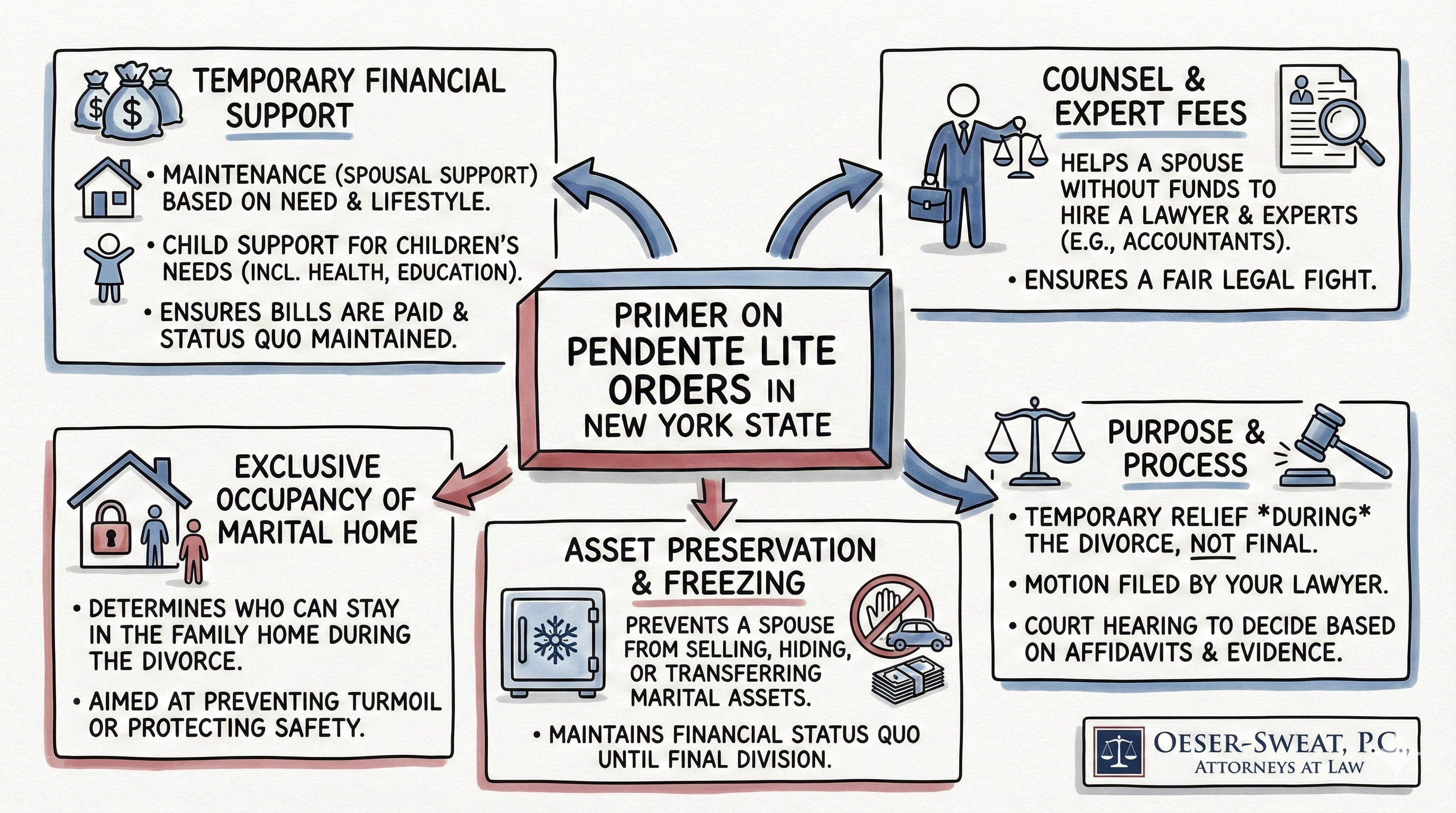
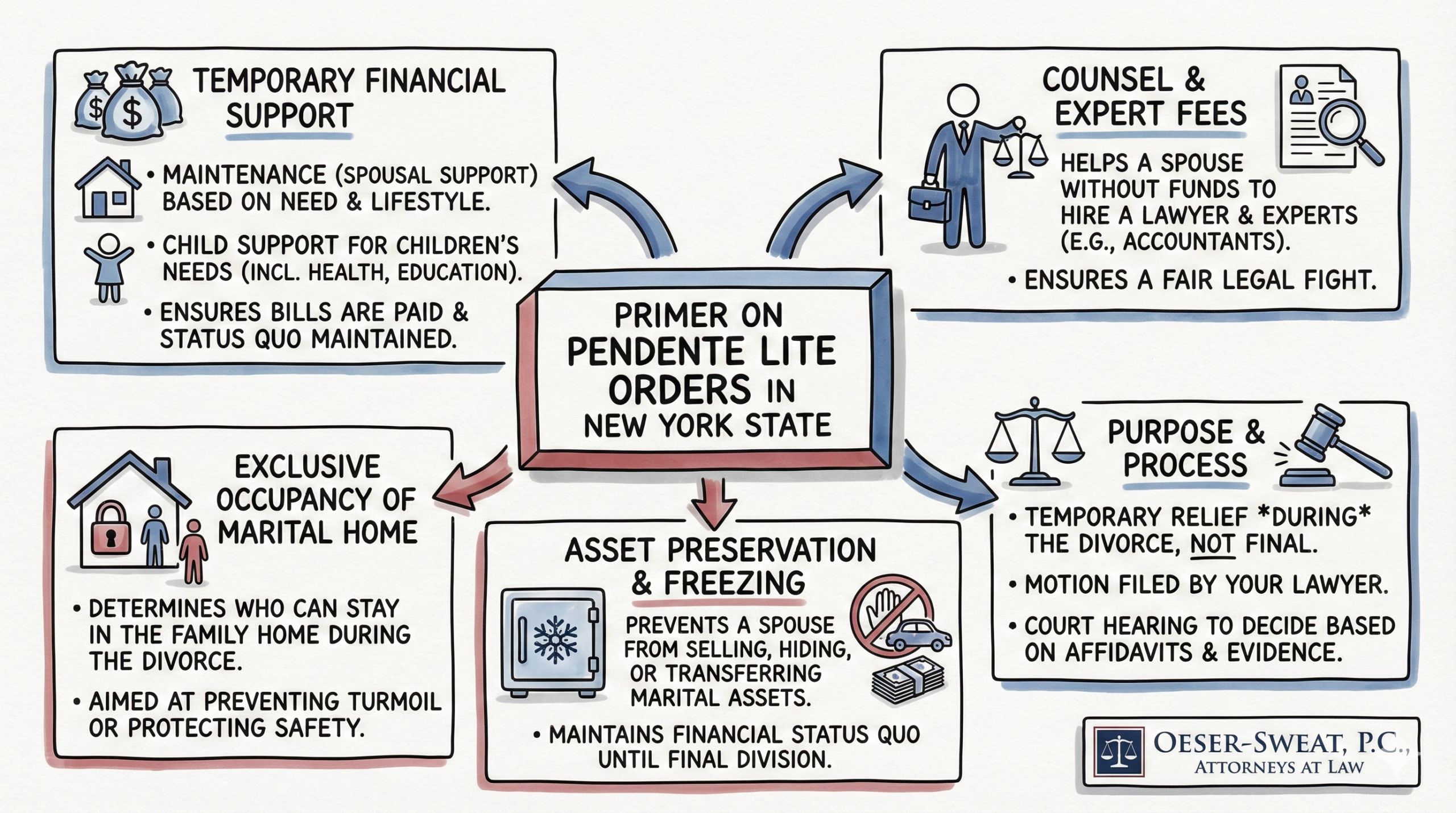
    Graphic: Overview of Pendente Lite Relief - Defining the concept of temporary orders during litigation.
    Figure 1: The Concept of Pendente Lite Relief
    View Text Description of Figure 1

    Definition: Pendente Lite is a temporary order issued by the Supreme Court while a divorce case is ongoing.

    Purpose: To maintain the “status quo,” prevent financial starvation of the less wealthy spouse, and ensure bills are paid.

    Scope: It can cover temporary maintenance (alimony), child support, interim counsel fees, and exclusive occupancy of the marital home.

    Method: It is not automatic; it requires filing a formal motion (Notice of Motion or Order to Show Cause) with a Statement of Net Worth.

    1. What is Pendente Lite Relief?

    A “Pendente Lite Order” is a temporary court order that dictates who pays for what, who lives where, and who the children stay with while the divorce is in progress. The purpose is to maintain the status quo and ensure the lower-income spouse (“non-monied spouse”) is not starved into a bad settlement.

    Key Concept: The Motion
    This relief is not automatic. You must file a formal written application to the court, known as a Motion for Pendente Lite Relief (via Notice of Motion or Order to Show Cause). The court decides based on the papers you submit.

    2. The Financial Lifelines: Support and Fees

    When you ask the court for financial help, the Judge looks at specific legal factors (often cited in sample decisions like the one provided in our sidebar):

    • Temporary Maintenance (Alimony): The court considers the standard of living established during the marriage (Hartog v. Hartog, 85 N.Y.2d 36, 623 N.Y.S.2d 537, 647 N.E.2d 749 (1995)). The goal is to make sure you can support yourself now.
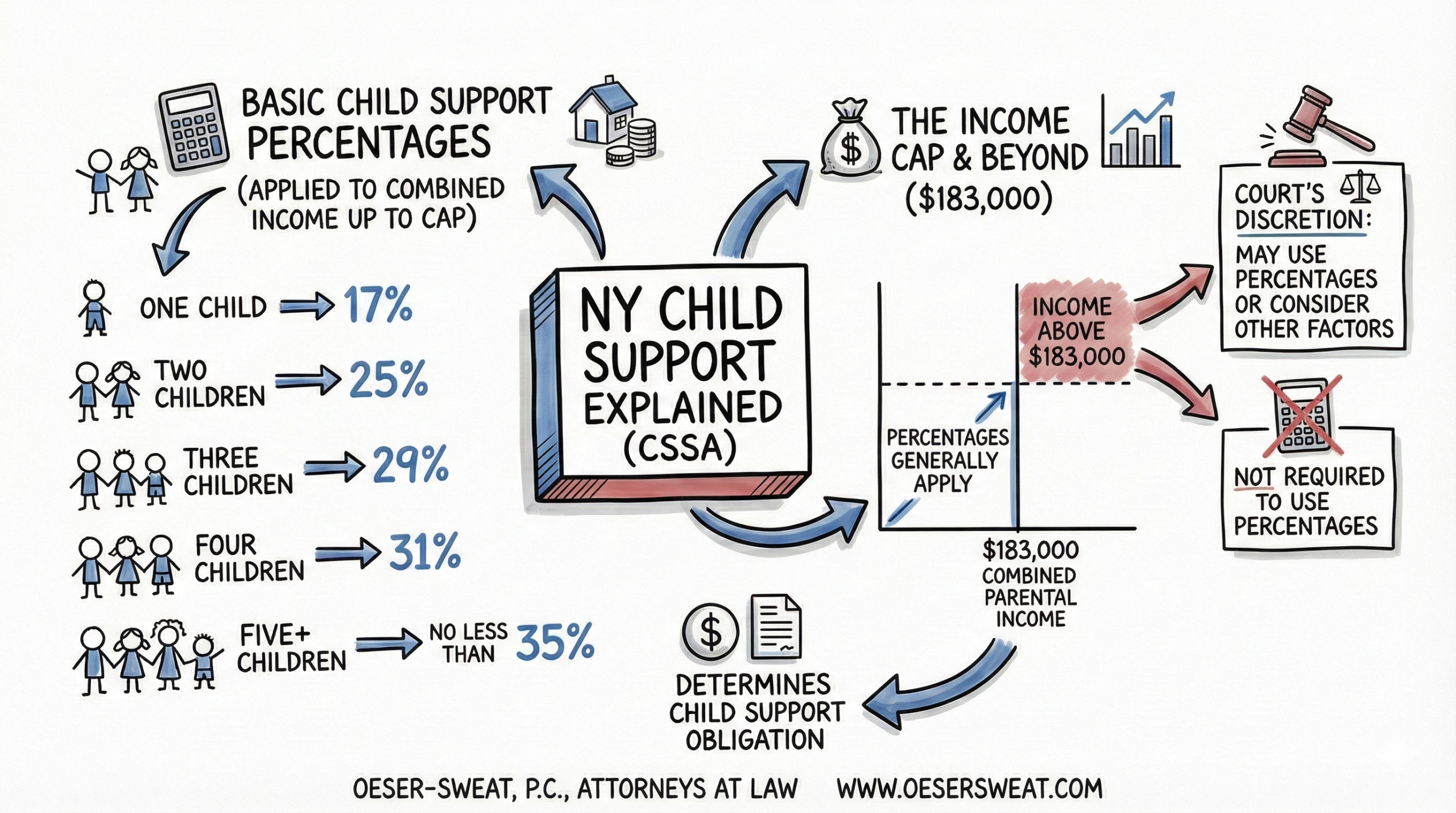
    • Child Support: The court applies the Child Support Standards Act (CSSA). They look at the combined income and apply the standard percentages (17% for one child, 25% for two, etc.), even on a temporary basis.
    • Interim Counsel Fees: Under DRL §237, there is a presumption that the “monied spouse” should pay the legal fees of the “non-monied spouse.” This is to ensure a level playing field so the wealthier spouse cannot out-spend you in litigation. (DeCabrera v. Cabrera-Rosete, 70 N.Y.2d 879, 524 N.Y.S.2d 176 (1987)).
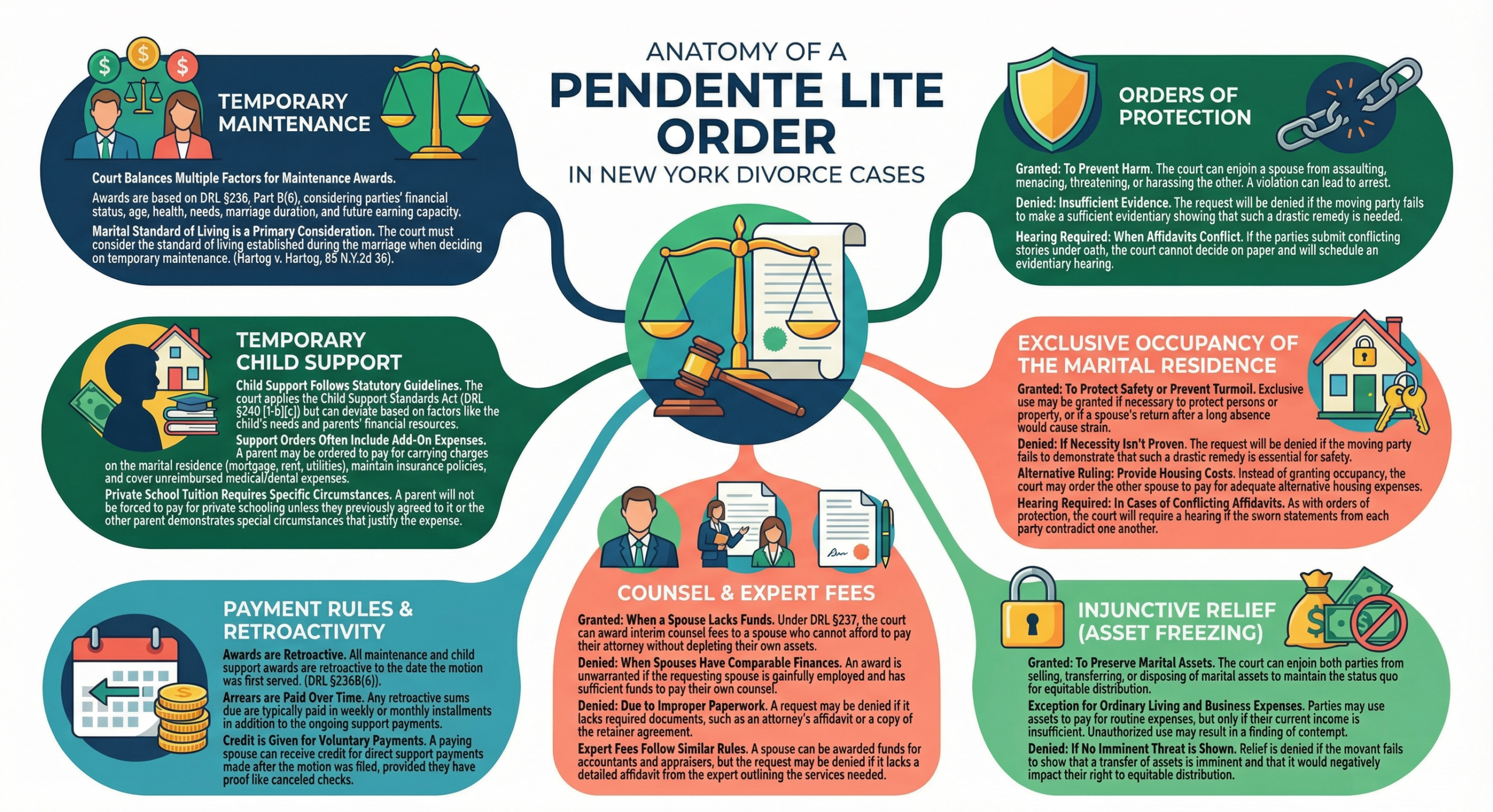
    Graphic: Breakdown of a Pendente Lite Order - Showing sections for Maintenance, Child Support, and Counsel Fees.
    Figure 2: The Anatomy of a Temporary Order
    View Text Description of Figure 2

    Key Components: A typical order breaks down obligations into distinct categories.

    Maintenance Calculation: Shows the court using statutory formulas based on income caps (often capped at approx. $228,000 for maintenance).

    Child Support: Calculated separately after maintenance is deducted, using the standard 17%/25% percentages.

    Carrying Charges: Often directs the monied spouse to directly pay the mortgage, utilities, and insurance (known as “carrying charges”) to prevent foreclosure or shut-offs.

    Retroactivity: The order emphasizes that amounts are owed from the date the motion was served, often creating immediate “arrears” (debt).

    3. Drastic Remedies: Occupancy and Restraints

    Sometimes money isn’t the only issue; safety or dissipation of assets is the concern. You can ask for:

    Exclusive Use and Occupancy

    This asks the court to kick your spouse out of the marital home while the case is pending. This is a drastic remedy. Courts rarely grant it unless you can show:

    • Physical violence or threats to safety; or
    • That the spouse’s presence causes “domestic strife and turmoil” so severe it damages the mental health of you or the children (Judell v. Judell, 128 A.D.2d 416, 512 N.Y.S.2d 693 (1st Dept. 1987)).
    • Note: If a spouse has voluntarily left for a long period (e.g., 30+ days), it can potentially be easier to get an order keeping them out.

    Restraining Orders (Injunctions)

    If you fear your spouse is hiding money or selling assets, you can ask for an injunction preventing the transfer of assets. The court will usually grant this to maintain the financial status quo, with an exception allowed for “ordinary and routine living expenses.”

    4. The Traps: Retroactivity and Credits

    WARNING: Retroactivity
    Pendente Lite awards are often retroactive to the date you served the motion papers. This means if it takes the Judge 3 months to decide, the payor may owe 3 months of back support immediately.

    Conversely, the paying spouse may be entitled to a credit for voluntary payments made during that time. If you are the higher earner, keeping receipts of every bill you pay while the motion is pending is critical (Peltz v. Peltz, 110 A.D.3d 1030, 973 N.Y.S.2d 762 (2013)).

    5. Filing the Application

    To succeed, you generally need three documents:

    1. Affidavit: Your sworn story detailing the finances, the need for support, and any safety issues.
    2. Statement of Net Worth: A mandatory New York form detailing every expense (rent, food, clothing) and asset. If this is incomplete, your motion may be denied.
    3. Attorney Affirmation: The legal arguments supporting your request.
  • Calculating Child Support in New York

    Calculating Child Support in New York

    A definitive guide to the Child Support Standards Act (CSSA), Pendente Lite support, and navigating the courts.

    Child support is not a punishment for one parent or a reward for the other; under New York law, it is the fundamental right of the child to be supported by their parents. Whether you are in Supreme Court for a divorce or in Family Court for a support petition, the math used to determine the obligation is strict, statutory, and largely unavoidable.

    Infographic: The New York Child Support Standards Act (CSSA) Calculation Process.
    Figure 1: The Step-by-Step Formula for Determining Support Obligations
    View Text Description of Graphic

    1. Calculate Income: Determine gross income for both parents as reported on the most recent tax return.

    2. Deductions: Subtract mandatory deductions like FICA (Social Security/Medicare) and NYC/Yonkers local taxes. This results in Adjusted Gross Income.

    3. Combined Income: Add both parents’ Adjusted Gross Incomes together.

    4. Apply Percentage: Multiply the combined income by the statutory percentage: 17% (1 child), 25% (2), 29% (3), 31% (4), 35%+ (5 or more).

    5. Pro Rata Share: Divide the total obligation between parents based on their specific contribution to the total combined income.

    1. The Formula: Child Support Standards Act (CSSA)

    New York does not guess at child support numbers. It uses a rigid formula known as the CSSA. The court looks at the “Combined Parental Income” and applies a percentage based on how many children you have:

    • 1 Child: 17% of combined parental income
    • 2 Children: 25% of combined parental income
    • 3 Children: 29% of combined parental income
    • 4 Children: 31% of combined parental income
    • 5 or More: No less than 35%

    This percentage applies to the combined income up to a statutory cap (which adjusts annually, currently approx. $183,000 as of 2024). For income over that cap, the court has the discretion to apply the same percentage or use a different calculation based on the “Paragraph F” factors (standard of living, special needs, etc.).

    2. The “Add-Ons”: It’s Not Just the Base Check

    The monthly check calculated by the percentage above is the “Basic Child Support Obligation.” However, parents can also be responsible for mandatory “add-ons” which are split pro-rata (based on who earns more). These include:

    • Health Insurance: The cost of premiums to cover the child.
    • Unreimbursed Medical: Co-pays, dental, and optical costs not covered by insurance.
    • Child Care: Costs incurred so a parent can work or attend school.
    • Education: In some cases, private school or tutoring costs.

    3. Supreme Court vs. Family Court

    Where you file depends on your marital status and the stage of your case.

    Supreme Court (The Divorce Forum)

    If you are getting divorced, child support is handled as part of the matrimonial action in Supreme Court. You do not need to go to a separate building. In fact, if a divorce is pending, Family Court generally cannot touch support issues unless the Supreme Court refers it there.

    Critical Concept: Pendente Lite Support
    Divorces can take years. Likely, you cannot wait until the trial is over to feed your children or pay tuition. In Supreme Court, a parent can file a Motion for Pendente Lite Relief (temporary support).

    To succeed on this motion, you must submit a detailed Statement of Net Worth, current pay stubs, and tax returns. The court uses the CSSA guidelines to calculate temporary support immediately. This “temporary” order often sets the tone for the final settlement, so it must be taken seriously.

    Family Court

    If you are not married, or if your divorce is already finished and you need to modify the order, you go to Family Court. Here, a “Support Magistrate” (not a Judge) usually hears the case. The process begins by filing a Petition. If you fail to appear for a hearing, a default judgment can be entered against you.

    4. What Needs to Be Shown?

    To get a court to set support, you do not need to prove the other parent is “bad.” Many times you only need to prove:

    1. The legal parent-child relationship exists.
    2. The child is under 21 (New York’s age of emancipation for support).
    3. The financial income of both parties.

    Warning on “Hidden” Income: If a parent claims they have no income but lives a lavish lifestyle, the court can “impute” income to them—basically pretending they earn what they should be earning based on their education and past employment history.

  • Fighting the System: The Article 78 Proceeding

    Fighting the System: The Article 78 Proceeding

    A definitive guide to challenging New York government agency decisions, denials, and abuses of power.

    When a New York State agency, local board, or public officer makes a decision that negatively affects you—whether it’s denying a license, terminating public housing, wrongly calculating a prison sentence, or firing a civil servant—you generally cannot sue them in a “normal” civil lawsuit. Instead, you must use a unique and powerful legal tool: the CPLR Article 78 Special Proceeding.

    This is not a trial with a jury. It is a fast-tracked review by a Supreme Court Judge to determine if the government followed the law. The stakes are high, the timelines are short, and the procedural traps are unforgiving.

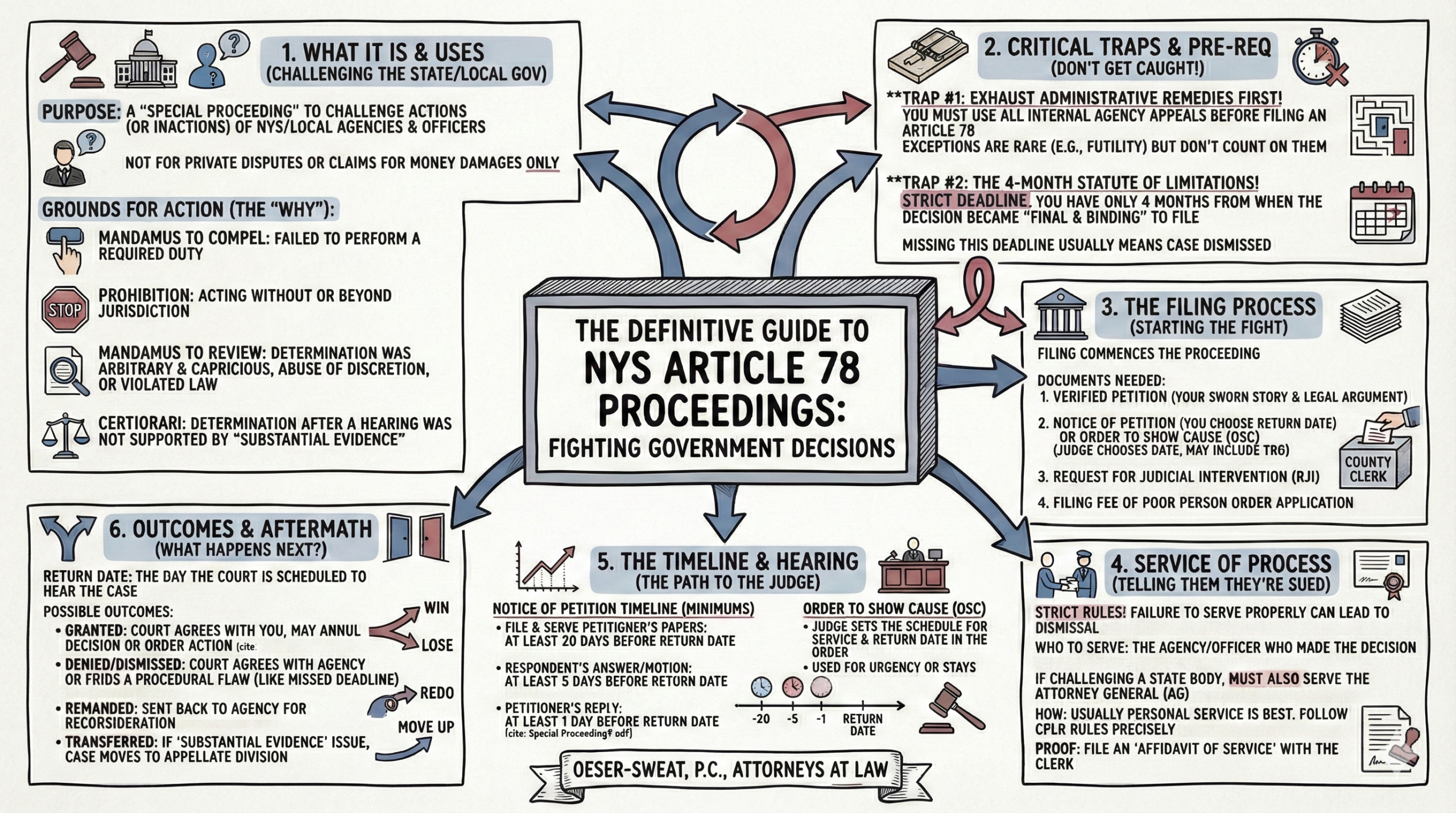
    Flowchart of the Article 78 Process: Agency Decision -> Exhaustion of Remedies -> 4 Month Statute of Limitations -> Filing -> Service -> Judgment.” 
                            class=”w-full h-auto rounded block”
                        />
                        <figcaption class= Figure 1: The Lifecycle of an Article 78 Proceeding
    View Text Description of Graphic

    1. The Agency Action: The process begins when an officer or agency makes a final determination or fails to act when required.

    2. Exhaustion of Remedies (CRITICAL): Before going to court, you must appeal internally within the agency (e.g., appeal to the Superintendent, then the Commissioner). Failing this gets your case dismissed.

    3. Statute of Limitations: You generally have exactly 4 months from the date the decision became final and binding to file your papers.

    4. Filing: You file a Notice of Petition (or Order to Show Cause) and Verified Petition with the Court Clerk and pay the fee.

    5. Service: You must serve the Agency AND the Attorney General. Strict proof of service is required.

    6. The Hearing: The Judge reviews the papers. There is rarely live testimony. The Judge issues a Judgment annulling the decision or dismissing the case.

    1. Grounds for Action: What Can You Challenge?

    You cannot use Article 78 simply because you disagree with a decision. You must fit your grievance into one of four specific legal categories established by CPLR § 7803:

    • Mandamus to Compel: Used when an agency failed to perform a duty required by law. (e.g., “The law says you must issue a decision within 30 days, and you have ignored me.”)
    • Mandamus to Review: The most common challenge. You argue the decision was “arbitrary and capricious” or an “abuse of discretion.” This means the decision lacked a rational basis or was made without regard to the facts.
    • Certiorari: Used to challenge a decision made after a formal trial-like hearing (with evidence and sworn testimony). The standard here is whether the decision was supported by “substantial evidence.”
    • Prohibition: Rare. Used to stop an official who is about to act without any legal jurisdiction or authority.

    2. The Two Deadly Traps: Exhaustion & Time

    WARNING: Most Article 78 cases filed by non-lawyers are dismissed not because they are wrong, but because they hit one of these two walls.

    Trap A: Exhaustion of Administrative Remedies

    You cannot run to court immediately after a low-level official says “no.” You must follow every step of the agency’s internal appeal process first.

    Example: If a prison Superintendent finds you guilty of a disciplinary infraction, you cannot file an Article 78 yet. You must first appeal to the Commissioner in Albany. Only after the Commissioner denies your appeal (or fails to rule in time) can you go to court. If you skip a step, the judge must dismiss your case.

    Trap B: The 4-Month Statute of Limitations

    The clock ticks fast. You generally have only 4 months from the date the agency’s decision becomes “final and binding” to file your papers in court. This is much shorter than the 3 years for negligence or 6 years for contracts. If you file 4 months and 1 day later, your case is dead.

    3. How to Commence the Proceeding

    An Article 78 is a “Special Proceeding,” meaning it moves faster than a normal lawsuit. Here is the procedural roadmap:

    A. The Papers

    You must prepare three main documents:

    1. Verified Petition: Your sworn statement telling the story. It must include the facts, the legal error the agency made, and what you want the court to do (e.g., “Annul the decision”). It must be “verified” (sworn to before a notary).
    2. Notice of Petition OR Order to Show Cause (OSC):
      • Notice of Petition: Used when you have plenty of time. You pick a court date at least 20 days away.
      • Order to Show Cause: Used if you are in a rush (e.g., you are about to be evicted or transferred) or if you are a prisoner who needs permission to serve papers by mail. The Judge signs this and picks the court date.
    3. Request for Judicial Intervention (RJI): A form that gets a Judge assigned to your case.

    B. Filing and Fees

    You file these papers with the County Clerk. The filing fee is generally $305 ($210 for the Index Number + $95 for the RJI). If you cannot afford this, you must file a “Poor Person’s Order” application with proof of your income to waive the fees.

    C. Service of Process

    Once you file and get an Index Number, you must “serve” (deliver) the papers to the other side. Strict Compliance is Required.

    • You must serve the Agency (Respondent).
    • You must ALSO serve the New York State Attorney General (if a State agency) or the Corporation Counsel (if a NYC agency).
    • You usually cannot mail the papers yourself unless the Judge gave you permission in an Order to Show Cause. Usually, a non-party over 18 must deliver them.

    4. The Judgment

    On the “Return Date,” the Judge takes the papers (oral argument is rare). The Judge will eventually issue a written Decision and Judgment. If you win, the Court may annul the agency’s decision or send it back for a new hearing. If you lose, you may have the right to appeal to the Appellate Division, but you must file a “Notice of Appeal” within 30 days.

  • How a Civil Lawsuit Works in NY Supreme Court

    How a Civil Lawsuit Works in NY Supreme Court

    A step-by-step guide for plaintiffs and defendants navigating the legal system.

    Whether you are suing someone for a breach of contract or you have been injured in an accident, entering the New York State court system can be intimidating. Understanding the procedural roadmap—from filing the first paper to receiving a judgment—is essential for anyone involved in a civil dispute.

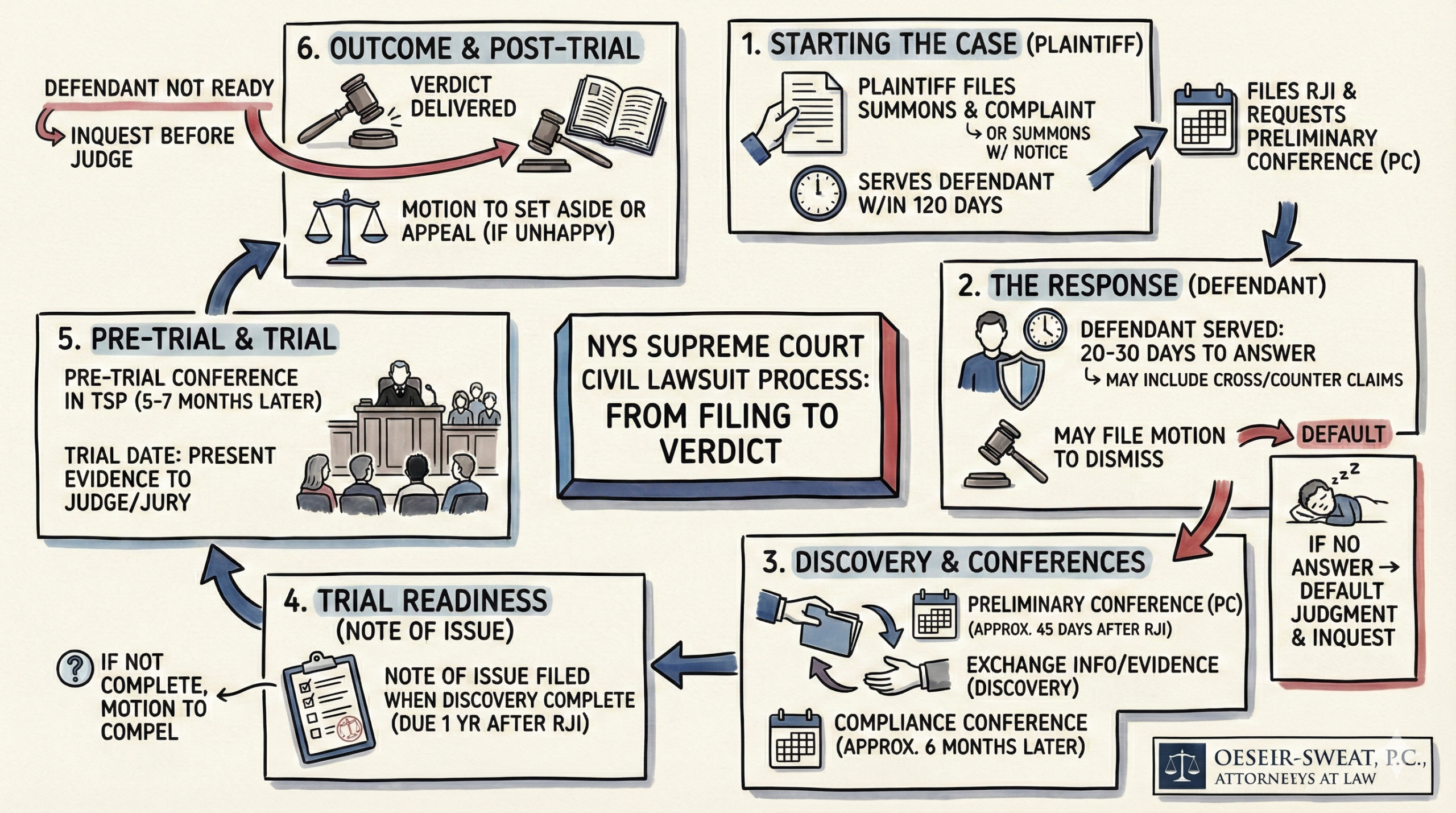
    Flowchart: The 7 Stages of a Civil Lawsuit in NYS Supreme Court. Detailed text description below.
    Figure 1: The Lifecycle of a Civil Case in New York
    View Text Description of Process Chart

    Step 1: Commencement. The Plaintiff files a Summons and Complaint (or Summons with Notice) with the County Clerk and pays the index number fee.

    Step 2: Service of Process. The papers must be legally delivered to the Defendant within 120 days. Proper service is critical for jurisdiction.

    Step 3: The Answer. The Defendant files a written response, admitting or denying allegations and asserting defenses.

    Step 4: Discovery. Both sides exchange evidence (documents, depositions, interrogatories) to learn the facts of the case.

    Step 5: Note of Issue. A document filed to tell the court that discovery is complete and the case is ready for trial.

    Step 6: Trial. The case is presented before a Judge (bench trial) or Jury to determine liability and damages.

    Step 7: Judgment. The final official decision of the court, which can be enforced to collect money or compel action.

    1. Where Do I File? Understanding Jurisdiction

    In New York, not all courts are created equal. You must file your case in the court that has the authority (“jurisdiction”) to hear it. The Supreme Court is the trial-level court of general jurisdiction, but it typically handles larger cases.

    • Supreme Court: Generally for cases where the amount in dispute is over $25,000. It also handles specific types of cases like divorce and major equity claims regardless of amount.
    • Civil Court (NYC) / District Court (Long Island): For disputes up to $50,000 (NYC) or $15,000 (District Courts).
    • Small Claims: For simple disputes up to $10,000 ($5,000 in some jurisdictions).

    2. Starting the Case: The Pleadings

    A lawsuit begins when the Plaintiff purchases an Index Number and files a Summons and Complaint. The Complaint tells the story: who did what, when they did it, and what you want (usually money). The Defendant then has a strict deadline (usually 20 or 30 days depending on service) to file an Answer. If they ignore it, they risk a “Default Judgment”—losing the case automatically.

    3. The Discovery Phase: No Surprises

    TV dramas often show surprise witnesses, but in real civil litigation, the goal is transparency. During Discovery, you are entitled to see the other side’s evidence. This includes:

    • Document Demands: requesting contracts, emails, medical records, or photos.
    • Depositions (EBTs): questioning the other party or witnesses under oath before a court reporter.

    This phase is often the longest part of the lawsuit, but it is where cases are won or lost.

    4. Motions and Resolutions

    Throughout the case, either side may file a Motion—a written request asking the Judge to do something. Common motions include:

    • Motion to Dismiss: Arguing the complaint is legally flawed.
    • Motion for Summary Judgment: Arguing that the facts are undisputed and the judge should decide the case without a trial.

    Most civil cases settle before trial. However, if no agreement is reached, the case proceeds to a trial where a verdict is rendered, leading to a final Judgment.

  • Understanding Intellectual Property: Protecting Your Ideas

    Understanding Intellectual Property: Protecting Your Ideas

    A guide to Trademarks, Copyrights, Patents, and Trade Secrets for business owners.

    For many entrepreneurs, the most valuable assets they own are not physical equipment or real estate, but intangible ideas. Understanding Intellectual Property (IP) is critical to safeguarding the unique identity and creative output of your business.

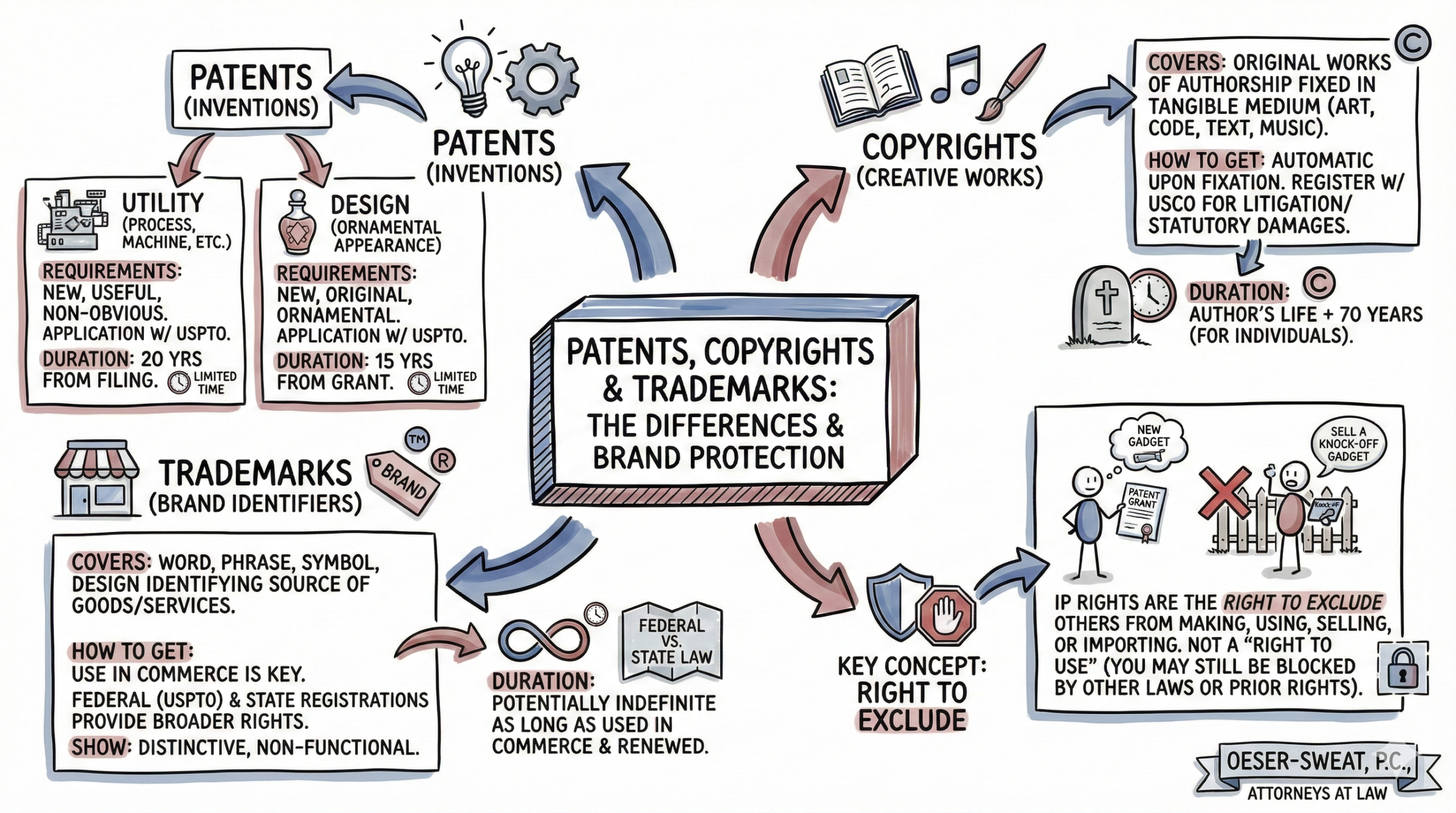
    Infographic: The Four Types of Intellectual Property - Copyright, Trademark, Patent, and Trade Secret.
    Figure 1: Distinguishing Between Different Forms of IP Protection
    View Text Summary of Graphic

    Copyright: Protects original works of authorship (books, music, software). Protection is automatic upon creation, but registration adds legal benefits.

    Trademark: Protects brand identifiers (logos, names, slogans) that distinguish goods or services in the marketplace.

    Patent: Protects inventions and discoveries. It provides a limited-time monopoly in exchange for public disclosure.

    Trade Secret: Protects confidential business information (recipes, client lists) that provides a competitive edge.

    1. The Core Concept: The Right to Exclude

    A common misconception is that owning Intellectual Property gives you the “right to use” your creation. In reality, IP rights are negative rights: they give you the right to exclude others from using your protected work without your permission. Securing these rights is what allows you to build a moat around your business and prevent competitors from profiting off your hard work.

    2. Trademarks: Your Brand’s Shield

    Trademarks are the most essential form of protection for building a brand identity. A trademark protects words, phrases, symbols, or designs that identify the source of your goods or services. Think of the Nike “Swoosh” or the Apple logo.

    Registering a federal trademark with the USPTO provides powerful benefits:

    • Nationwide Protection: It puts the entire country on notice that you own the mark.
    • Legal Leverage: It gives you the ability to sue for infringement in federal court.
    • Asset Value: A registered trademark is an asset that can be licensed, franchised, or sold.

    Before launching a brand, it is crucial to conduct a comprehensive search to ensure you aren’t infringing on an existing mark.

    3. Copyrights: Protecting Creative Output

    Copyright protects “original works of authorship” fixed in a tangible medium. This includes everything from the code that runs your app to the text on your website, your marketing videos, and your training manuals.

    While you technically own the copyright the moment you create the work, registration is key. You generally cannot file a lawsuit to stop someone from stealing your content unless you have registered that work with the U.S. Copyright Office. Registration is an accessible and cost-effective way to secure your creative assets.

    4. Patents and Trade Secrets

    Patents are for inventions—new machines, processes, or compositions of matter. One can get a Design or a Utility Patent. They are powerful but can be expensive and time-consuming to obtain. They grant a limited monopoly (usually 20 years for a utility patent and 15 years for a design patent) to exclude others from making or selling your invention.

    Trade Secrets cover confidential information that gives you a competitive advantage, such as the Coca-Cola formula or Google’s search algorithm. Unlike patents, you don’t register them; you protect them through strict internal contracts (NDAs) and security measures.

  • Prenuptial Agreements: A Roadmap for Your Marriage

    Prenuptial Agreements: A Roadmap for Your Marriage

    Why having “the conversation” now can protect your future and strengthen your partnership.

    For many, the mention of a Prenuptial Agreement feels like an accusation. If you are being pressured by family or a fiancé to sign one, it is natural to feel defensive. However, viewed correctly, a prenup is not about planning for divorce—it is about defining the rules of your marriage on your own terms, rather than letting the state decide for you.

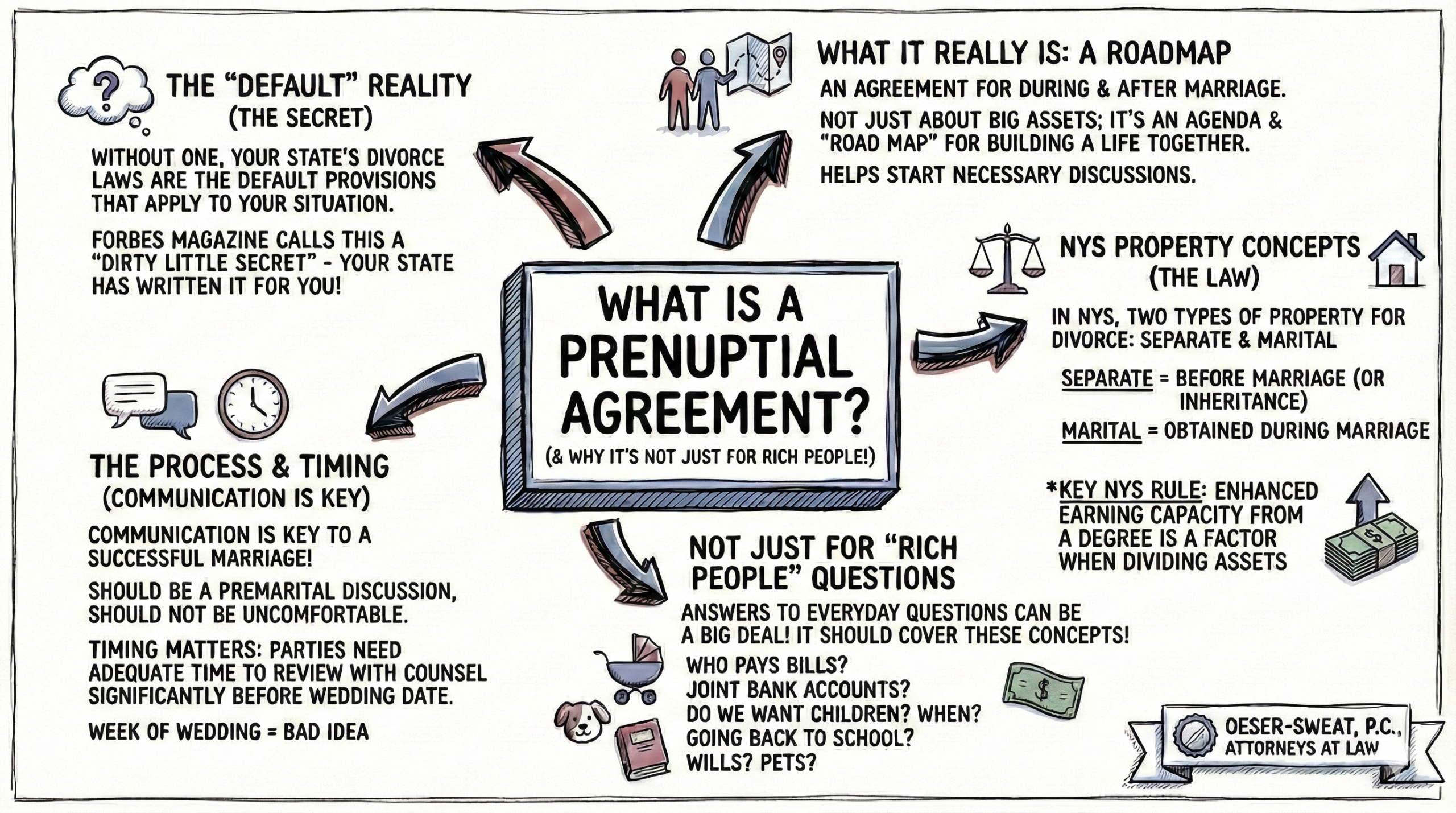
    Infographic: Understanding Prenuptial Agreements. A guide to planning your financial future together.
    Figure 1: Turning Uncomfortable Conversations into a Life Plan
    View Text Summary of Graphic

    The Default Prenup: The infographic reminds readers that everyone already has a prenup—it’s called “State Law.” If you don’t write your own, the state’s default rules apply to your assets.

    The Conversation: Encourages couples to use crayons, chalk, or fun methods to discuss serious topics to lower the tension.

    Timing Warning: “Week of Wedding = Bad Idea.” Agreements signed under time pressure are vulnerable to being overturned by a court.

    Scope: A prenup is an agenda for discussion: Children, career goals, parents living in the home, and property division.

    1. The Legal Requirement: DRL §236(B)(3)

    In New York, a prenuptial agreement is a powerful document, but only if it strictly follows the law. Under Domestic Relations Law §236(B)(3), an agreement must be:

    • In writing;
    • Subscribed (signed) by the parties; AND
    • Acknowledged or proven in the manner required to entitle a deed to be recorded.

    This “acknowledgment” requirement is critical. A simple notary stamp is often not enough; specific language is required. If these technical formalities are missed, the entire agreement can be tossed out years later.

    2. Designing Your “Lifestyle Agenda”

    If you are feeling pressured, try shifting the focus from “assets” to “lifestyle.” A well-crafted agreement plans for the everyday realities of your life together:

    • Finances: Will you have a joint bank account for bills? Who contributes what percentage?
    • Career & Education: If one spouse goes back to school, is that degree marital property? Who pays for the tuition?
    • Family Dynamics: What happens if an aging parent needs to move in?

    Use the agreement to have these difficult conversations now, when you love each other, rather than fighting about them later.

    3. What You CANNOT Include

    While you have broad freedom to contract, there are lines you cannot cross. Courts generally will not enforce provisions regarding:

    • Child Custody: You cannot pre-determine who gets the kids. The court always decides based on the “best interests of the child” at the time of divorce.
    • Child Support: You cannot waive your child’s right to support.
    • “Lifestyle Clauses”: Penalties for gaining weight or not visiting in-laws are often viewed as unenforceable or frivolous by New York courts.

    4. The Danger Zone: Timing & Counsel

    The closer you are to the wedding date, the more scrutiny a court will apply to the agreement. If a prenup is presented on the eve of the wedding (“Sign this or the wedding is off”), it may be challenged later on the grounds of duress.

    You Need Independent Counsel: It is practically mandatory that both sides have their own lawyer. One lawyer cannot ethically represent both parties in a prenup. If you are being asked to sign an agreement written by your fiancé’s wealthy family lawyers, you must have your own advocate to review it and explain what you are giving up.

  • Choosing the Right Entity for Your NY Business

    Choosing the Right Entity for Your NY Business

    A strategic comparison of LLCs, Corporations, and Sole Proprietorships for New York entrepreneurs.

    One of the first and most critical decisions you will make as a founder in New York is selecting the legal structure of your business. This choice affects everything from your personal liability and tax obligations to your ability to raise capital.

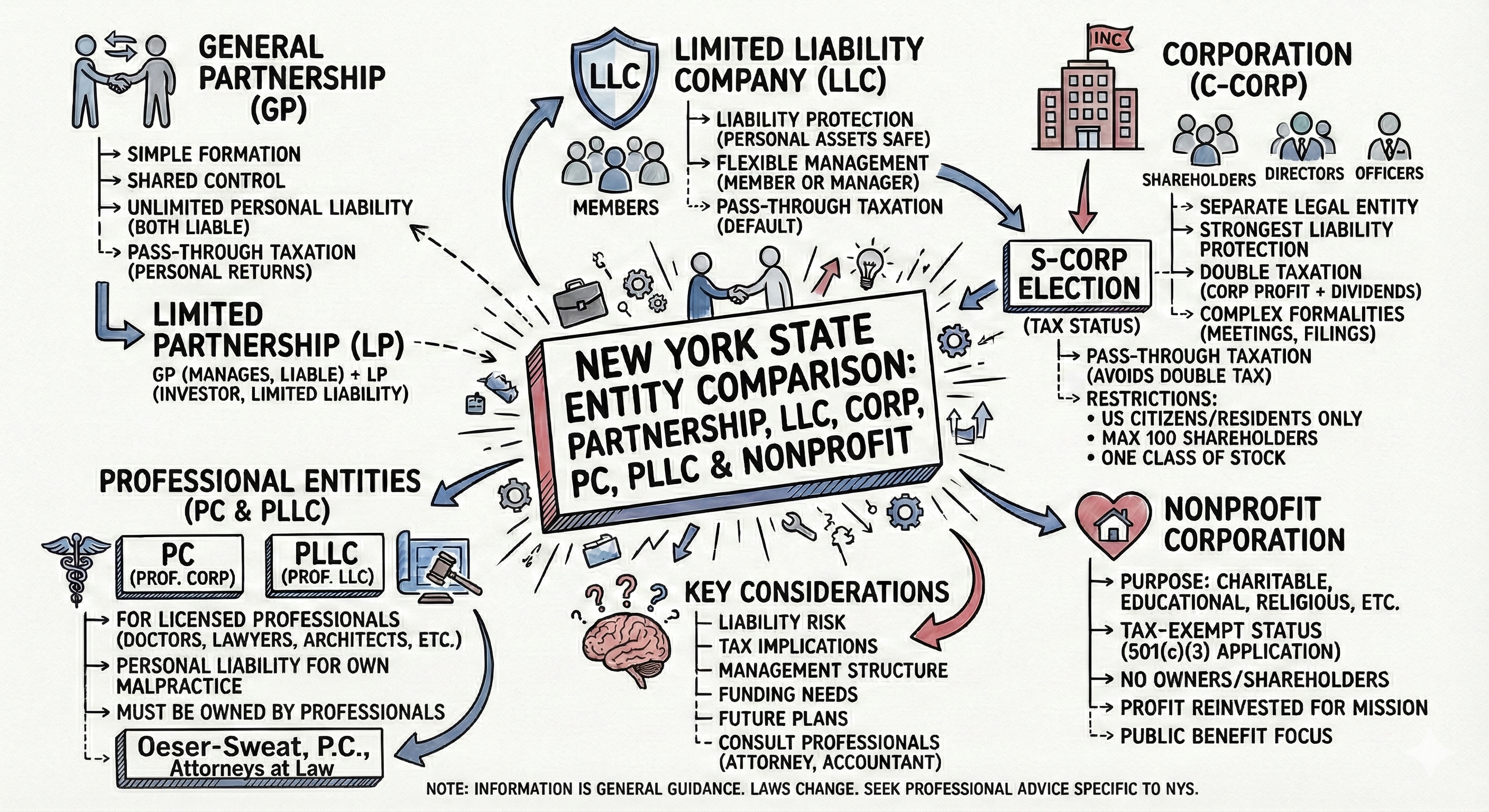
    Chart comparing New York business entities: Sole Proprietorship, Partnership, LLC, and Corporation. Text summary below.
    Figure 1: Comparison of Legal Liability, Taxation, and Formation Requirements
    View Text Description of Entity Chart

    Sole Proprietorship: The simplest form. No liability protection (personal assets are at risk). Taxes are filed on personal returns. No state filing is required to exist, though a DBA is needed for trade names.

    General Partnership: Similar to a Sole Prop but for two or more people. Partners share unlimited personal liability for business debts. A Partnership Agreement is highly recommended but not filed with the state.

    Limited Liability Company (LLC): Offers personal liability protection. Taxes are “pass-through” (avoiding corporate tax) unless elected otherwise. Requires filing “Articles of Organization” and meeting New York’s Publication Requirement.

    Corporation (Inc.): A formal separate legal entity. Offers strong liability protection. Owned by shareholders and managed by a Board. “C-Corps” face double taxation, while “S-Corps” (if eligible) allow pass-through taxation.

    1. Sole Proprietorship: The Default Option

    If you start doing business today without filing any paperwork, you are a Sole Proprietor. While this is the easiest and cheapest way to start, it carries the highest risk. In a Sole Proprietorship, there is no legal distinction between you and the business. If the business is sued, your personal house, car, and savings are at risk.

    2. Limited Liability Company (LLC): The Modern Standard

    For most small businesses in New York, the LLC is the preferred vehicle. It provides a “corporate veil” that protects your personal assets from business liabilities, much like a corporation, but offers the tax flexibility of a partnership.

    The NY Publication Requirement: Unique to New York, newly formed LLCs must publish a copy of their Articles of Organization in two newspapers for six consecutive weeks. This can be a surprising expense for new founders, particularly in New York City.

    3. The Corporation: Built for Scale

    If you plan to raise venture capital or go public, a Corporation (C-Corp) is usually the required structure. Investors prefer the formal share structure of a corporation. However, C-Corps face “double taxation”—the company pays tax on profits, and shareholders pay tax on dividends.

    The S-Corp Election

    Many small corporations (and LLCs) elect “S-Corp” status with the IRS. This allows the business to be taxed like a partnership (pass-through), avoiding double taxation, while maintaining the formal structure of a corporation. Strict eligibility rules apply.

    4. Naming & Compliance

    Before falling in love with a brand name, you must check its availability. You cannot use a name that is “confusingly similar” to an existing entity. Use the state’s database as well as the USPTO’s Trademark database to research your potential name before spending money on marketing.

  • NYC Criminal Prosecution Guide: From Arrest to Disposition

    NYC Criminal Prosecution Guide: From Arrest to Disposition

    A roadmap for families navigating the New York City criminal justice system for the first time.

    Learning that a loved one has been arrested in New York City is a frightening experience. The system moves quickly, but the waiting can feel endless. Understanding the specific steps of the prosecution process—from Central Booking to the final disposition—is the first step in advocating for your family member’s rights.

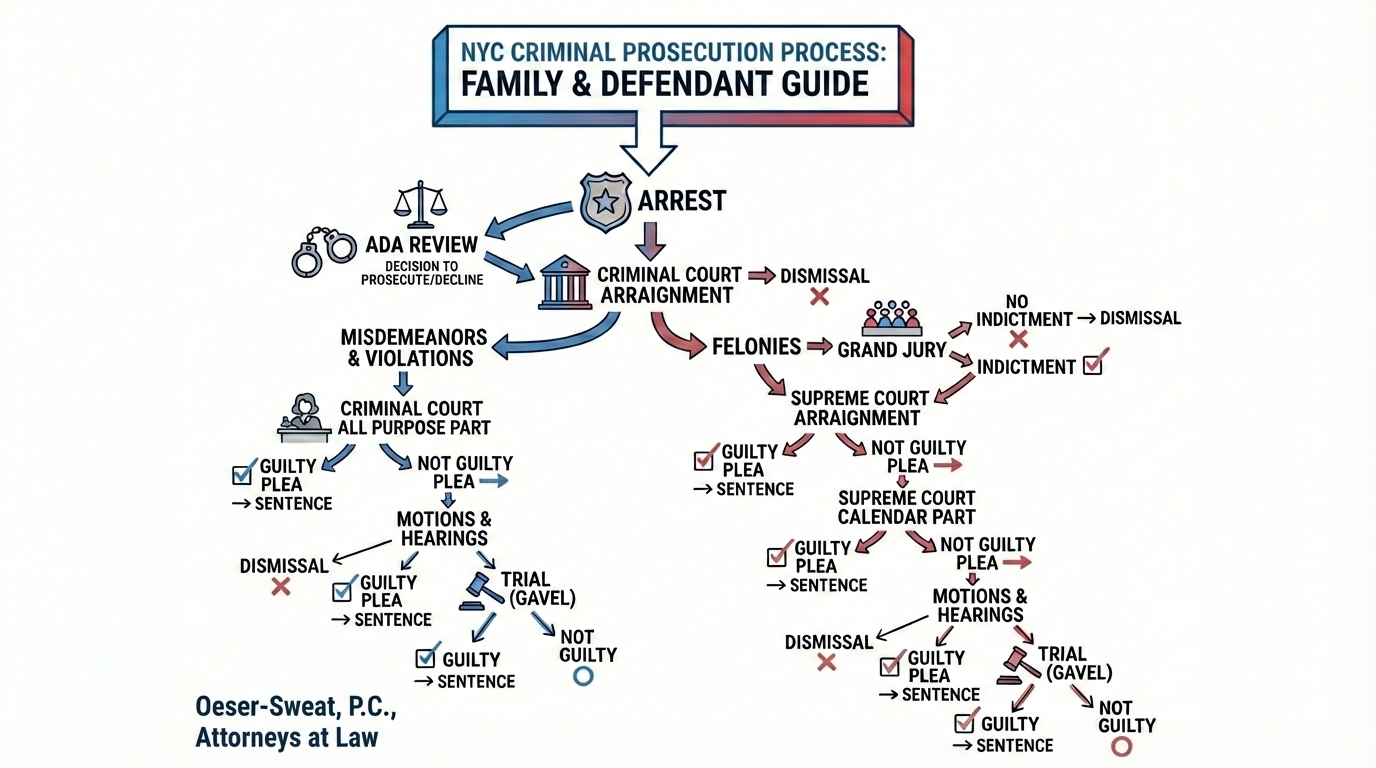
    Infographic: Oeser-Sweat P.C. Criminal Prosecution Process. Detailed text description below.
    Figure 1: The Criminal Justice Process in New York City
    View Text Description of Process Chart

    Step 1: Arrest & Processing. The individual is taken into custody, transported to the precinct for fingerprinting, and then to Central Booking.

    Step 2: Arraignment. Usually within 24 hours. The accused appears before a judge for the first time. Charges are formally read, and bail or release (ROR) is determined.

    Step 3: Grand Jury (Felonies). If charged with a felony, a Grand Jury reviews evidence to determine if an indictment should be issued. This step can often be waived for plea negotiations.

    Step 4: Discovery & Pre-Trial. Attorneys exchange evidence (Discovery). Motions are filed to suppress evidence. Plea bargaining negotiations occur actively during this phase.

    Step 5: Trial or Disposition. The case resolves either through a guilty plea, a dismissal, or a trial verdict (Guilty/Not Guilty).

    Step 6: Sentencing. If convicted, the judge imposes a sentence, which can range from fines or probation to incarceration.

    1. The Arrest & Central Booking

    After an arrest, the defendant is taken to the local police precinct and then to Central Booking. This is where fingerprints and photographs are taken. The waiting period here can be stressful for families, but legally, the police generally have 24 hours to bring the defendant before a judge.

    During this time, the District Attorney’s office is drafting the “Complaint”—the formal document listing the charges. You can sometimes locate a loved one or check their status using Central Booking Info.

    2. The Arraignment

    The Arraignment is the most critical first step. It is the first time the accused sees a judge and a lawyer. At this hearing:

    • The charges are formally read.
    • The defendant enters a plea of “Not Guilty.”
    • Bail is decided. The judge will either release the defendant on their own recognizance (ROR), set a cash bail/bond amount, or remand them (hold without bail).

    For official details on how this hearing works, the NY Courts website provides an excellent guide to arraignments.

    3. Grand Jury (Felony Cases)

    If the charges are felonies (crimes punishable by more than one year in prison), the case cannot proceed to trial without an Indictment. A Grand Jury of 23 citizens must vote on whether there is enough evidence to charge the defendant. Often, defense attorneys may advise waiving this timeline temporarily to negotiate a better resolution.

    4. Discovery and Plea Bargaining

    Once the case is in the system, the “Discovery” phase begins. Recent laws in New York require prosecutors to turn over evidence (body cam footage, police reports, witness statements) much faster than before. Defense attorneys use this evidence to negotiate Plea Bargains—agreements to plead guilty to lesser charges in exchange for a lighter sentence—or to prepare for trial.

    You can track future court dates and charges using the public WebCrims system.

    5. Trial and Sentencing

    If no plea agreement is reached, the case goes to Trial. A jury (or judge in a bench trial) determines guilt beyond a reasonable doubt. If found guilty, the case moves to sentencing. If found not guilty, the defendant is released, and the records are typically sealed.

  • Eviction Process Guide: Sale of Property & Holdover

    Eviction Process Guide: Sale of Property & Holdover

    A strategic roadmap for New York landlords preparing to sell property with existing tenancies.

    Selling a residential property in New York is complicated when a tenant is in possession. Whether you are dealing with an expired lease or a month-to-month arrangement, terminating the tenancy correctly is the most critical step to ensuring a successful closing.

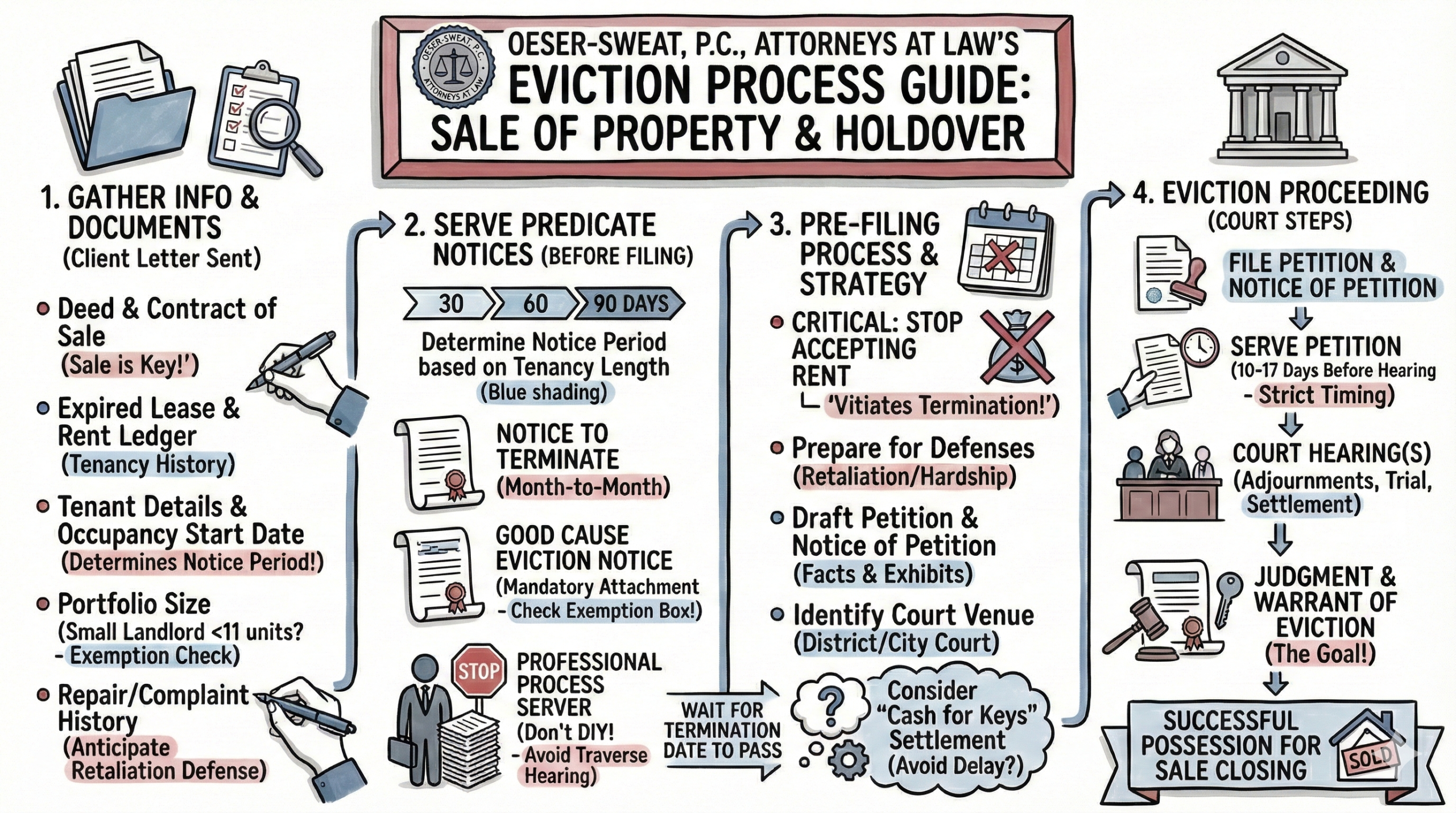
    Infographic: Oeser-Sweat P.C. Eviction Process Guide for Sale of Property & Holdover. Detailed text description below.
    Figure 1: The Step-by-Step Holdover Eviction Process for Landlords
    View Text Description of Eviction Roadmap

    Step 1: Gather Info & Documents. Collect the Deed, Contract of Sale, expired leases, rent ledgers, and tenant occupancy start dates. Verify your portfolio size for Good Cause Eviction exemptions.

    Step 2: Serve Predicate Notices. Determine the notice period (30, 60, or 90 days) based on the length of tenancy. Serve a Notice to Terminate and a Good Cause Eviction Notice via a professional process server.

    Step 3: Pre-Filing Strategy. CRITICAL: Stop accepting rent after the termination date as it “vitiates termination.” Prepare for defenses (Retaliation/Hardship) and identify the correct Court Venue.

    Step 4: Eviction Proceeding. File the Petition and Notice of Petition. Serve the tenant with strict timing (10-17 days before hearing). Attend court hearings. Secure a Judgment and Warrant of Eviction.

    1. Preparation: The “Sale is Key” Strategy

    Before any legal action is taken, you must audit your documentation. In New York, the length of a tenant’s occupancy determines the notice period required to terminate a month-to-month tenancy. If you are selling the property, your Contract of Sale is a vital document that underscores the necessity of delivering the property vacant.

    You must also determine if your property falls under the Good Cause Eviction Law. Small landlords (those owning 10 units or fewer) may be exempt, but this must be specifically asserted in your notices.

    2. Serving the Predicate Notices

    You cannot simply tell a tenant to move out. You must serve formal legal notices. Depending on how long the tenant has lived there, you must provide:

    • 30 Days Notice: Occupancy of less than 1 year.
    • 60 Days Notice: Occupancy between 1 and 2 years.
    • 90 Days Notice: Occupancy of more than 2 years.

    Pro-Tip: Never attempt “DIY” service. Using a professional process server is essential to avoid a “Traverse Hearing,” where a tenant challenges the validity of the service, potentially resetting your entire timeline.

    3. The “No Rent” Rule

    A common mistake landlords make is accepting rent after the termination date specified in the notice. In New York, accepting rent after the termination date but before starting the court case can “vitiate” (cancel) your notice, forcing you to start the 30/60/90 day process all over again.

    4. The Eviction Proceeding (Court Steps)

    If the tenant remains after the notice period expires, we file a Holdover Proceeding in the local District or City Court. This involves:

    • Filing the Petition: Stating the facts of the tenancy and the reason for eviction.
    • The Hearing: Most cases involve at least one adjournment. We aim for a settlement (like “Cash for Keys”) or a trial.
    • The Judgment: Once granted, the Judge signs a Warrant of Eviction, which is then processed by a Sheriff or Marshal.

    Seeking a Settlement

    In many cases, a “Cash for Keys” settlement is the most efficient path. While it may feel counterintuitive to pay a tenant to leave, it often saves months of litigation costs and ensures you meet your closing deadlines for the sale of the property.