
The End of the “Rocket Docket”: New Divorce Venue Rules
Why you can no longer “shop” for a court, and why filing in your home county is now the law.
For years, getting a “quickie divorce” in New York often meant filing your paperwork in a tiny county hundreds of miles away—a place where neither you nor your spouse had ever lived. This practice, of using a “Rocket Docket,” allowed litigants from crowded counties like New York or Kings to skip the line. As of February 19, 2025, that door has been slammed shut.
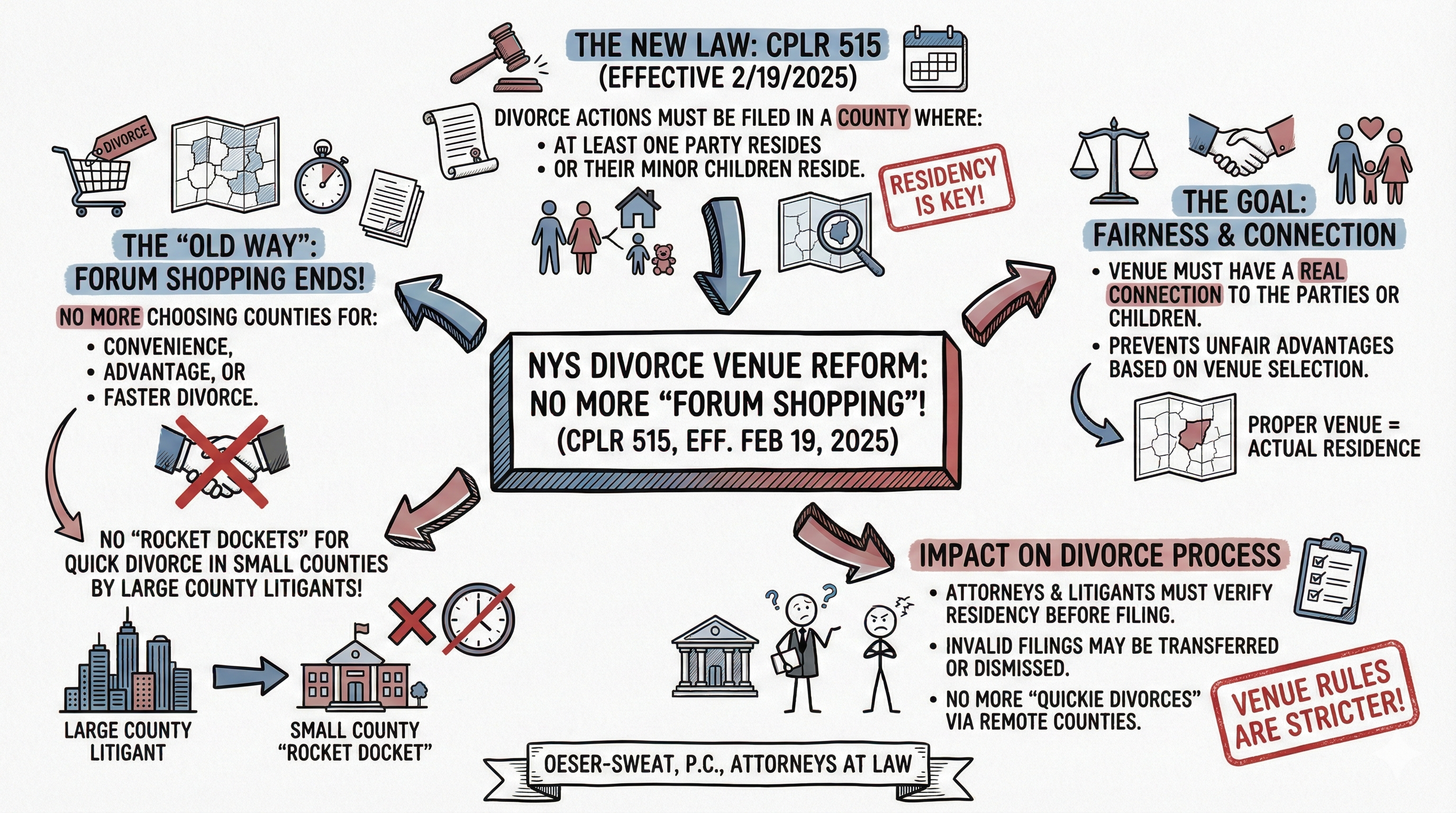
View Text Description of Graphic
The Old Way: People living in busy areas (like NYC) would file in distant, quiet counties to get a judgment faster.
The New Way (CPLR 515): You must file in a county where the Plaintiff, the Defendant, or their minor children actually reside.
The Goal: Fairness. To ensure local courts handle local families and prevent wealthy litigants from “buying” a faster divorce.
1. What Exactly Changed? (CPLR 515)
Under the new law, CPLR § 515, you are no longer allowed to pick a court based on convenience or speed. The law now mandates that a divorce action must be filed in a county where:
- The Plaintiff (the person filing) resides; OR
- The Defendant (the other spouse) resides; OR
- Their minor children reside.
Before this change, law firms often advised clients to file in counties hours upstate. Why? Because those court clerks had fewer cases and could sign a Judgment of Divorce in weeks, whereas a Downstate court might take months. This created a system where people were “shopping” for the best court.
2. The “Rocket Docket” Trap
While the old way seemed faster, it carried a hidden danger that this new law eliminates. Under the old system, if you filed in a county 4 hours away because it was “fast,” you were taking a gamble. If your “uncontested” divorce suddenly became “contested” (meaning your spouse disagreed with something), that distant court would still be the one handling your case.
3. Exceptions to the Rule
The legislature understood that sometimes, you need to hide your location. CPLR 515(b) provides strict exceptions where you can still file in a different county (as allowed by CPLR 509):
- Confidentiality Orders: If your address is confidential due to a court order (like in Domestic Violence cases under DRL §254 or Family Court Act §154-b).
- Address Not Public: If the addresses of the parties and children are not matters of public record.
- Good Cause: A judge can still allow a case to proceed in a different county if you can prove there is a very good reason (“good cause”) to do so, though “convenience” is no longer enough.
4. What This Means for You
If you are looking to get divorced, you must plan to file locally. While it might feel frustrating to wait in line with everyone else in your home county, this rule ensures that if issues regarding custody or support arise, the court handling them is in the same community where your children actually sleep at night.