
Pendente Lite Relief: Survival During Divorce
How to secure temporary support, custody, and exclusive occupancy while your divorce is pending.
Divorce cases in New York can take months or even years to resolve. But mortgages, tuition, and grocery bills are due today. If your spouse has cut off your access to funds, locked you out of accounts, or is hiding assets, you cannot wait for the final trial. You need Pendente Lite (Latin for “pending the litigation”) relief immediately.
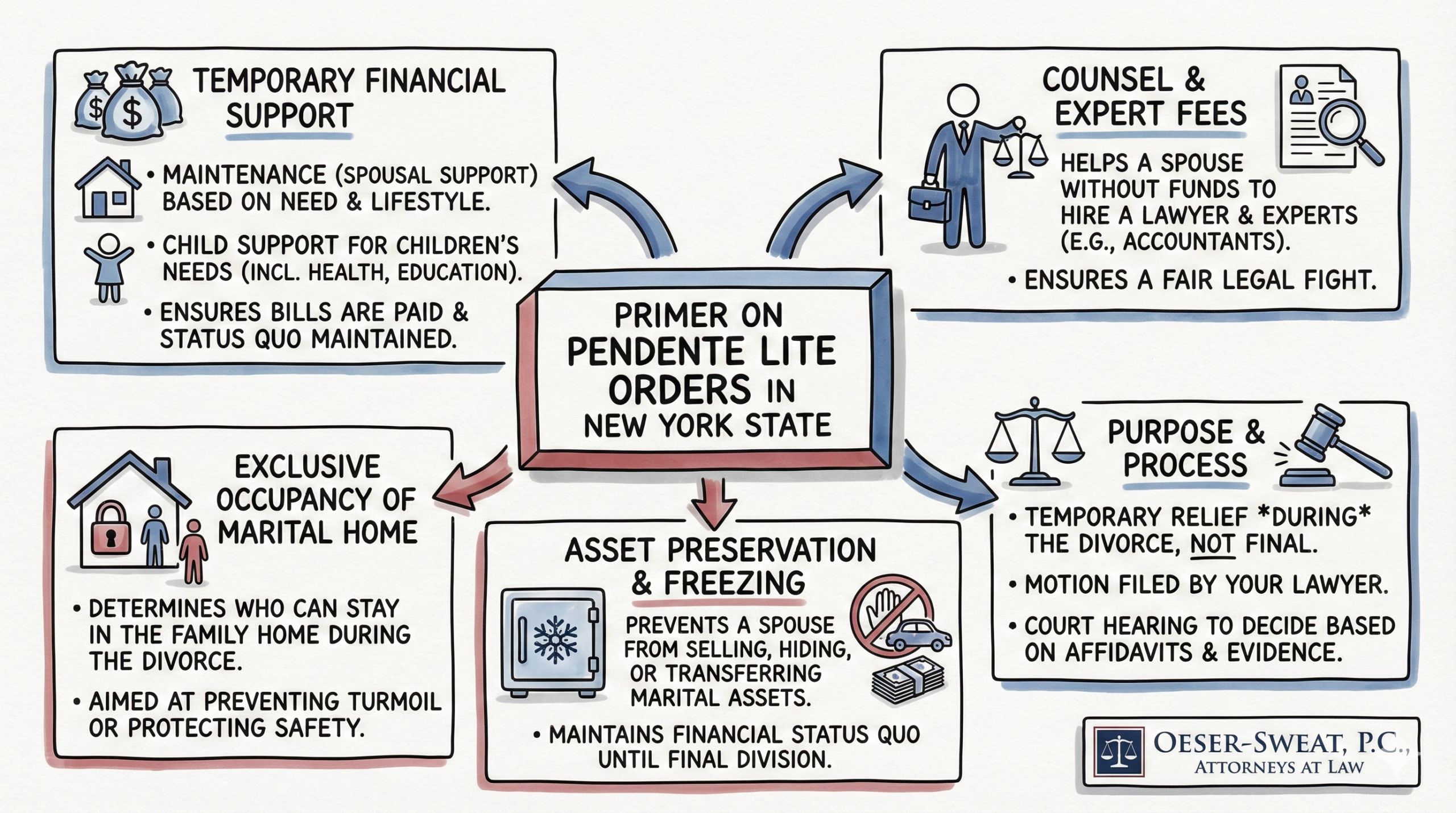
View Text Description of Figure 1
Definition: Pendente Lite is a temporary order issued by the Supreme Court while a divorce case is ongoing.
Purpose: To maintain the “status quo,” prevent financial starvation of the less wealthy spouse, and ensure bills are paid.
Scope: It can cover temporary maintenance (alimony), child support, interim counsel fees, and exclusive occupancy of the marital home.
Method: It is not automatic; it requires filing a formal motion (Notice of Motion or Order to Show Cause) with a Statement of Net Worth.
1. What is Pendente Lite Relief?
A “Pendente Lite Order” is a temporary court order that dictates who pays for what, who lives where, and who the children stay with while the divorce is in progress. The purpose is to maintain the status quo and ensure the lower-income spouse (“non-monied spouse”) is not starved into a bad settlement.
This relief is not automatic. You must file a formal written application to the court, known as a Motion for Pendente Lite Relief (via Notice of Motion or Order to Show Cause). The court decides based on the papers you submit.
2. The Financial Lifelines: Support and Fees
When you ask the court for financial help, the Judge looks at specific legal factors (often cited in sample decisions like the one provided in our sidebar):
- Temporary Maintenance (Alimony): The court considers the standard of living established during the marriage (Hartog v. Hartog, 85 N.Y.2d 36, 623 N.Y.S.2d 537, 647 N.E.2d 749 (1995)). The goal is to make sure you can support yourself now.
- Child Support: The court applies the Child Support Standards Act (CSSA). They look at the combined income and apply the standard percentages (17% for one child, 25% for two, etc.), even on a temporary basis.
- Interim Counsel Fees: Under DRL §237, there is a presumption that the “monied spouse” should pay the legal fees of the “non-monied spouse.” This is to ensure a level playing field so the wealthier spouse cannot out-spend you in litigation. (DeCabrera v. Cabrera-Rosete, 70 N.Y.2d 879, 524 N.Y.S.2d 176 (1987)).
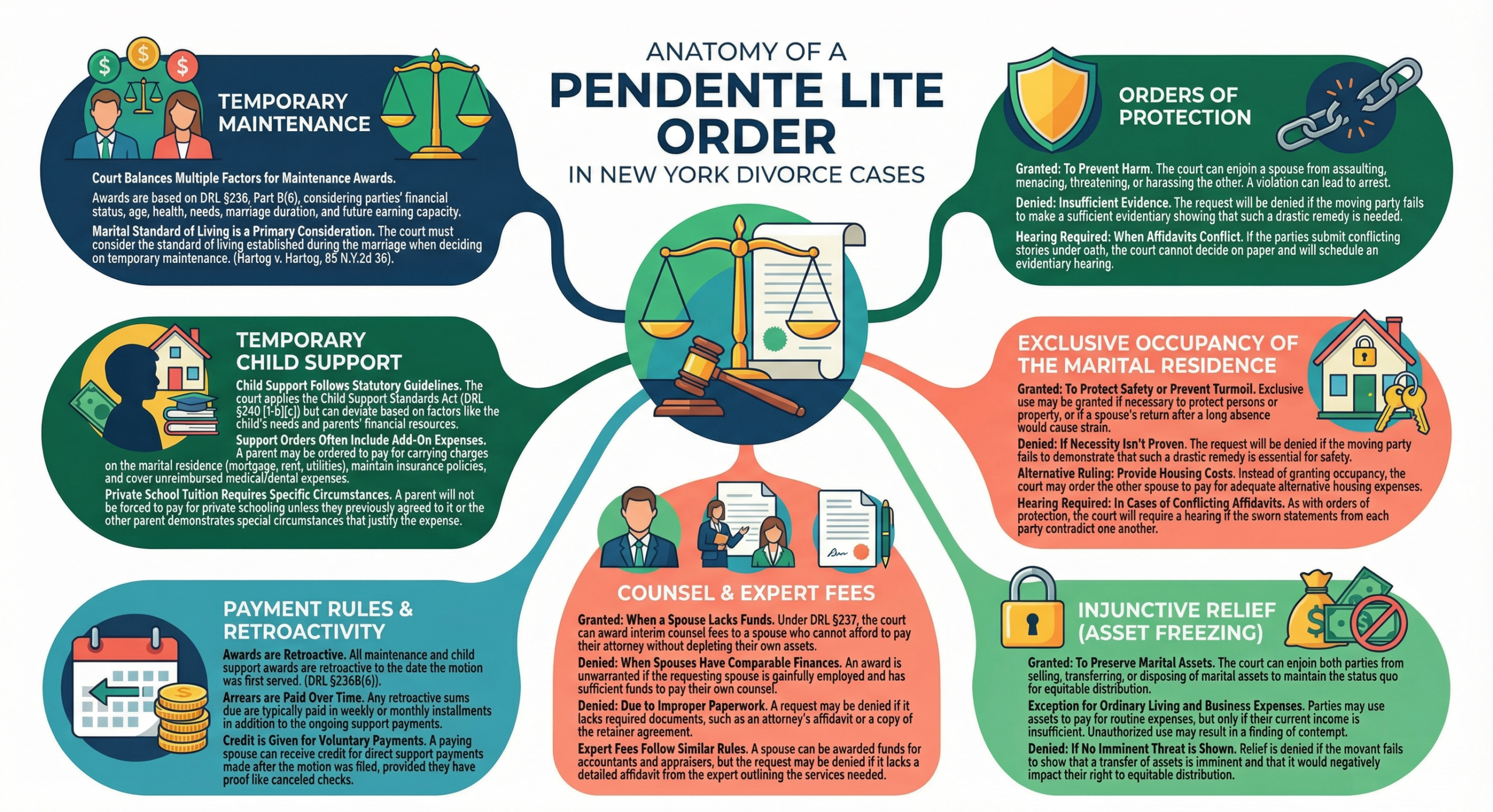
View Text Description of Figure 2
Key Components: A typical order breaks down obligations into distinct categories.
Maintenance Calculation: Shows the court using statutory formulas based on income caps (often capped at approx. $228,000 for maintenance).
Child Support: Calculated separately after maintenance is deducted, using the standard 17%/25% percentages.
Carrying Charges: Often directs the monied spouse to directly pay the mortgage, utilities, and insurance (known as “carrying charges”) to prevent foreclosure or shut-offs.
Retroactivity: The order emphasizes that amounts are owed from the date the motion was served, often creating immediate “arrears” (debt).
3. Drastic Remedies: Occupancy and Restraints
Sometimes money isn’t the only issue; safety or dissipation of assets is the concern. You can ask for:
Exclusive Use and Occupancy
This asks the court to kick your spouse out of the marital home while the case is pending. This is a drastic remedy. Courts rarely grant it unless you can show:
- Physical violence or threats to safety; or
- That the spouse’s presence causes “domestic strife and turmoil” so severe it damages the mental health of you or the children (Judell v. Judell, 128 A.D.2d 416, 512 N.Y.S.2d 693 (1st Dept. 1987)).
- Note: If a spouse has voluntarily left for a long period (e.g., 30+ days), it can potentially be easier to get an order keeping them out.
Restraining Orders (Injunctions)
If you fear your spouse is hiding money or selling assets, you can ask for an injunction preventing the transfer of assets. The court will usually grant this to maintain the financial status quo, with an exception allowed for “ordinary and routine living expenses.”
4. The Traps: Retroactivity and Credits
Pendente Lite awards are often retroactive to the date you served the motion papers. This means if it takes the Judge 3 months to decide, the payor may owe 3 months of back support immediately.
Conversely, the paying spouse may be entitled to a credit for voluntary payments made during that time. If you are the higher earner, keeping receipts of every bill you pay while the motion is pending is critical (Peltz v. Peltz, 110 A.D.3d 1030, 973 N.Y.S.2d 762 (2013)).
5. Filing the Application
To succeed, you generally need three documents:
- Affidavit: Your sworn story detailing the finances, the need for support, and any safety issues.
- Statement of Net Worth: A mandatory New York form detailing every expense (rent, food, clothing) and asset. If this is incomplete, your motion may be denied.
- Attorney Affirmation: The legal arguments supporting your request.