Dividing “Ideas” in Divorce: The Ruling in D.P. v S.P.
How New York courts value and split complex intellectual property, patents, and software code.
Valuing a bank account in a divorce is easy. Valuing an invention, a patent, or a line of code is much harder. In the recent decision of D.P. v S.P. (2026 NY Slip Op 50129(U)), the New York courts provided a critical roadmap for how complex Intellectual Property (IP) is treated during the “Equitable Distribution” phase of a marriage.
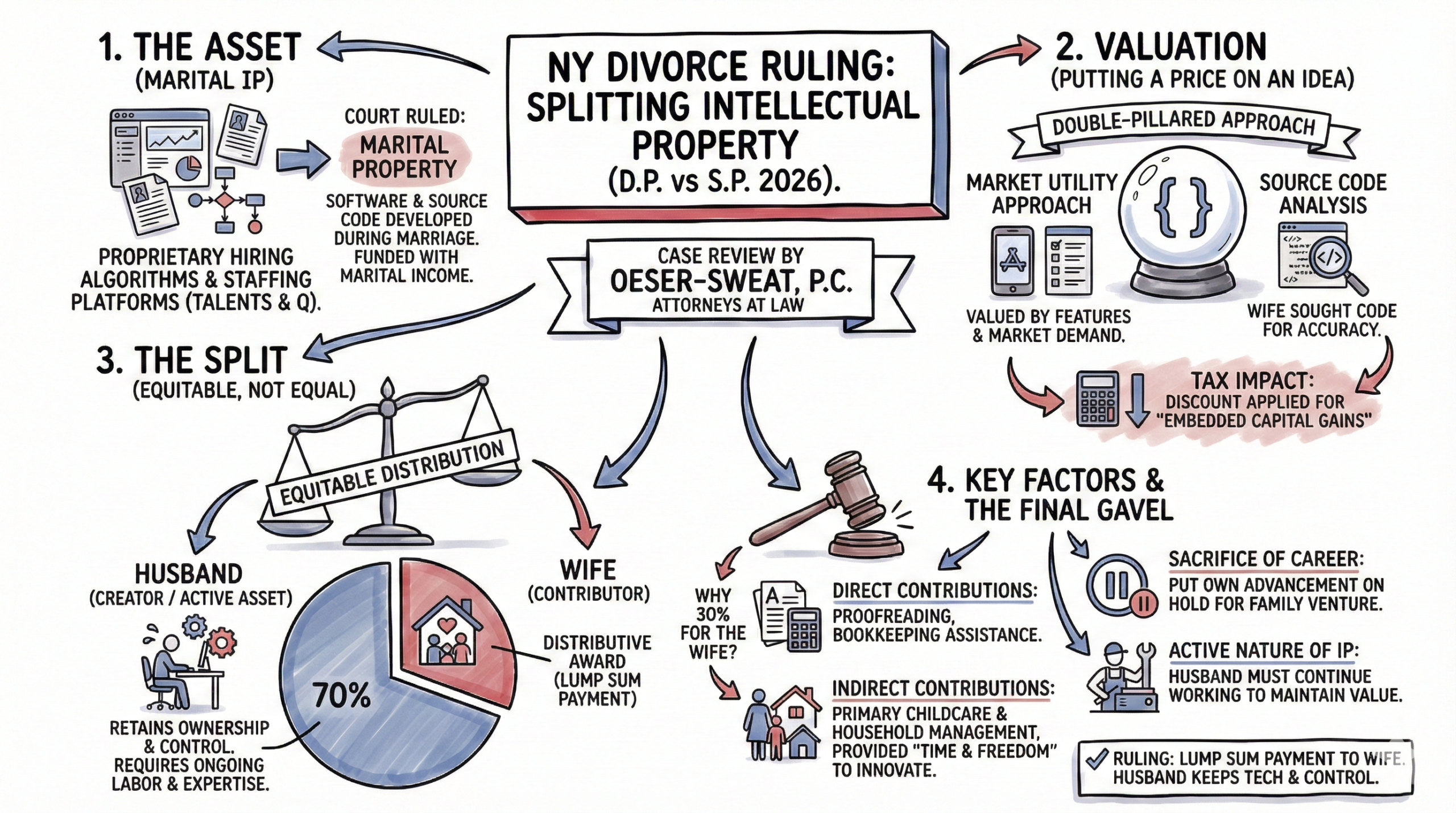
View Text Description of Case Summary
The Asset: Software that helped in the hiring process. Ruled as Marital Property because it was developed during the marriage using marital funds.
Valuation Method: The court used a “Double-Pillared” approach:
1. Income Approach: Projected royalties over 10 years.
2. Market Approach: Sales prices of similar forensic technology startups.
Note: A discount was applied for future taxes (Embedded Capital Gains).
The Split (70/30): The court awarded 70% to the Husband (creator) and 30% to the Wife. Why? The IP is an “Active Asset” requiring the husband’s continued labor to maintain value.
The Resolution: A “Distributive Award.” The Husband pays the Wife a cash lump sum for her share, rather than making them co-owners of the patent.
1. The Asset: What was the Intellectual Property?
The core of the dispute involved proprietary software and related patents developed by the husband (the titled spouse) during the marriage. Specifically, this IP consisted of software that helped in the hiring process (the SCAnDi Connection).
The Classification: The Court ruled the IP was Marital Property. Even though the husband was the listed “inventor” and wrote the code, the work was performed during the marriage, and marital income was used to fund the initial patent filings.
2. Valuation: How to Price an “Idea”
Valuing IP is notoriously difficult because its value often lies in future potential rather than current cash. The court utilized a “Double-Pillared” approach:
- The Income Approach: A neutral forensic accountant projected the potential royalty streams and licensing fees the software would generate over the next 10 years.
- The Market Approach: The court looked at what similar forensic technology startups had been sold for recently.
3. The Split: Equitable, Not Equal
New York is an Equitable Distribution state, which means “fair,” but not necessarily “equal” (50/50). In this case, the court did not split the IP down the middle.
The Result: The court awarded 70% to the Husband (the creator) and 30% to the Wife.
The Reasoning: The court categorized the IP as an “Active Asset.” Unlike a passive stock portfolio that grows on its own, this software’s continued value depended heavily on the husband’s unique expertise, ongoing labor, and future “manual” refinements. Since he had to keep working to make it valuable, he was entitled to a greater share.
4. Why the Non-Titled Spouse Got 30%
The court identified four main factors to justify the 30% award to the Wife, highlighting that contributions to a marriage are not just financial:
- Direct Contributions: She assisted in the early days by proofreading patent applications and managing the business’s initial bookkeeping.
- Indirect Contributions: By handling the primary care of the couple’s three children and managing the household, she provided the Husband with the “time and freedom” necessary to innovate.
- Sacrifice of Career: She put her own professional advancement on hold to support the “family venture” of developing this technology.
- The “Active” Nature of IP: As noted above, the necessity of the creator’s future work prevented a higher (50%) award.
5. The “Final Gavel” (The Holding)
To avoid forcing divorced spouses to remain business partners, the Court ordered a “Distributive Award.” Instead of making the couple co-owners of the patents (which would lead to endless future conflict), the Husband was ordered to pay the Wife a lump sum representing her 30% share of the appraised value. This allowed him to retain full ownership and control of the technology while she received her fair equity in cash.