
Category: Personal Injury

  • How to Get a Police Accident Report in NYC

    How to Get a Police Accident Report in NYC

    A simple guide to retrieving your collision report (MV-104AN) online or by mail.

    Getting into a car accident is scary and confusing. Once the dust settles, you need proof of what happened for your insurance company or for a lawsuit. In New York City, this proof is called the Police Collision Report (form MV-104AN). Getting this report used to be easy, but the rules have changed.
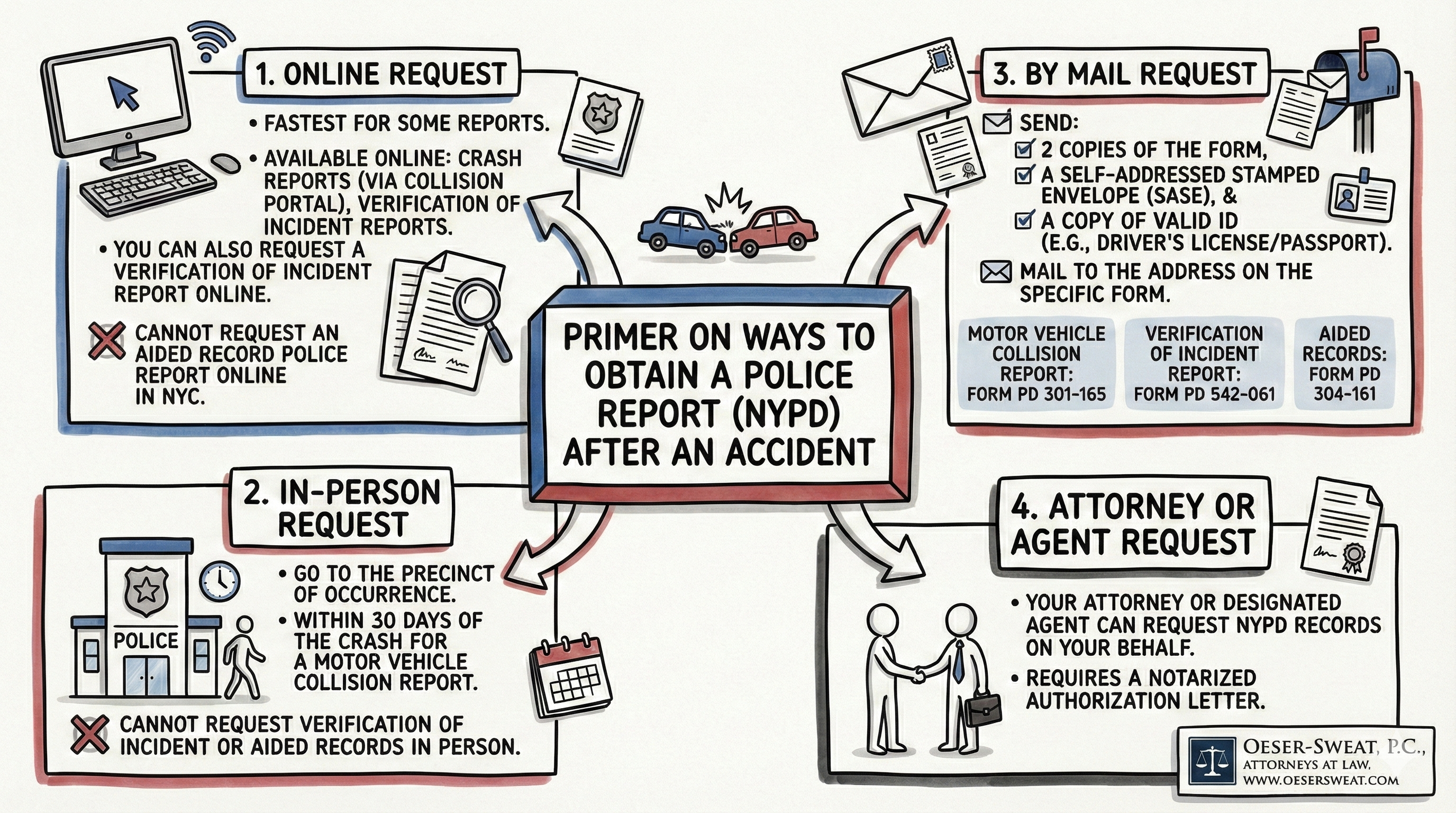
    Flowchart showing the steps to get a police report: At the Scene, The Waiting Period, and How to Request Online or by Mail.
    Figure 1: The Steps to Retrieve Your Collision Report
    View Text Description of Graphic

    1. At the Scene: The police officer writes down the details. You should ask for the “Accident Report Number” or “Complaint Number.”

    2. The Wait: It usually takes a few days for the report to be typed up and put into the computer system.

    3. Requesting the Report: You can go to the NYPD Collision Report Portal online. You enter the date and your license plate number to find it.

    4. Alternative: If you can’t find it online, you have to mail a “Verification of Incident” form to the NYPD Criminal Records Section.

    1. What is the MV-104AN?

    The MV-104AN is the official form the police fill out when they come to an accident scene. It lists the drivers involved, the insurance information, and a diagram of how the crash happened. This piece of paper is critical. Without it, your insurance company might delay fixing your car or paying your medical bills.

    2. Don’t Just Go to the Station (Most of the Time)

    WARNING: You might think you should just walk into the police precinct to get your report. Stop! Many precincts in New York City no longer give out these reports at the front desk.

    To save time and avoid frustration, you should try to get the report online first. If you just show up at the station, they might just hand you a piece of paper telling you to go home and use the computer. You can go to the local precinct where the accident occurred within 30 days and get the report.

    3. The Best Way: Go Online

    The fastest way to get your report is through the NYPD Collision Report Portal. It is free and available 24/7. Here is how it works:

    1. It can take up to 7 days after the accident for the report to be available. It takes time for officers to enter the data.
    2. Go to the Collision Report Website.
    3. You will need to search using the Incident Date and the License Plate Number of one of the cars involved.
    4. If found, you can download the PDF right away.

    4. The Slower Way: By Mail

    If you cannot find the report online, or if the police did not file a full collision report but only made a record of the incident, you have to use the mail. You must fill out a specific form depending on what you need:

    • Collision Report Request: Use the form found in the links to request the standard accident report.
    • Verification of Incident: Use form PD 542-061 if you just need proof that something happened (like a tree falling on your car) but it wasn’t a two-car crash.
    • Aided Record: Use form PD 304-161 if someone was hurt and taken to the hospital by ambulance.

    You must include a stamped, self-addressed envelope with your request so they can mail the report back to you.

    5. Is There a Fee?

    Getting the report from the NYPD website is usually free. However, if you order it through the New York State DMV, there might be a fee. Also, if you are paying for other police records, you might use the CityPay portal. Always check if a fee applies before you send a check.
  • How a Civil Lawsuit Works in NY Supreme Court

    How a Civil Lawsuit Works in NY Supreme Court

    A step-by-step guide for plaintiffs and defendants navigating the legal system.

    Whether you are suing someone for a breach of contract or you have been injured in an accident, entering the New York State court system can be intimidating. Understanding the procedural roadmap—from filing the first paper to receiving a judgment—is essential for anyone involved in a civil dispute.

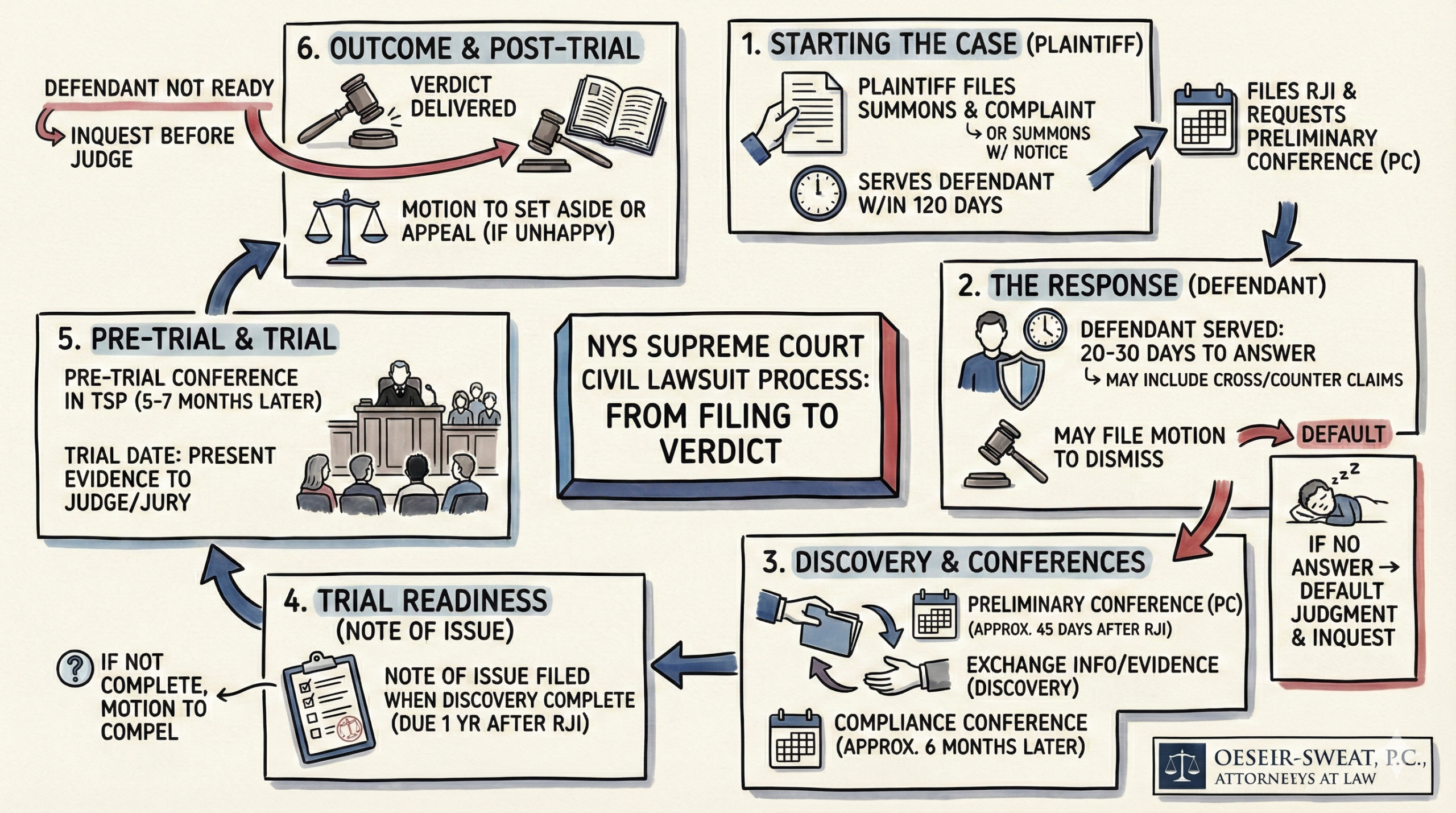
    Flowchart: The 7 Stages of a Civil Lawsuit in NYS Supreme Court. Detailed text description below.
    Figure 1: The Lifecycle of a Civil Case in New York
    View Text Description of Process Chart

    Step 1: Commencement. The Plaintiff files a Summons and Complaint (or Summons with Notice) with the County Clerk and pays the index number fee.

    Step 2: Service of Process. The papers must be legally delivered to the Defendant within 120 days. Proper service is critical for jurisdiction.

    Step 3: The Answer. The Defendant files a written response, admitting or denying allegations and asserting defenses.

    Step 4: Discovery. Both sides exchange evidence (documents, depositions, interrogatories) to learn the facts of the case.

    Step 5: Note of Issue. A document filed to tell the court that discovery is complete and the case is ready for trial.

    Step 6: Trial. The case is presented before a Judge (bench trial) or Jury to determine liability and damages.

    Step 7: Judgment. The final official decision of the court, which can be enforced to collect money or compel action.

    1. Where Do I File? Understanding Jurisdiction

    In New York, not all courts are created equal. You must file your case in the court that has the authority (“jurisdiction”) to hear it. The Supreme Court is the trial-level court of general jurisdiction, but it typically handles larger cases.

    • Supreme Court: Generally for cases where the amount in dispute is over $25,000. It also handles specific types of cases like divorce and major equity claims regardless of amount.
    • Civil Court (NYC) / District Court (Long Island): For disputes up to $50,000 (NYC) or $15,000 (District Courts).
    • Small Claims: For simple disputes up to $10,000 ($5,000 in some jurisdictions).

    2. Starting the Case: The Pleadings

    A lawsuit begins when the Plaintiff purchases an Index Number and files a Summons and Complaint. The Complaint tells the story: who did what, when they did it, and what you want (usually money). The Defendant then has a strict deadline (usually 20 or 30 days depending on service) to file an Answer. If they ignore it, they risk a “Default Judgment”—losing the case automatically.

    3. The Discovery Phase: No Surprises

    TV dramas often show surprise witnesses, but in real civil litigation, the goal is transparency. During Discovery, you are entitled to see the other side’s evidence. This includes:

    • Document Demands: requesting contracts, emails, medical records, or photos.
    • Depositions (EBTs): questioning the other party or witnesses under oath before a court reporter.

    This phase is often the longest part of the lawsuit, but it is where cases are won or lost.

    4. Motions and Resolutions

    Throughout the case, either side may file a Motion—a written request asking the Judge to do something. Common motions include:

    • Motion to Dismiss: Arguing the complaint is legally flawed.
    • Motion for Summary Judgment: Arguing that the facts are undisputed and the judge should decide the case without a trial.

    Most civil cases settle before trial. However, if no agreement is reached, the case proceeds to a trial where a verdict is rendered, leading to a final Judgment.