Category: News

  • SCAnDi: Single-cell and single molecule analysis for DNA identification

    SCAnDi: Single-cell and single molecule analysis for DNA identification.

    The end of the “DNA Smoothie?”

    Why prosecutors and defense attorneys need to watch this novel single-cell DNA technology.

    DNA evidence has long been considered the “gold standard” of forensic science. But it has a major weakness: mixtures. When multiple people touch the same object, their DNA gets blended together, often leading to inconclusive results. A new technology currently in development, SCAnDi (Single-cell and Single Molecule Analysis for DNA Identification), promises to solve this problem by analyzing individual cells before they are mixed.
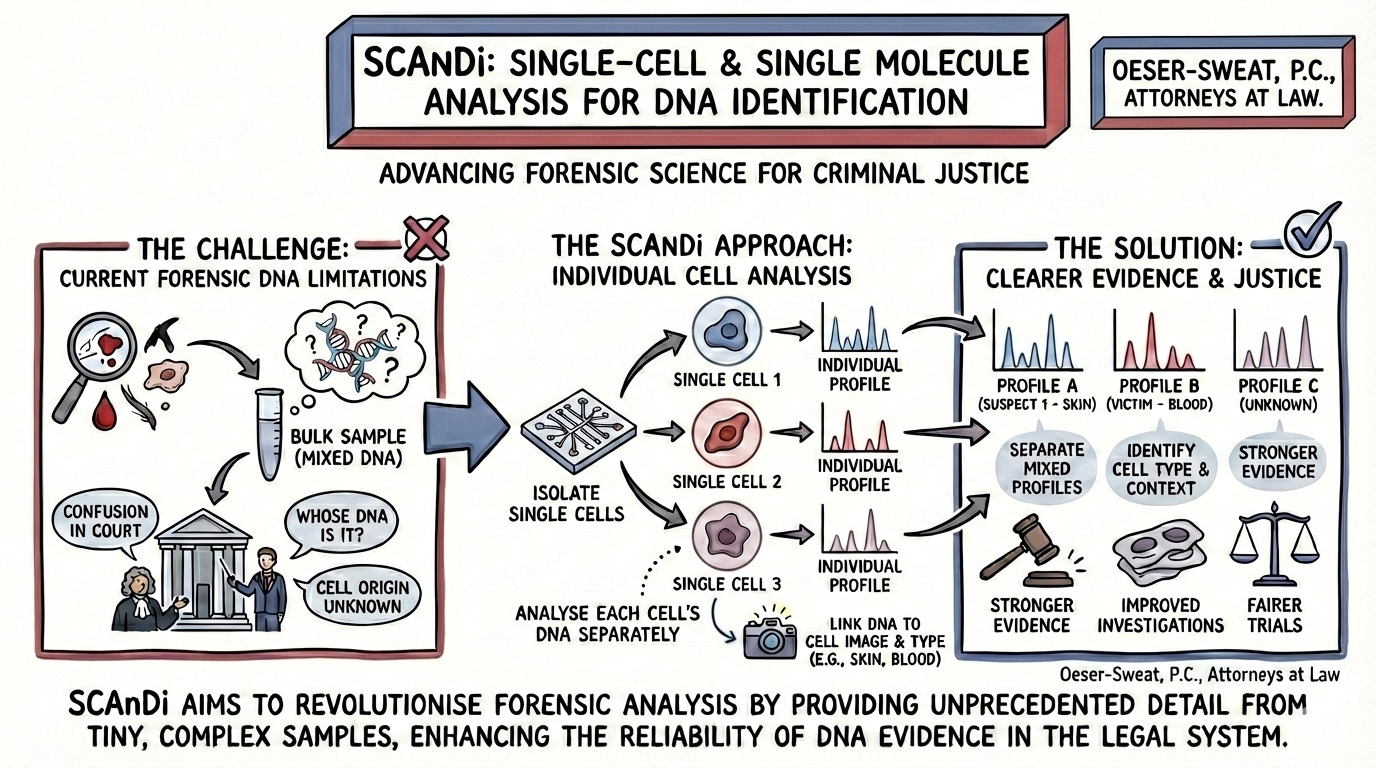
    Infographic: How SCAnDi technology separates individual cells from a mixed DNA sample to create clear profiles.
    Figure 1: The Goal-Moving from “Bulk Mixtures” to Single-Cell Precision
    View Text Description of Infographic

    The Old Way (“DNA Smoothie”): Current methods take a bulk sample (e.g., a swab from a doorknob) and mash all the DNA together. If three people touched it, you get a mixed profile that is hard to interpret.

    The SCAnDi Way: This new tech uses a flow cytometer or similar device to physically separate individual cells before DNA extraction. Each cell is analyzed separately.

    The Result: Instead of a mixture, you get distinct profiles: Profile A (Suspect), Profile B (Victim), and Profile C (Unknown), with no ambiguity.

    1. The Problem: The “DNA Smoothie”

    Current forensic methods rely on “bulk samples.” Imagine a crime scene doorknob touched by the victim, the suspect, and a police officer. When the lab processes the swab, they extract DNA from all three people simultaneously. To a scientist, this looks like a “DNA Smoothie”—a jumbled mix of genetic code.

    Analysts then have to use statistical software (like STRmix) to try to “unmix” the smoothie and guess the probability that a specific person contributed. This often leads to results that are inconclusive or open to fierce debate in court.

    2. The Proposed Solution: SCAnDi

    SCAnDi stands for Single-cell and Single Molecule Analysis for DNA Identification. Instead of blending the sample, SCAnDi uses advanced technology to pick out individual cells one by one.

    • Isolation: The machine isolates a single cell from Person A and a single cell from Person B.
    • Analysis: It extracts a clean, “pristine” DNA profile from each specific cell.
    • Context: Beyond just identity, SCAnDi can potentially tell us what kind of cell it is. It could prove, for example, that the DNA on a jacket came specifically from saliva (implying spitting or biting) rather than skin cells (implying casual contact).

    3. Prosecution vs. Defense: The Upcoming Battle

    Prosecution Perspective: “The End of Ambiguity”
    For prosecutors, SCAnDi is the “Holy Grail.” It moves forensics away from “likelihood ratios” and probabilities toward definitive identifications. It could solve cold cases where samples were previously too mixed to be useful.
    Defense Perspective: “New Science, New Risks”
    Defense attorneys must view this with skepticism. If a machine is sensitive enough to find a single cell, how do we prove that cell wasn’t transferred by a gust of air or “innocent transfer” (secondary touch)? Finding a single skin cell doesn’t prove presence at a crime scene if we shed millions of cells a day.

    4. Current Legal Status: Not Court-Ready

    It is critical to note that SCAnDi is currently a research project. It looks like a very promising scientific endeavor. However, there are some current caveats. It has not yet been accepted as evidence in United States courts yet. Before a jury ever sees SCAnDi results, the technology must pass the Frye or Daubert legal standards. This requires:

    • Peer Review: Publication in scientific journals.
    • Testing: Proof of reliability and known error rates.
    • General Acceptance: Consensus in the scientific community.

    Researchers at institutions like Edge Hill University and the Earlham Institute are currently refining the process and working to advance the science. This work may be groundbreaking. Lawyers on both sides should be watching this space closely.
  • New Divorce Venue Rules

    The End of the “Rocket Docket”: New Divorce Venue Rules

    Why you can no longer “shop” for a court, and why filing in your home county is now the law.

    For years, getting a “quickie divorce” in New York often meant filing your paperwork in a tiny county hundreds of miles away—a place where neither you nor your spouse had ever lived. This practice, of using a “Rocket Docket,” allowed litigants from crowded counties like New York or Kings to skip the line. As of February 19, 2025, that door has been slammed shut.

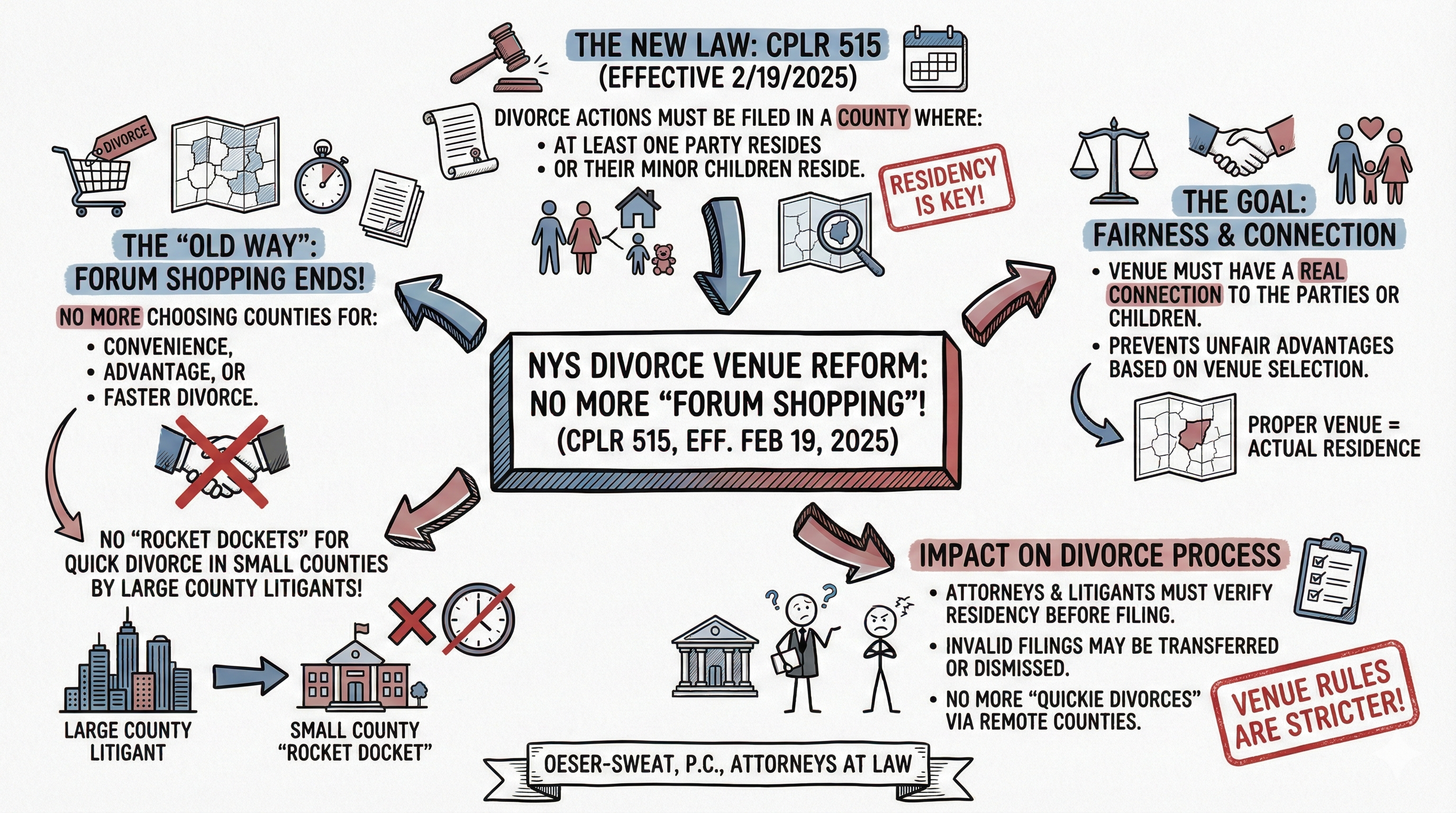
    Graphic: No More Forum Shopping. Visual illustrating that you must file where you live.
    Figure 1: The New Rule – No More Shopping for Better Courts
    View Text Description of Graphic

    The Old Way: People living in busy areas (like NYC) would file in distant, quiet counties to get a judgment faster.

    The New Way (CPLR 515): You must file in a county where the Plaintiff, the Defendant, or their minor children actually reside.

    The Goal: Fairness. To ensure local courts handle local families and prevent wealthy litigants from “buying” a faster divorce.

    1. What Exactly Changed? (CPLR 515)

    Under the new law, CPLR § 515, you are no longer allowed to pick a court based on convenience or speed. The law now mandates that a divorce action must be filed in a county where:

    • The Plaintiff (the person filing) resides; OR
    • The Defendant (the other spouse) resides; OR
    • Their minor children reside.

    Before this change, law firms often advised clients to file in counties hours upstate. Why? Because those court clerks had fewer cases and could sign a Judgment of Divorce in weeks, whereas a Downstate court might take months. This created a system where people were “shopping” for the best court.

    2. The “Rocket Docket” Trap

    While the old way seemed faster, it carried a hidden danger that this new law eliminates. Under the old system, if you filed in a county 4 hours away because it was “fast,” you were taking a gamble. If your “uncontested” divorce suddenly became “contested” (meaning your spouse disagreed with something), that distant court would still be the one handling your case.

    The Danger: If the court upstate refused to allow remote (video) appearances, you and your lawyer would have to drive 4 hours each way for every 15-minute conference. This turned a “cheap, fast” divorce into an expensive logistical nightmare.

    3. Exceptions to the Rule

    The legislature understood that sometimes, you need to hide your location. CPLR 515(b) provides strict exceptions where you can still file in a different county (as allowed by CPLR 509):

    • Confidentiality Orders: If your address is confidential due to a court order (like in Domestic Violence cases under DRL §254 or Family Court Act §154-b).
    • Address Not Public: If the addresses of the parties and children are not matters of public record.
    • Good Cause: A judge can still allow a case to proceed in a different county if you can prove there is a very good reason (“good cause”) to do so, though “convenience” is no longer enough.

    4. What This Means for You

    If you are looking to get divorced, you must plan to file locally. While it might feel frustrating to wait in line with everyone else in your home county, this rule ensures that if issues regarding custody or support arise, the court handling them is in the same community where your children actually sleep at night.

  • Oeser-Sweat Mentioned In New York Law Journal Due To Novel Use of Resources During Pandemic

    Oeser-Sweat Mentioned In New York Law Journal Due To Novel Use of Resources During Pandemic

    Woman Teleconferencing with masked individual

    In a recent article in the New York Law Journal by Janet Falk, entitled Using COVID-19 as a Springboard for New Marketing Activity, Jamel Oeser-Sweat, Esq. and Oeser-Sweat, P.C. were mentioned as examples of how New York City Attorneys adapted and marketed their services during the Pandemic Shutdown.

    Falk’s marketing savvy is legendary. Her Lawline CLE: “Why Her & Not Me?”: How You Can Be the Attorney Reporters Call Without Losing Your License, was the most popular Lawline CLE in New Jersey.

    In the Article, efforts by Oeser-Sweat are highlighted:

    Jamel Oeser-Sweat created a COVID resource page for attorneys and individuals on his website. It offers “comprehensive information resources linking to real-time
    information sources,” which range from the New York City Department of health to the
    New York state courts to guidance from the federal Small Business Administration. He
    has a criminal defense practice at Oeser-Sweat.

    One of the key areas where the firm shined over the Pandemic was the use of Zoom.  You can learn more about our usage of Zoom and other telecommunications methods on our webpage. This includes our free download of Zoom Rules & Etiquette.

    The article notes:

    Speaking of Zoom, consider Oeser-Sweat’s approach to this tool and format. OeserSweat has been using Zoom for three years, “with one powerful computer that I treat like a Zoom phone booth. It has a virtual background and all the features I need to handle client work remotely.” Oeser-Sweat finds this Zoom setup particularly useful to
    arrange “meetings without logistical issues, which is especially important for those of us with practices that require field work, like court and site visits, and who do not sit at a desk full-time.” Given the rise of work from home for clients and referral sources, OeserSweat’s reliance on Zoom is likely to be followed by many other solo attorneys.

    Attorneys will continue to adapt to the unprecedented circumstances that the Pandemic presents. Our firm is proud to serve our clients through these times.

    Photo by Ann Shvets courtesy of Pexels.

  • 194 New York City Organizations Sign Letter to NYC Mayor Demanding Funding to Social Services Agencies be Restored

    194 New York City Organizations Sign Letter to NYC Mayor Demanding Funding to Social Services Agencies be Restored

    calculator and budget

    SCAN-HARBOR and 193 other Community Based Organizations in New York City signed a letter to the Mayor outlining how the COVID-19 Pandemic has amplified inequilities that exist within the institutions that all New Yorkers rely upon.

    The organizations joined with the City Council’s letter to the Mayor stating that proposed budget cuts were not equitable.

    The letter states:

    When we are facing a budget deficit where the city is emphasizing that difficult decisions must be made across the board, the decision to decrease funding for social services while maintaining funding for the NYPD is the opposite of what our values should be. Particularly in light of the actions of the NYPD over the last few days, it is clear that our city requires diametrically opposite approaches to repair what has been broken.

    The letter concludes with sound guidance:

    It’s time to invest in supporting our communities instead of policing them. It’s time to be bold by making targeted cuts to the NYPD. We need to protect investments in human services, the social safety net, racial and economic justice, and the vision that all New Yorkers deserve to thrive.

    Check out the article in CITYLIMITS for more information.


    Jamel Oeser-Sweat, Esq. is the President of the Board at SCAN-HARBOR.

    Photo by Pixabay courtesy of Pexels.

  • SCAN-HARBOR Receives Grant from Garden of Dreams to Provide Support during COVID-19

    SCAN-HARBOR Receives Grant from Garden of Dreams to Provide Support during COVID-19

    Bear with bandages

    SCAN-HARBOR recently received a grant in the amount of approximately $64,650 from the Garden of Dreams Foundation as a partner organization in connection with servicing persons affected by COVID-19 in Bronx and other parts of upper New York City.


    The grant from Garden of Dreams was part of a one million dollar grant program the Foundation established to assist partner organizations that serve low-income areas in New York City. There are 30 Partner Organizations.

    The funds will be used for the implementation of virtual education activities for inner city youth, to hire additional professionals to provide telehealth services, to provide support to children via a visual projective art project, to strengthen infrastructure through the purchase of computer equipment for staff, hiring IT professionals to support teleconferencing with clients and staff, and hiring staff to build food distribution resources.

    Check out the article in Bronx Times for more information.

    Jamel Oeser-Sweat, Esq. is the President of the Board at SCAN-HARBOR.

    Photo by Pixabay courtesy of Pexels.